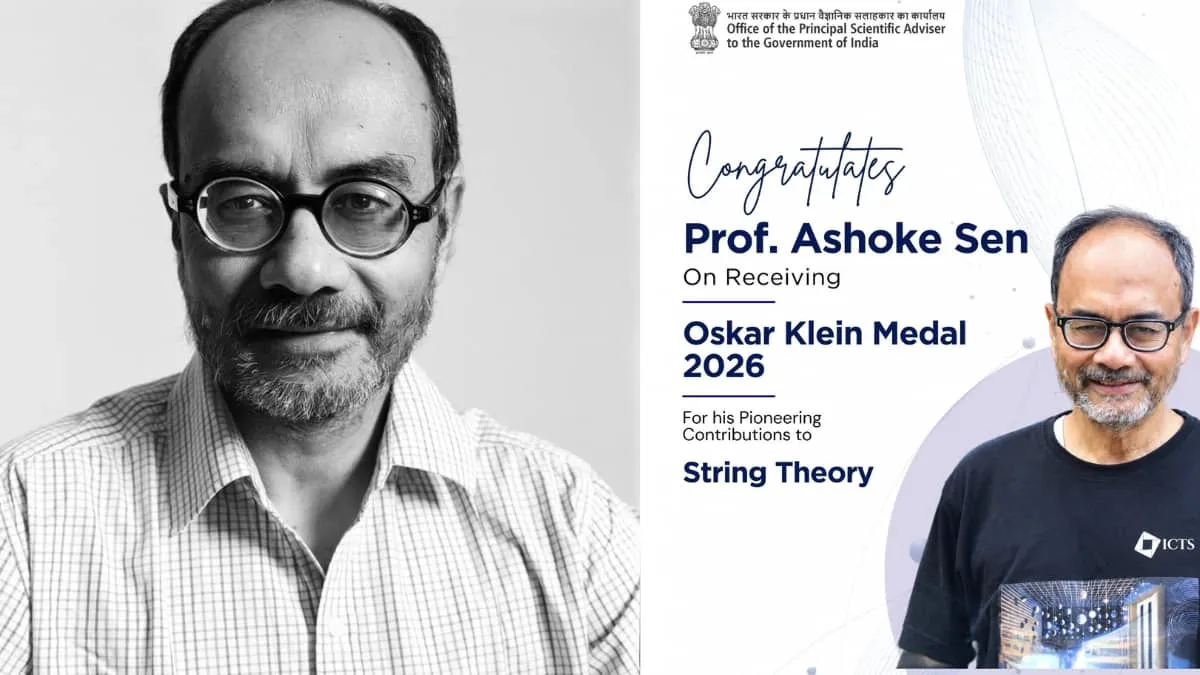
Ashoke Sen is an eminent Indian theoretician in the field of string theory. He has made important contributions to black hole entropy study, S-duality study, and quantum physics.
In October 2026, he got the prestigious Oskar Klein Medal, marking him as the first Indian physicist to receive this award. He has been nationally and internationally recognised for his work.
Let’s explore Ashoke Sen's biography, his early life, education, research, awards and achievements.
Ashoke Sen Wins Oskar Klein Medal 2026
On October 22, 2026, ICTS announced that Ashoke Sen has been selected for the Oskar Klein Medal for 2026. The award is for his outstanding contributions to physics, including his work in S-duality, black hole entropy and string field theory.
This accomplishment was a significant one for Indian theoretical physics, and acknowledged his impact on the study of theoretical physics.
Related Stories
Who Is Ashoke Sen?
Ashoke Sen is an Indian scientist specialising in theoretical physics and string theory. He was born on July 15, 1956. He is affiliated with the International Centre for Theoretical Sciences (ICTS-TIFR) in Bengaluru, and is an ICTS-Infosys Madhava Chair Professor there.
His official institutional profile says that his research interests include basic forces, string theory and physics of black holes.
Ashoke Sen Biography: Early Life and Education
Ashoke Sen had his schooling in Shailendra Sircar Vidyalaya, Kolkata. He graduated from Presidency College, Kolkata with a B. Sc. qualification in Physics in 1975.
After this he went on to do an M.Sc. (Physics) at the Indian Institute of Technology (IIT) Kanpur in 1978. He earned his PhD from the State University of New York at Stony Brook, USA in 1982.
Upon receiving his doctorate, Sen joined Fermilab and Stanford Linear Accelerator Center (SLAC) as a postdoctoral researcher.
Ashoke Sen's Research and Contributions
Ashoke Sen is well known for his research in string theory, an attempt to explain the fundamental particles and forces of nature by very small “strings”.
His major contributions include:
-
S-Duality: His work in theoretical physics helped to explain how strong coupling and weak coupling are related.
-
Black Hole Entropy: His work contributed to the knowledge of black holes and their microscopic properties.
-
Unstable states in string theory: He was an important contributor to the understanding of unstable states in string theory, known as tachyon condensation.
-
String Field Theory: His work has contributed to a mathematical understanding of string theory.
Sen's work has played an important role in the development of modern theoretical physics.
Ashoke Sen Awards and Achievements
Ashoke Sen has received several prestigious awards for his contributions to science.
|
Year
|
Award or Honour
|
|
1989
|
ICTP Prize
|
|
1994
|
Shanti Swarup Bhatnagar Prize
|
|
2001
|
Padma Shri
|
|
2009
|
Infosys Prize in Mathematical Sciences
|
|
2012
|
Breakthrough Prize in Fundamental Physics
|
|
2013
|
Padma Bhushan
|
|
2014
|
Dirac Medal
|
|
2024
|
ICBS Frontiers of Science Award
|
|
2026
|
Oskar Klein Medal
|
In 1998, he was elected a Fellow of the Royal Society. Additionally, in 2026, he was elected an International Honorary Member of the American Academy of Arts and Sciences.
Conclusion
Ashoke Sen's journey from studying physics in Kolkata to becoming an internationally recognised scientist highlights the importance of research and scientific curiosity. His contributions to string theory and black hole physics continue to influence scientists worldwide.