The importance of freedom of speech can be understood from the fact that freedom of speech enables individuals to express their views and discuss among themselves.
In addition, this freedom of speech is also important because it brings transparency and accountability within governance.
As per the Constitution of India, all citizens have several Fundamental Rights that include freedom of speech and expression.
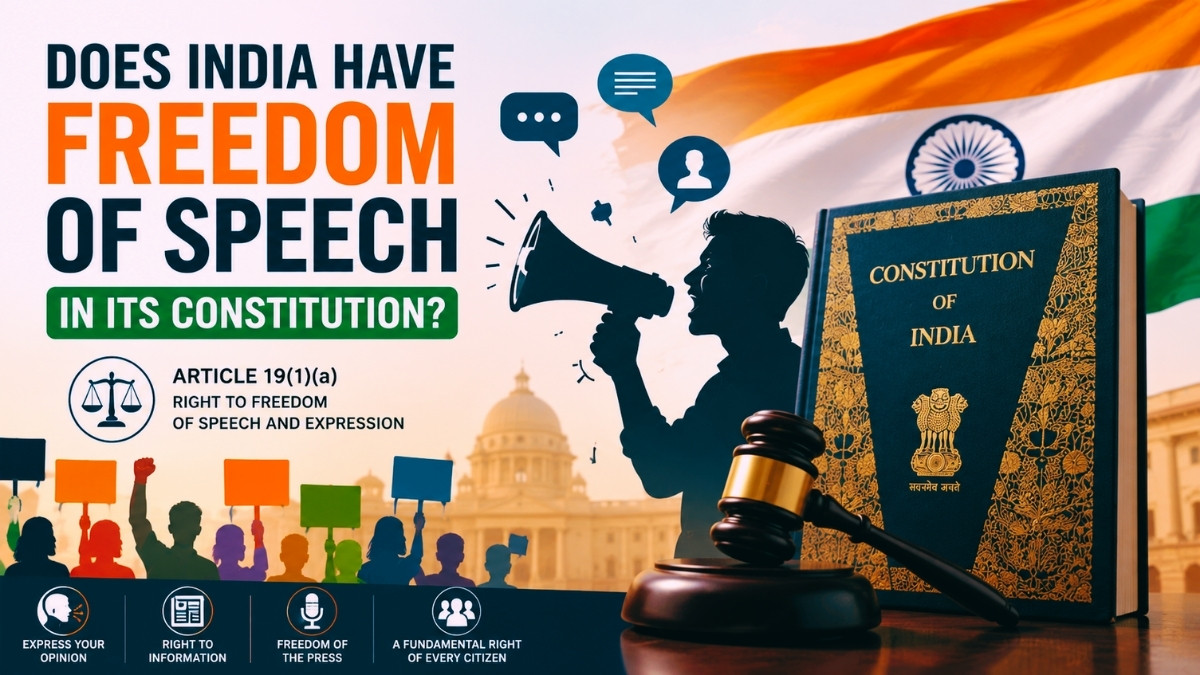
Yes, freedom of speech and expression is present in India's Constitution. Freedom of speech and expression is enshrined as a Fundamental Right in Article 19(1)(a) of the Indian Constitution.
Does India have Freedom of Speech in its Constitution?
Yes, India guarantees freedom of speech and expression under the Indian constitution. Under this right, Indian nationals have the liberty to speak their minds without fear of reprisal, within the framework set out by law.
The freedom of speech forms part of the pillars of any democracy. The right gives people the chance to engage in open discussion and contribute towards the growth of society.
But this liberty is not unlimited; rather, the government has the mandate to impose reasonable restrictions where necessary. These restrictions can only be imposed in circumstances when public interest is involved.
Related Stories
Which Article of the Indian Constitution Gives Freedom of Speech?
Article 19(1)(a) in the Indian Constitution confers upon all citizens the fundamental right of the freedom of speech and expression.
The fundamental right grants the liberty to express one’s opinions and ideas by speaking, writing, or printing, or through any other means whatsoever. It constitutes the backbone of India’s democratic structure.
It must be noted, however, that this right is not unlimited. According to Article 19(2), reasonable restrictions can be imposed by the State in the interests of "sovereignty and integrity of India, public order, decency or morality, or in relation to contempt of court, defamation, or incitement to an offense."
Core Scope of the Right to Freedom of Speech
The Right to Freedom of Speech and Expression encompasses various kinds of expressions and communications.
-
The right to freedom of speech and expression is much more comprehensive than just speaking as there are various other rights involved in it.
The right enables the citizens to share their thoughts and opinions, gather information, and communicate using different media.
There are certain types of expression which may not consist of speech itself but come under this category.
People can use oral words, literature, books, painting, photography, movies, placards, and the internet to express their views on certain matters.
The right to freedom of speech also includes freedom of sharing and receiving information and ideas from each other.
There is another aspect of freedom of speech which allows people to stay silent without communicating any opinion.
Freedom of the press is considered an important right under freedom of speech even if it is not specifically stated under Article 19(1)(a).
Only Indian citizens enjoy this fundamental right, while foreigners are not entitled to it.
Reasonable Restrictions on Article 19 Freedom of Speech
Freedom of speech, even though an inherent right, allows for some restrictions as per the provisions of the Constitution of India.
The objective of such restrictions is to achieve a balance between individual interests and those of the society and the country.
-
The restrictions, as mentioned in Article 19(2), are permissible by law as and when needed. The restrictions aim at ensuring responsible usage of freedom rather than curtailing it in any way.
-
These restrictions can be imposed by the government in matters related to the sovereignty and integrity of India, security of the state, friendly relations with other states, public order, decency, morality, contempt of court, defamation, and incitement to an offence.
The legality of such restrictions is thoroughly verified by courts in order to keep up the balance between the two aspects.
Conclusion
The Indian constitution, in its Article 19(1)(a), provides for the freedom of speech and expression. This essential liberty ensures that an individual can freely voice his views and exchange information in a democratic setup. Simultaneously, certain restrictions prevent abuse of this liberty.