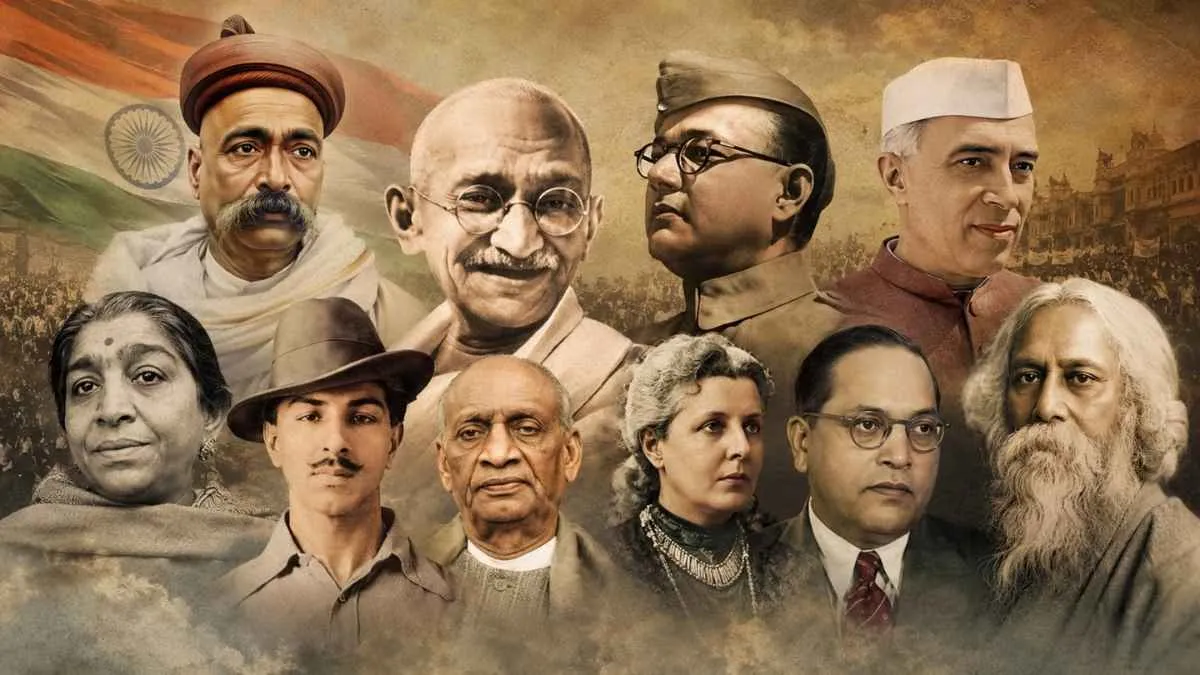
The freedom movement in India was the result of better words that touched the soul of people. It inspired nearly millions to revolt against the British empire. The speeches and words of political leaders for Swaraj (self-rule), 'Do or Die' and many more changes the tone of the whole struggle, transforming the grievances of the people into organised resistance.
The leaders Mahatma Gandhi, Bal Gangadhar Tilak, Subhas Chandra Bose, Jawaharlal Nehru among others used to inspire people with pride, unity, courage, and nationalistic feelings. And they earned their names through speeches that reflected the change in the demands of the freedom struggle, which included self-rule, civil resistance, violent revolution, and eventually speaking about Indian independence.
Landmark Freedom Quotes by Indian Leaders
|
No.
|
Leader
|
Quote / Famous Words
|
|
1
|
Bal Gangadhar Tilak
|
'Swaraj is my birthright, and I shall have it.'
|
|
2
|
Mahatma Gandhi
|
'Do or Die.'
|
|
3
|
Jawaharlal Nehru
|
'At the stroke of the midnight hour, when the world sleeps, India will awake to life and freedom.'
|
|
4
|
Subhas Chandra Bose
|
'Give me blood, and I will give you freedom.'
|
|
5
|
Sarojini Naidu
|
'We want deeper sincerity of motive…'
|
|
6
|
Bhagat Singh
|
'It takes a loud voice to make the deaf hear.'
|
|
7
|
Sardar Vallabhbhai Patel
|
'Take to the path of truth and justice.'
|
|
8
|
Annie Besant
|
'Self-rule is our right.'
|
|
9
|
Dr. B. R. Ambedkar
|
'Freedom of mind is the real freedom.'
|
|
10
|
Rabindranath Tagore
|
'Where the mind is without fear…'
|
History Behind the Most Famous Freedom Speeches
1. Jawaharlal Nehru- 'Tryst with Destiny' (1947)
On August 14-15, 1947, Jawaharlal Nehru delivered his midnight address to the free nation. It was a speech that would become one of the defining moments in modern Indian history. As India was nearly ready to attain independence, Nehru made his reflections on the country’s long struggle and the responsibilities that came with freedom.
Jawaharlal Nehru’s midnight address was delivered just before independence.As British rule in India ended, it became a symbol of hope, renewal and nation-building.
Related Stories
2. Bal Gangadhar Tilak- 'Swaraj Is My Birthright' (1906)
Bal Gangadhar Tilak was one of the strongest voices of assertive nationalism in the early freedom movement. He made an iconic slogan famous. It was Swaraj, which was a rallying cry for self-rule. The slogan was a reflection of the increased demand for greater rights and political participation and was a reaction against imperial domination. It was an effective tool for the Indian nationalist movement to persuade people beyond the standard constitutional demands.
Tilak’s politics helped strengthen the extremist or assertive nationalist wing of the Indian National Congress during the early 20th century.
3. Mahatma Gandhi- 'Do or Die' (1942)
The 'Do or Die' call to action was made by Mahatma Gandhi during the launch of the Quit India Movement in August 1942 in which he appealed to India to demand an immediate end to British rule and join a mass movement.
The Quit India Movement was launched during the Second World War and was one of the most impressive mass movements against British rule. The call by Gandhi was a manifestation of the need for independence.
4. Subhas Chandra Bose- 'Give Me Blood, and I Will Give You Freedom' (1944)
Subhas Chandra Bose used this forceful appeal to rally support for the Indian National Army and armed struggle against the British. His appeal underscored sacrifice and total dedication to the struggle for independence.
Bose was leading the Indian National Army from outside British India and wanted to fight British rule with armed force, with Japanese aid in the Second World War.
5. Sarojini Naidu- Voice of Mass Participation (1930)
Sarojini Naidu was the leading nationalist leader and one of the most prominent women in the Indian freedom struggle. She urged Indians to jump into the freedom struggle and spoke very encouragingly about the importance of courage, unity and sacrifices.
In 1930 the Civil Disobedience Movement, Sarojini Naidu was an important personality in mobilising the march against colonial rulers following the arrest of Mahatma Gandhi
6. Bhagat Singh- 'It Takes a Loud Voice to Make the Deaf Hear' (1929)
Bhagat Singh’s iconic remark during the Assembly Bomb Case has become synonymous with the revolutionary movement. His words captured the conviction that bold political action was needed to bring attention to India’s call for freedom.
In 1929, Bhagat Singh and Batukeshwar Dutt threw non-lethal bombs into the Central Legislative Assembly in Delhi. They hung back to be arrested, and used their trial to publicise their political beliefs.
7. Sardar Vallabhbhai Patel- Bardoli Satyagraha (1928)
Sardar Vallabhbhai Patel was elevated as a mass leader during Bardoli Satyagraha in Gujarat. His addresses motivated farmers to stay unified, well-ordered and devoted to non-violent struggle.
The Bardoli movement fought against increased land revenue sustenance imposed by the British government. The victorious movement bolstered Patel’s image as a mass leader and earned him the title 'Sardar.'
8. Annie Besant- Home Rule Movement (1916) 'Self-rule is our right.'
Annie Besant helped Laird to popularise the Home Rule demand in India. Through speeches, political campaigns and public meetings, Besant argued for Indians to have more say over their affairs. The All India Home Rule League. Besant founded this movement in 1916 and it helped to popularise the demand for self-government, which was a growing aspect of nationalist politics.
9. Dr. B.R. Ambedkar- 'Freedom of mind is the real freedom.' (1936)
Dr. B.R. Ambedkar broadened the connotation of freedom to include more than the fight against British oppression. He believed in the twin principles of equality and dignity, and in the eradication of discrimination on the basis of caste.
Dr. Ambedkar in the 1936 text Annihilation of Caste (originally written as a speech) argued that, although political independence (i.e., freedom from British colonial rule) would be achieved in 1947, it would not be of any benefit (in the form of freedom from political oppression) unless the social inequalities existing in India (which hindered the
10. Rabindranath Tagore- 'Where the mind is without fear and the head is held high' (1917)
Rabindranath Tagore’s concept of freedom went beyond the political sense. His famous lines imagined a society of people who could think freely, search for knowledge and live without fear and without fear and inconsequential divisions.
Historical significance: Tagore’s writings and speeches played an important role in India’s intellectual and cultural revival. He associated national freedom with education, reason, human dignity and moral development.