Personality of the Day: How Dr. B.R. Ambedkar Shaped Modern India
Learn about B. R. Ambedkar, his early life, education, and how he played a key role in shaping the Constitution of India.

On April 14 every year, India takes time to honor a man who decided the constitution of the country. Dr. Bhimrao Ramji Ambedkar jurist, economist, and social reformer was a lifetime fighter against the very system that was devised to keep him invisible. He didn’t just survive that system, he broke it step by step with the help of education, law, and his perseverance.
On his birthday, we trail the life of a boy that came from an untouchable family and lived in a little town in Central India. His relentless will took him to earn more academic degrees than any Indian ever did during his era.
READ| GK Questions and Answers on Doctor B.R. Ambedkar
Who Was Dr. B.R. Ambedkar?
Dr. Bhimrao Ramji Ambedkar also known as Babasaheb Ambedkar was born in the year 1891 on 14th April in Mhow (now Dr. Ambedkar Nagar) Madhya Pradesh. He was a jurist, economist, politician, and social reformer who inspired the Dalit Buddhist movement against discrimination of social differences. He was also the Chairman of the Drafting Committee of the Indian constitution as well as the first Law Minister of India after the independence.
He was a posthumous recipient of the Bharat Ratna the greatest civilian honour of India in 1990.
The Museums of India mentions: “'Bharatratna', India's highest Civil Award was conferred on Dr. Ambedkar (Posthumous) on April 14th, 1990. H. E. Shri. R. Venkatraman, President of India presented 'Bharatratna' to Dr. (Mrs.) Savita Ambedkar, wife of Dr. Ambedkar at Rashtrapati Bhavan, New Delhi.”
Early Life of Dr. B.R. Ambedkar
Bhimrao Ramji Ambedkar was the last and 14th child of Ramji Maloji Sakpal who was an army officer and Bhimabai Sakpal. His family belonged to the Mahar caste which is known to have an untouchable caste as per the rigid caste system.
Dalit children were either forced to sit outside classrooms, or were denied the right to share the water pot, and were regularly beaten by their teachers and other children in school. All this was witnessed by young Bhimrao.
What separated him from others is that he didn’t let humiliation become an identity. His father was a poor man yet he valued education and it was the first weapon which young Ambedkar was to be wielding.
Education of Dr. B.R. Ambedkar
Source: Columbia University
Ambedkar’s academic journey is extraordinary given the situation of the society which was working against him.
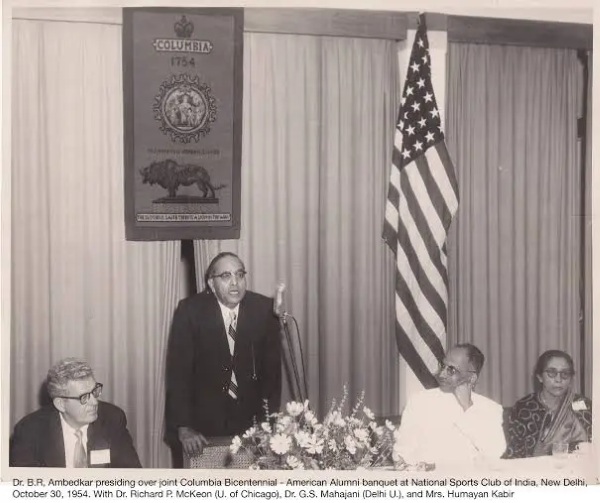
He was granted a scholarship to Columbia University, New York, with the help of the Maharaja of Baroda, Sayajirao Gaekwad III. He was a student of the renowned philosopher John Dewey at Columbia whose philosophy of democracy inspired the mind of Ambedkar. In 1915 he was awarded the MA and in 1927 his doctorate.
The Supreme Court of India mentions: “in 1913 he was awarded a scholarship by Sayajirao Gaikwad, then Maharaja (King) of Baroda state to pursue his M.A. and Ph.D. at Columbia University in New York, USA. His Master’s thesis in 1916 was titled “The Administration and Finance of the East India Company”. He submitted his Ph.D. thesis on “The Evolution of Provincial Finance in India: A Study in the Provincial Decentralization of Imperial Finance”.
It is assumed that Dr. Ambedkar had acquired about 32 degrees in different universities making him one of the most learned Indians in the 20th century. He was also fluent in 9 languages such as Pali, English, French, German, Marathi, Hindi, Persian, Gujarati and Kannada.
The Fight Against Caste
It was not like that Ambedkar suddenly ventured into activism, as he was systematic in his activism that was based on the law and strategy. He knew that social change would be only temporary unless accompanied by institutional support and so he developed the two fronts simultaneously.
The Mahad Satyagraha, 1927
In March 1927, Ambedkar led a Dalit march to the Chavadar Tank at Mahad, Maharashtra to demand the right of Dalits to access water at a community source. As a reaction, the upper-caste society received a court stay and attempted to purify the tank after Dalits had used it. It was a ritual, but seismic, step and it is believed that it was the first planned Dalit civil rights movement in India.
The Supreme Court of India mentions: “On March 20, 1927, Dr. Ambedkar and his followers marched to the Chavdar Lake, where he drank water from it, asserting their right of equality and equal access to public resources. This act sent shockwaves through the conservative society. The oppressor castes even performed a purification ritual of the tank, which according to them had been defiled by the touch of the Untouchables. Under pressure from the oppressor castes, the Mahad Municipality on 4 August 1927 revoked its resolution of 1924 under which it had declared the Chavdar Tank open to the Depressed Classes.”
The Poona Pact, 1932
Mahatma Gandhi took a fast in opposition to the action of the British when they announced that Dalits were going to elect differently by Communal Award since he felt that the move would split up the Hindu society.
Ambedkar found himself in an agonizing position and eventually gave up. He also put his signature on the Poona Pact which was a swap of separate seats with reserved seats in a joint electorate.
The Constitution of India website mentions: “On 20th September 1932, while in prison, Gandhi announced a fast unto death till the time separate electorates were removed from the Award. The British had have given the assurance that it would make changes to the Award if these changes were the result of an agreement between the communities concerned. Indian political leaders realised that the best chance to get Gandhi to terminate his fast was to facilitate an agreement between Gandhi and Ambedkar. Initially, Ambedkar was not fazed by Gandhi’s fast. But later, he came around and agreed to negotiate. In the end, Gandhi and Ambedkar came to an agreement – the Poona Pact 1932 – that discarded separate electorates.”
Annihilation of Caste, 1936
Ambedkar was called upon to speak at the Jat-Pat Todak Mandal, a Hindu reform conference but drafted a speech so radical that the organisers called off the meeting rather than have him speak at the conference. He self-published it as Annihilation of Caste, among the strongest indictments of the caste system that have ever been published.
Dr. B.R. Ambedkar and the Indian Constitution
In 1947, India got its independence and he was the first law minister of the country after being nominated by the Prime Minister Jawaharlal Nehru. He was later elected as a Chairman of the Constitution Drafting Committee - the post that would leave a mark on the future of India.
It was a gigantic undertaking. India was a new nation of astounding diversity, hundreds of languages, dozens of religions, millennia of caste hierarchy, and fresh wounds of the partition. The Constitution which Ambedkar helped to draft had to have it all and guarantee rights which have never been allowed to millions of Indians.
His major contributions in the constitutions involve:
-
Non-negotiable basic rights, including, the right to equality, which is enforceable by the courts.
-
Eliminating untouchability under Article 17, by declaring the practice a punishable offence.
-
Introducing reservations for Scheduled Castes and Tribes in legislatures and government jobs
-
Preaching the universal adult franchise - the vote of each and every adult would be counted equally, not based on caste or gender.
-
Advocating for strong individual rights against both state power and social oppression
Quotes by Dr. B.R. Ambedkar
-
“I measure the progress of a community by the degree of progress which women have achieved.”
-
“The relationship between husband and wife should be one of closest friends.”
-
“If I find the constitution being misused, I shall be the first to burn it.”
-
“Cultivation of mind should be the ultimate aim of human existence.”
-
“Indifferentism is the worst kind of disease that can affect people.”
READ| Top 60+ Dr. B R Ambedkar Quotes for Inspiration and Motivation
Ambedkar is not a figure to be confined in the history books or his anniversary. He lives in every courtroom which knows that the right to equality lives, in every student who has been offered a scholarship on the basis of the reserved category, in every woman who has become a first time voter in her family and in every constitutional challenge which has been made against unjust law.
Check out some more interesting articles from the general knowledge section to boost your knowledge of national and international topics. Stay connected with Jagran Josh for more topics like this.

Nikhil is a dedicated digital journalist and communications professional with more than five years of experience, currently working within the General Knowledge section at Jagran Josh. He has established himself as a subject matter expert in Finance, Economy, History, Technology, and Trending News, consistently delivering accurate, engaging, and easy-to-read content for a wide global audience.
Over the course of his career, Nikhil has developed deep expertise in crafting informative listicles, viral trending stories. His editorial portfolio also spans finance, historical research, and technology reporting, making him a versatile and well-rounded content professional. Every piece he produces reflects a strong balance between factual accuracy and reader engagement.