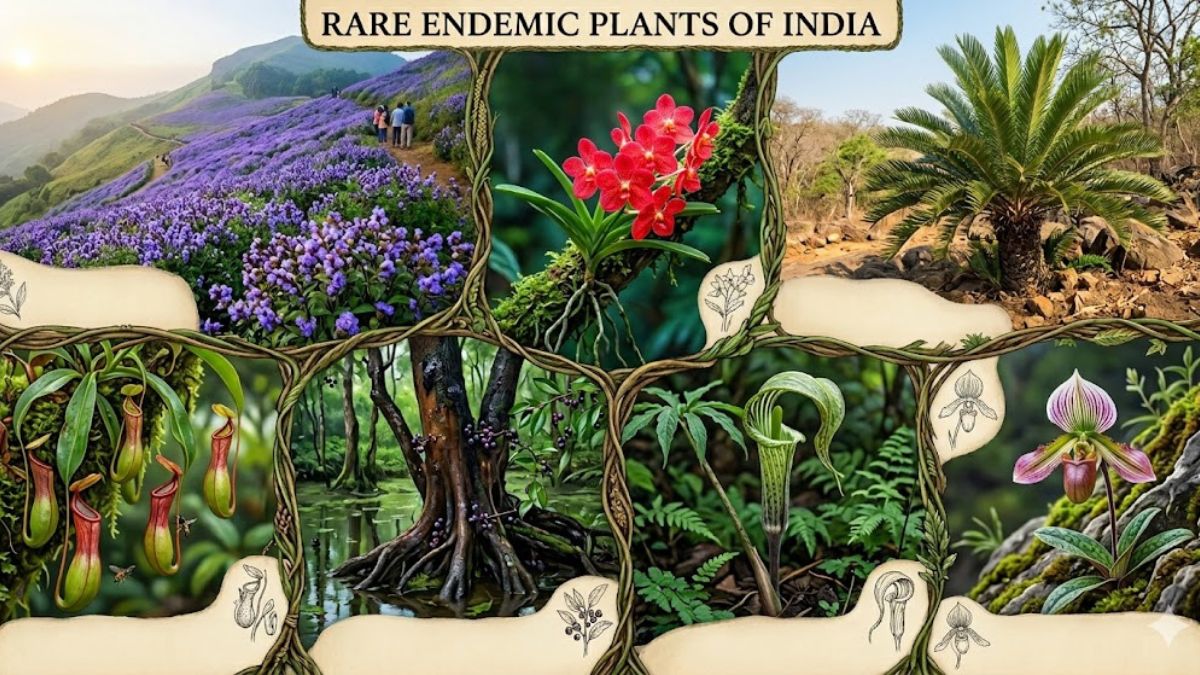
India is one of the most biodiverse places on earth, with its mountains, forests, deserts, wetlands and tropical ecosystems home to thousands of plant species. Many of the rare plants found in India are endemic, which means that they can be seen only in some parts of the country and nowhere else in the world. The Himalayas, Western Ghats and the Northeastern states with their unique climate and prolific flora are globally recognised hot-spots of biological diversity. They are important to the ecological balance, tourism, medicine, scientific research and environmental preservation. A number of native Indian plants threatened by habitat loss and climate change have received protection.
Top 7 Plants that are found only in India
Neelakurinji
Neelakurinji is one of the most famous endemic flowering plants of the Western Ghats of Southern India, especially in Kerala and Tamil Nadu. Its flowers, which bloom only once every twelve years, have made the plant internationally famous, turning hillsides blue-purple. Thousands of tourists and photographers visit hill stations during blooming seasons to witness this unique natural phenomenon. The Neelakurinji flowering cycle is regarded as one of the most fascinating botanical phenomena in India, and it is also important for local tourism and biodiversity awareness.
Related Stories
Red Vanda
Orchids of the rare Red Vanda are found mainly in northeast India. Botanists and orchid collectors prize it for its bright red flowers and its beauty as an ornamental plant. The plant is very much dependent on some climatic conditions and it grows in the humid forest environment. The Red Vanda, a rare Indian orchid, has become a focus of conservation efforts as its natural population has dwindled due to habitat destruction and illegal collection.
Beddome’s Cycad
The Cycad of Beddome is a very ancient species of plant, native to parts of southern India, especially the Eastern Ghats. Cycads are often referred to as “living fossils” because they resemble ancient plants that lived millions of years ago when the dinosaurs roamed the Earth. This plant prefers rocky forest habitat and has a slow growth cycle. The Beddome’s Cycad is key to understanding the evolution of plants and prehistoric ecosystems, say scientists. Overharvesting and habitat destruction have dramatically reduced its numbers in the wild.
Pitcher Plant of Meghalaya
Their carnivorous nature makes the Meghalayan pitcher plant one of the weirdest plant species in India. To obtain its nutrients, the plant digests insects caught in its pitcher-shaped leaves. It is mainly found in the humid hills of Meghalaya, where moisture and rainfall are very high. Its unusual feeding mechanism attracted scientists and researchers from all over the world. The plant is also considered ecologically important as it is one of the few carnivorous plant species growing naturally in India.
Syzygium Travancoricum
The Western Ghats swamp forests are home to the critically endangered Syzygium travancoricum tree species. The plant is an important element for the preservation of regional biodiversity and is related to wetland ecosystems. Habitat destruction, rapid urbanisation and wetland drainage resulted in a substantial decline in its population. Conservationists believe the species is very important as wetland forests support many rare plants and animals.
Cobra Lily
The cobra lily is a rare plant of the Himalayas, notable for its distinctive flower structure which resembles the hood of a cobra snake. It is a mountain-plant of cool, moist climates. Its odd appearance made it a favourite with botanists, gardeners and flower lovers. The plant is an interesting species for scientific research because of its unique flower structure, which also attracts pollinators.
Lady’s Slipper Orchid
Lady’s slipper orchid is one of the most beautiful orchids of northeast Himalaya ranges of India. The flower is famous for its exotic look, with petals shaped like slippers. Highly prized for its beauty and rarity, it is of great value to flower collectors and enthusiasts worldwide. Its natural survival was threatened by habitat destruction and the illegal plant trade, so more conservation efforts were put into place.
Why India Has Unique Plant Diversity?
India’s varied geography and climate were ideal for the evolution of rare and endemic plants. Different types of vegetation are supported by tropical forests, alpine mountain regions, monsoon climates, wetlands and coastal ecosystems. The Western Ghats and the Himalayas are internationally acknowledged biodiversity hotspots as they contain thousands of plant species which are found nowhere else in the world.