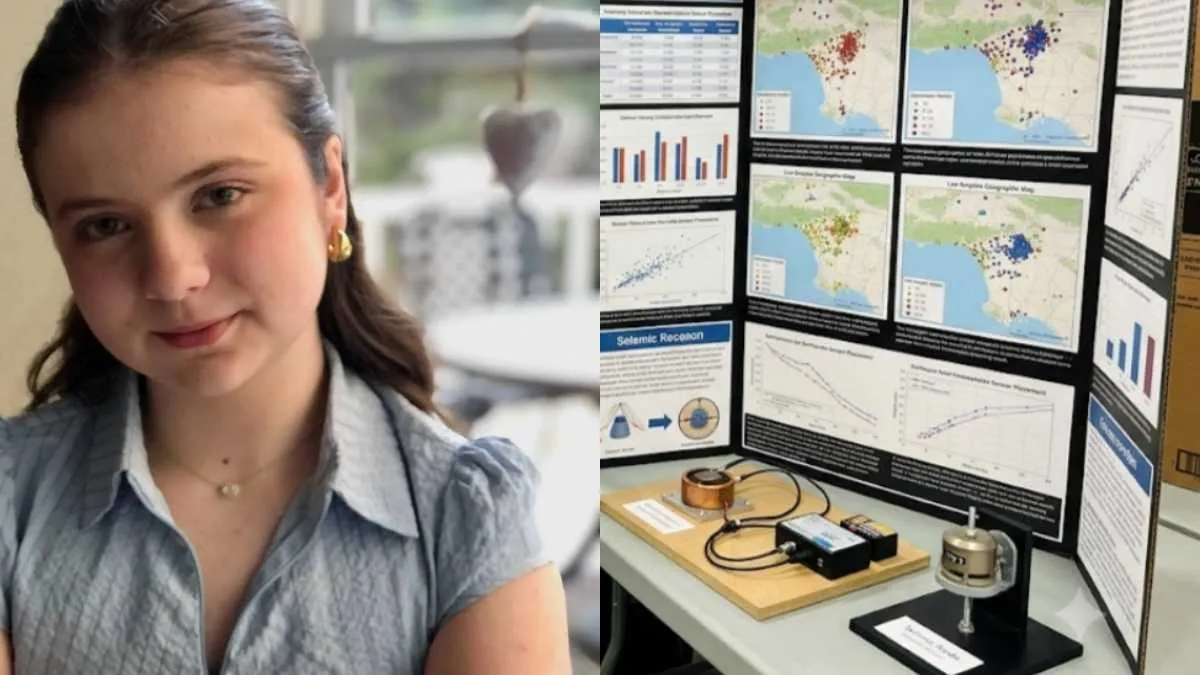
In a significant development, a 14-year-old student from the United States, has made headlines for her research on improving the placement of earthquake sensors.
Isabel Rossi developed a mathematical model that showed a potential 16.7% improvement in earthquake detection coverage using a few additional sensors.
This has led her project to earn a place among the 30 finalists of the Thermo Fisher Scientific Junior Innovators Challenge 2026.
Who is Isabel Rossi?
Isabel Rossi is a 14-year-old student from Williamsburg, Virginia, in the United States. She independently developed a science project in the eighth grade at James Blair Middle School and is now studying at Jamestown High School.
She was highly inspired by her own family. Her father, Andrew Kurose, was a physics teacher, while her mother is an English professor at Christopher Newport University. She grew up in a scientific environment, with her elder sister using chemistry and physics experiment kits.
When Rossi was 9 years old, she started working with a NASA engineer, using mathematical equations to improve rocket and flight performance.
Related Stories
Isabel Rossi: Key Details
|
Detail
|
Information
|
|
Age
|
14 years
|
|
Hometown
|
Williamsburg, Virginia, US
|
|
Middle School
|
James Blair Middle School
|
|
Current School
|
Jamestown High School
|
|
Father's Profession
|
Physics teacher (Enrico Rossi)
|
|
Mother's Profession
|
English professor (Margarita Marinova)
|
|
Research Project
|
Earthquake sensor placement using Game Theory and optimization models
|
What is Isabel Rossi's Earthquake Sensor Placement Project?
The purpose of Isabel Rossi's project named -Listening in the Right Places: Game Theory and Optimisation for Earthquake Sensor Placement- is the application of mathematical modeling in order to determine effective positions for earthquake sensors.
Seismic sensors track earthquakes and provide necessary data for scientists who monitor this process.
The position of sensors is important since the arrangement of the network may lack the necessary detection coverage.
Meanwhile, Rossi in her research work, concentrated on the geographical area of Los Angeles, California. She utilized data about earthquakes and already existing sensors to analyze various arrangements of sensors and to develop a program for computer analysis.
The project is based on two criteria: the effectiveness of detection and the accessibility of sensors. Simply speaking, sensors should be placed so that they could monitor seismic activity and be easy to install.
|
Aspect
|
Details
|
|
Main Objective
|
Find effective positions for earthquake sensors
|
|
Study Area
|
Los Angeles, California
|
|
Data Used
|
Earthquake records and existing sensor locations
|
|
Method
|
Mathematical modeling and computer simulations
|
|
Key Factors
|
Earthquake detection effectiveness and sensor accessibility
|
|
Practical Goal
|
Help researchers compare sensor locations before installation, particularly in resource-limited or hard-to-access regions
|
How Did Isabel Rossi Use Game Theory to Compare Sensor Locations?
Game theory is an area of applied mathematics that assists in finding solutions when several objectives have to be taken into account at the same time. Though it has numerous applications in economics and management, it is applicable for solving engineering problems too.
In her study, Rossi compared 2 mathematical models to find more appropriate places for earthquake sensors. They were the weighted sum model and Nash bargaining. Also, she used Pareto frontier to compare effectiveness of the models in balancing different objectives.
Below you will see what the two models are and what was discovered by Rossi:
-
Weighted Sum Model: It combines different objectives, assigning particular weight to each of them.
Nash Bargaining: It finds a compromise between opposing objectives, such as detection effectiveness and sensor accessibility.
Pareto Frontier: It comprises solutions that cannot improve one objective without compromising the other one.
Key Discovery: Rossi discovered that Nash bargaining generated sensor placement solutions closer to Pareto frontier.
Result of Research: Her model showed 16.7% increase in earthquake detection coverage in simulated environment with only 5 sensors added.
However, the improvement was achieved through computer simulation and is yet to be tested in the real world earthquake monitoring system.
Comparison of the Two Mathematical Models
|
Feature
|
Weighted Sum Model
|
Nash Bargaining Model
|
|
Approach
|
Combines objectives using assigned weights
|
Balances competing objectives
|
|
Main Focus
|
Weighted optimization
|
Compromise between objectives
|
|
Research Finding
|
Used as a comparison baseline model
|
Produced solutions closer to the Pareto frontier
|
|
Key Result
|
Compared sensor placement outcomes
|
16.7% improvement in simulated coverage achieved with 5 additional sensors
|