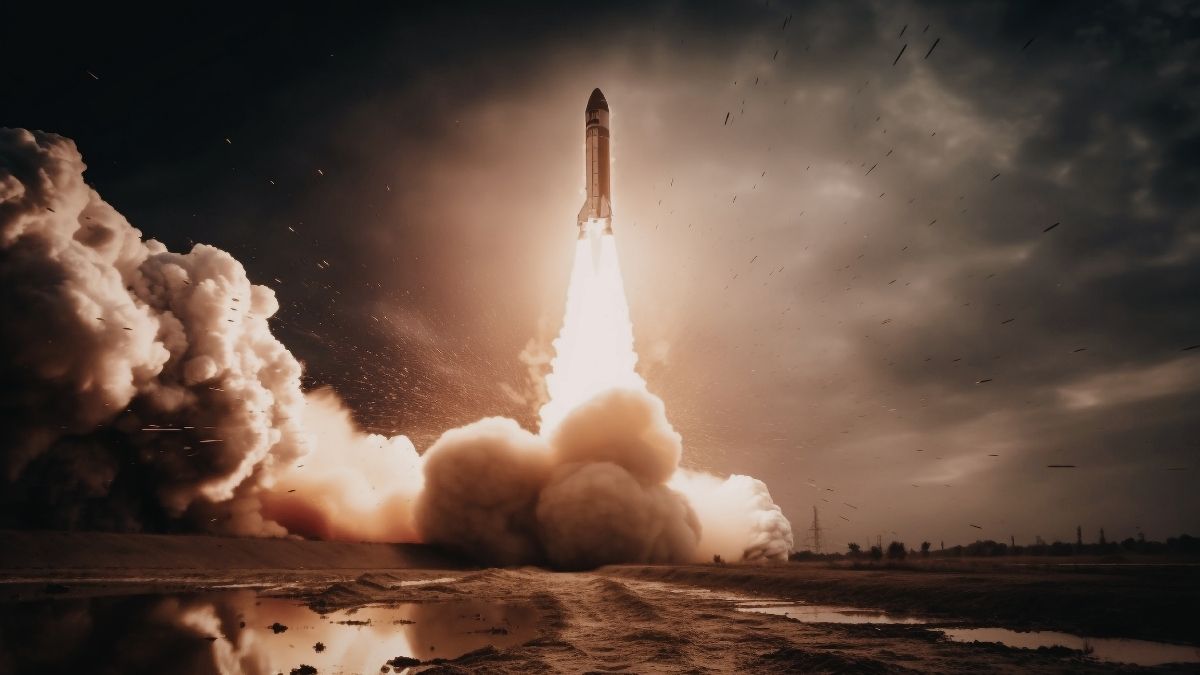
A massive Blue Origin rocket explosion today shook Florida’s Space Coast after a critical pre-launch test went catastrophically wrong. The heavy-lift Blue Origin New Glenn rocket erupted into a towering fireball at Launch Complex 36 inside the Cape Canaveral Space Force Station around 9:00 p.m. Eastern Time.
Jeff Bezos rocket was undergoing a routine static hot-fire engine test ahead of an upcoming commercial satellite mission when the vehicle experienced a major anomaly. The resulting Cape Canaveral explosion lit up the night sky, with local residents reporting that the blast rattled windows miles away. The shocking incident represents a severe hurdle for the private space venture as it attempts to break into the commercial launch sector.
What Caused the Blue Origin Rocket Explosion Today?
The Blue Origin rocket explosion occurred while engineers anchored the 29-story-tall launch vehicle to the ground to test its engines. According to official statements released by Space Launch Delta 45 and company representatives on X, the vehicle suffered a catastrophic anomaly midway through the ignition sequence.
Footage captured by local trackers showed a sudden breach near the rocket’s base, instantly triggering a massive secondary explosion that completely engulfed the launchpad structure.
Emergency response crews rushed to the scene to secure the area, later confirming that toxic fumes did not pose a threat to surrounding beachside communities.
Thankfully, the company confirmed that all pad personnel were safely accounted for, avoiding any injuries or fatalities. Jeff Bezos, who owns Blue Origin, addressed the incident publicly on social media shortly after the fire was contained.
How will the New Glenn Launch Delay Impact Amazon and NASA?
This unexpected Blue Origin explosion in 2026 creates severe scheduling challenges for both commercial and government partners.
The destroyed rocket was being prepped for a critical Blue Origin launch originally scheduled for early June, meant to deploy 48 Project Kuiper broadband satellites for Amazon.
Furthermore, NASA recently selected this exact heavy-lift platform over competitor fleets to pioneer its upcoming Moon Base 1 uncrewed logistics infrastructure.
Because Launch Complex 36 is currently the company’s only operational pad capable of supporting the massive booster, repairs to the ground support equipment could halt operations for months.
|
Impacted Program
|
Planned Mission Details
|
Potential Delay Consequences
|
|
Amazon Project Kuiper
|
Deployment of 48 LEO Internet Satellites
|
Slows deployment timeline against SpaceX's Starlink network.
|
|
NASA Artemis Initiative
|
Moon Base 1 robotic infrastructure and cargo delivery
|
Forces NASA to re-evaluate near-term fall lunar exploration timelines.
|
|
Blue Moon Development
|
Lunar lander qualification flights for human crew
|
Postpones vital hardware flight validation milestones.
|
How did Elon Musk React to the Cape Canaveral Explosion?
As news of the Cape Canaveral explosion today spread across the aerospace community, rival executives expressed solidarity. Space exploration remains notoriously difficult, a sentiment echoed by competitors who understand the thin margins of error.
SpaceX CEO Elon Musk reacted to the footage online, offering a brief note of encouragement to his rival's engineering teams. "Most unfortunate," Musk posted on X. "Rockets are hard. I hope you recover quickly."
NASA Administrator Jared Isaacman also issued a supportive statement, reinforcing that building new heavy-lift capabilities is an extraordinarily unforgiving process. Isaacman noted that the agency remains committed to supporting a thorough investigation alongside the aerospace company to safely return the vehicle to flight.
Other Space Programs that Failed during Launch
The incident at Cape Canaveral is a stark reminder that space exploration remains incredibly unforgiving. Blue Origin is not alone; several high-profile space programs have suffered severe launch anomalies recently.
-
JAXA (Japan) – H3 Rocket: Experienced a critical second-stage ignition failure, forcing mission controllers to terminate the vehicle mid-flight.
-
Firefly Aerospace (USA) – Alpha: Suffered a premature upper-stage engine shutdown, failing to reach its intended orbital insertion parameters.
-
Landspace (China) – Zhuque-2: The methane-fueled rocket encountered a guidance anomaly that resulted in the total loss of its commercial payloads.
While the fiery blue origin rocket explosion at Cape Canaveral sets back the immediate timeline for the New Glenn launch, the company's long-term infrastructure remains financially backed by Amazon's founder. Investigations are underway to pinpoint the engineering flaw, ensuring safety modifications are implemented before the next major countdown begins.