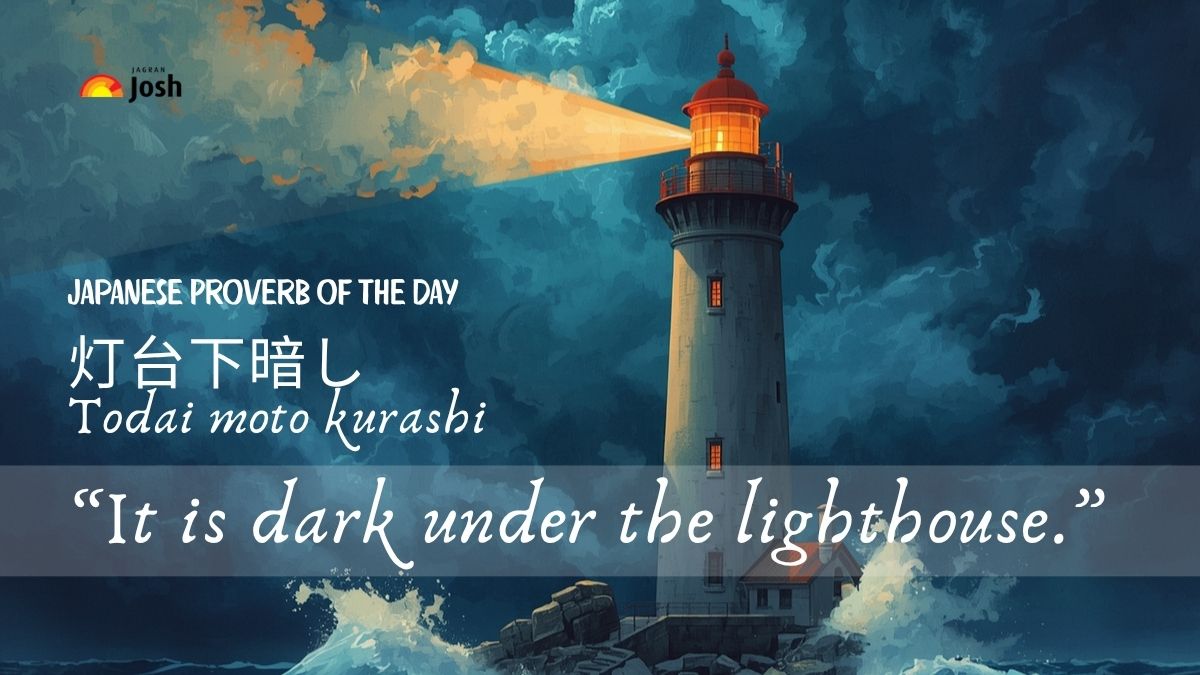
Do you always look way out on the horizon for everyday solutions, to find the answer was right in front of you all along? The Japanese proverb of the day, “Todai moto kurashi” (灯台下暗し), literally, “It is dark under the lighthouse,” applies to this very human failing.
In a world overwhelmed by algorithmic noise and global trends, it is remarkably easy to overlook your immediate reality. This sophisticated Japanese proverb about wisdom is a much-needed dose of reality. It reminds us that real clarity begins with awareness and localized focus, not far-flung distraction.
Japanese Proverb of the Day
Japanese Proverb: Todai moto kurashi (灯台下暗し)
Literal English Translation: “It is dark under the lighthouse.”
Related Stories
Meaning of Japanese Proverb “It is dark under the lighthouse”
At its heart, the Japanese proverb "Todai moto kurashi " is a reminder of the mental blind spots we develop in our day-to-day lives. The space around its foundation is utterly dark, like the bright beam of a lighthouse that shines miles out into the dark sea, guiding ships that are far away.
The Proximity Paradox: The closer you are to a situation, problem, or even a personal characteristic, the harder it is to view it objectively.
External vs. Internal Focus: We, as human beings, want answers in the distance. We want to blame things that are far away or look for opportunities that are far away, and we don’t want to look at what is right under our feet.
The Illusion of Awareness: This Japanese saying highlights how expertise or intense focus on global matters can create a total ignorance of one’s immediate personal environment or mental well-being.
How does this Japanese Proverb Apply in Modern Life?
You do not need to look far to see this Japanese proverb playing out in modern life. Whether you are a student, a young professional, or navigating relationships, we all suffer from the lighthouse effect within our day-to-day lives:
|
Modern Scenario
|
The Distant Focus
(The Light Beam)
|
The Overlooked Reality
(The Dark Base)
|
|
Career and Networking
|
Chasing high-profile LinkedIn connections globally.
|
Ignoring mentorship from a senior colleague sitting next to you.
|
|
Personal Growth
|
Reading dozens of self-help books and wellness trends.
|
Overlooking basic habits like sleep, hydration, and daily routine.
|
|
Tech and Creativity
|
Searching for revolutionary, complex coding or business ideas.
|
Missing a simple, elegant solution to an everyday frustration.
|
|
Relationships
|
Seeking validation from hundreds of digital followers.
|
Neglecting the genuine, supportive friends and family nearby.
|
What is the Origin History of this Japanese Proverb?
The origins of this ancient proverb have an interesting linguistic evolution closely related to historical Japanese domestic life rather than coastal seafaring.
During the Edo period (1603–1867), as urban life flourished and Zen philosophies integrated into daily idioms, this observation became a metaphor for human psychology. Samurai and scholars used it to warn against pride, noting that a master strategist could read an opponent miles away but fail to see treachery or weakness in their own household.
Read More Japanese Proverbs and Their Meanings Here!
"Even Monkeys Fall From Trees."
“Fall Seven Times, Stand Up Eight.”
"A Seed That Is Not Sown Will Not Sprout."
"The Bamboo that bends is Stronger than the Oak that Resists."
Before you look outward to solve your next big challenge, pause and check the shadows beneath your own lamp. Practice the wisdom of Todai moto kurashi today by auditing your surroundings. Check back tomorrow for another Japanese Proverb of the Day to keep sharpening that perspective!