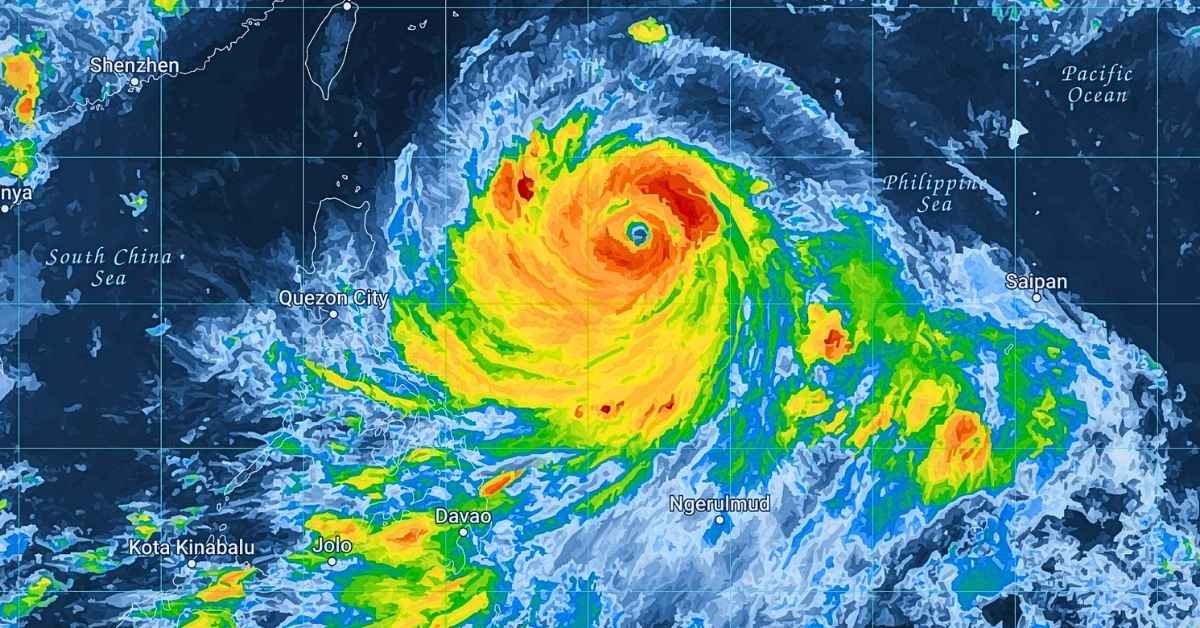
The Western Pacific witnessed strong atmospheric accelerations in recent history in the first week of July 2026. Super Typhoon Bavi emerged from a tropical storm into a category 5-equivalent behemoth in just over 24 hours. The wind speed was up to 290 km/h (180 mph) and reached at the sea surface at 346 km/h (215 mph).
Typhoon Bavi was caused by hot oceanic waters. It caused severe damage to East asian countires. This disaster also exposed the growing vulnerability of both remote Pacific territories and populated East Asian coastlines to explosive and climate-driven superstorms.
What is a Typhoon and how does it form?
A typhoon is a rotating storm system that forms over tropical oceans. It is the exact same weather phenomenon as a hurricane or cyclone form. It is simply called a typhoon when it develops in the Northwes Pacif Ocean. A typhoon acts like a huge heat engine that requires a specific five-step recipe to form:
Related Stories
-
The sea surface temperature must be at least 26.5°C down to a depth of 50 meters. It causes huge amounts of warm, moist air to evaporate and rise.
As this air rises it leaves a low-pressure void at the surface. Surrounding air rushes in to fill this gap, gets heated by the ocean, and rises in a continuous upward cycle.
The rising moisture condenses into thunderclouds in the atmosphere. This condensation releases latent heat. It acts as thermal fuel that rapidly intensifies the storm.
The Earth's rotation creates the Coriolis Effect, which deflects the incoming winds and force. The force is weak near the equator, typhoons only form at 5 degrees north and 5 degrees south counter-clockwise (in the Northern Hemisphere) latitude away from it.
The storm requires calm upper-level winds and high wind shear would rip the storm apart. But low wind shear allows it to stack vertically and grow into a structured monster ( Bavi placed under category 5 )
The storm develops a calm at its peak. The cloudless Eye at the center is surrounded by the Eyewall. A ring of maximum destruction hosting the fastest winds and heaviest rainfall.
How Did Marine Heatwaves fuelled the explosion of Bavi
Tropical cyclones require specific conditions to form. However rapid intensification with a wind speed of 35mph in 24 hours can also cause a tropical cyclone. Super Typhoon Bavi found perfect thermodynamic conditions in the Western Pacific such as
Unprecedented Heat
Bavi got the unprecedented ocean heat that is confirmed by the satellite observations from NASA and NOAA. The sea surface temperature along Bavi’s path hovered between 30°C and 32°C (86°F to 90°F), 2°C to 4°C above the long-term historical average for July.
The El Niño Impact
Bavi was aligned with the El Niño pattern. During the El Niño phase typoons often form farther east in the Pacific and provided them with vast runways of deep, warm water to draw on before making landfall. Absence of
Atmospheric Friction
Bavi also benefited from weak vertical wind shear aloft without strong upper-level winds to tilt or disrupt the storm’s vertical structure. Its central core remained aligned. It allowed the eyewall to draw maximum thermal energy from the sea continuously.
Regions Impacted by Typhoon Bavi
Super Typhoon Bavi’s made an emergency declarations across multiple nations and territories.
Guam and the Northern Mariana Islands of the US
Bavi made its first major land impact on July 5–6, 2026, dealing a severe blow to communities still rebuilding from Super Typhoon Sinlaku just three months prior. Islands like Rota, Saipan, Tinian and Guam.
Philippines
Bavi's centre was to the north of the Philippine archipelago. Its 380-kilometer radius dragged monsoonal moisture across the country. On the southern island of Mindanao and resulted in the torrential rains caused severe landslides.
Japan‘s Sakishima and Ryukyu Islands
Bavi impacted the northwestward of Japan. It also impacted the southern island chains, including Ishigaki in Okinawa. Flight and ferry networks came to a halt, leaving popular tourist places isolated amidst flying debris and fierce coastal surges.
Tiwan
Bavi marked the largest typhoon by physical radius to threaten Taiwan in over 30 years. The Central Weather Administration (CWA) issued extensive sea and land warnings.
The government evacuated over 14,000 citizens from vulnerable mountainous zones. Taiwan declared Typhoon holidays, shutting down schools and businesses
Eastern China
Bavi targeted the eastern coast of mainland China. The National Meteorological Service announced high-level flood emergency responses. Densely populated economic zones in Zhejiang and Fujian provinces braced for widespread disruptions with fishing fleets recalled and offshore wind farms evacuated.