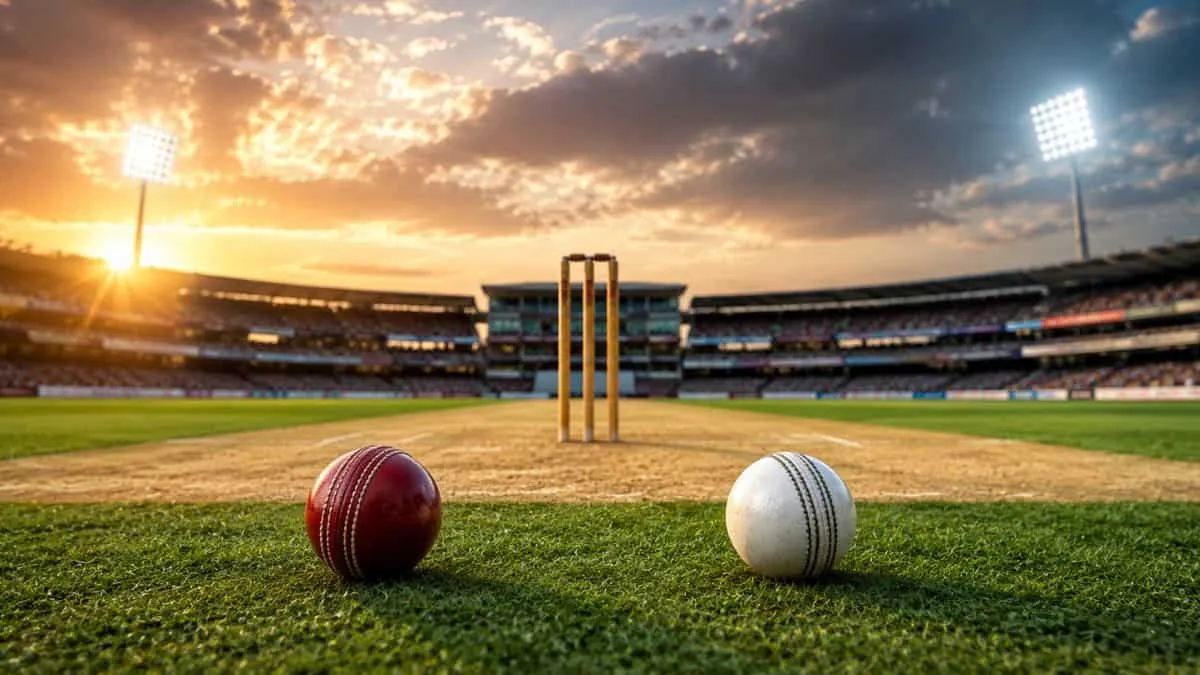
While watching a cricket match have you ever wondered why Test cricket uses a red ball while the ODIs and T20Is are generally played with white balls.
Well the answer is not just about tradition as the colour of the ball in a cricket format is closely linked to visibility, lighting conditions and the way each format is played.
Test matches are played during the day and can last upto a few days and on the other hand, ODIs and T20Is are much shorter and are often played under floodlights. That is why different coloured balls are used in different formats.
Red Ball vs White Ball in Cricket: Quick Comparison
|
Feature
|
Red Ball
|
White Ball
|
|
Mainly used in
|
Test cricket
|
ODIs and T20Is
|
|
Main reason
|
Ideal for traditional daylight Test matches
|
Better visibility in limited-overs cricket, especially when played under lights
|
|
Ball usage
|
Designed in such a way that they support longer periods of play
|
Designed in a way that it can be used in different formats with different rules
|
|
Common lighting
|
Mostly daylight
|
Day and night
|
How Many Balls Are Used in Test Cricket and ODIs?
|
Format
|
Ball Usage
|
|
Test cricket
|
A new ball is used at the start of an innings. A new ball can be taken after 80 overs
|
|
ODI
|
Two new balls are used for the first 34 overs, one from each end. After that, the fielding team chooses one ball for the remaining overs
|
|
T20I
|
One new ball is used for each innings
|
Is the Red Ball Actually Different From the White Ball?
The answer is yes! Apart from the difference in colour, the construction, leather, stitching, seam and surface treatment can affect how a ball behaves. The condition of the ball also changes during a match.
A new ball can move differently from an older ball. Its shine, surface and seam condition can influence how it behaves.
However, it is important not to assume that every red ball and every white ball behaves in exactly the same way.
The manufacturer and specific ball can also make a difference. Playing conditions, pitch, weather and the bowler's technique are important too.