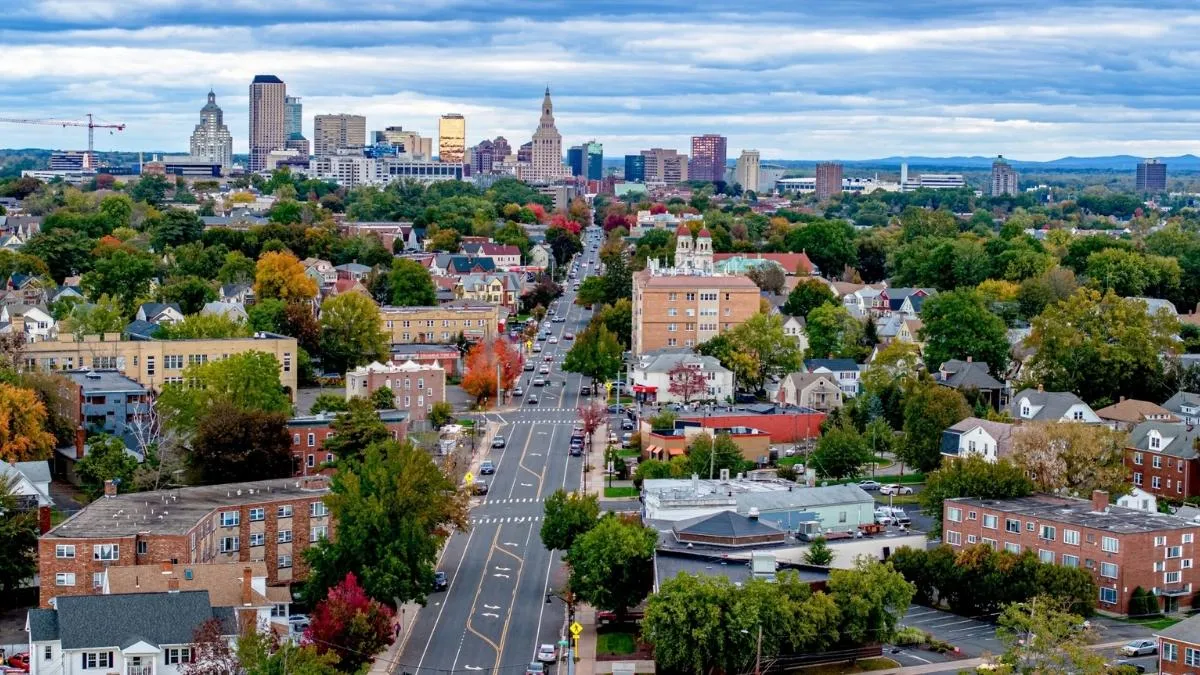
Across the United States, many cities are famous for their massive populations and skylines. New York City dominates by population, while Jacksonville, Florida, is known as one of the largest cities by land area. However, Connecticut stands out for a different reason, and here, size is measured more by land coverage than by urban density, making geography a defining factor rather than population alone.
When people search for the largest cities in Connecticut, they often assume population size defines “largest.” However, Connecticut works differently. In the state, all municipalities are legally towns, and the term city is mostly historical. This means some of the largest places by land area are actually rural or semi-rural towns rather than dense urban centres.
In Connecticut, New Milford stands out as the largest municipality by land area. It covers approximately 61.6 square miles. When the total area is considered, including water bodies, it expands to nearly 63.7 square miles. This makes it the biggest in the state by sheer size, highlighting how Connecticut’s geography shapes its largest communities.
List of Largest Cities (Towns) in Connecticut by Land Area
These Connecticut municipalities rank as the largest based on land area, not population. The list below highlights how many of the state’s biggest “cities” are actually towns with vast rural and suburban landscapes:
| Rank | Town Name | Land Area (sq. miles) |
| 1 | New Milford | 61.6 |
| 2 | East Haddam | 54.33 |
| 3 | Lebanon | 54.1 |
| 4 | Glastonbury | 51.4 |
| 5 | Killingly | 48.5 |
| 6 | Kent | 48.5 |
| 7 | Greenwich | 47.8 |
| 8 | Guilford | 47.1 |
| 9 | Cornwall | 46.01 |
| 10 | Mansfield | 44.5 |
Let us read what makes these towns so large:
1. New Milford
It is located in Litchfield County and combines residential neighbourhoods with forests, lakes, and open land, explaining its massive footprint. Despite being part of the Greater Danbury region, much of its area remains non-urban.
2. East Haddam and Lebanon
These are largely rural towns, featuring state parks, farmland, and historic villages rather than dense city blocks. Their size reflects preserved land rather than population growth.
3. Glastonbury and Greenwich
These are notable exceptions, as these are large in area but also economically significant. For example, Greenwich is part of the New York Metropolitan Area and blends suburban development with wooded and coastal zones.
4. Kent, Killingly, and Cornwall
These are spread-out towns with small populations, emphasising how Connecticut’s biggest municipalities by area are often quiet and scenic rather than crowded.
Cities vs Towns: A Connecticut Distinction
While Bridgeport is the largest city in Connecticut by population, it covers far less land than towns like New Milford or Greenwich. The same is true for Stamford and New Haven, which are major population hubs with comparatively small geographic footprints.





Comments
All Comments (0)
Join the conversation