MTech vs MBA: Which Career Path to Choose After Graduation?
MTech vs MBA: Confused between MTech and MBA after graduation? Check the eligibility criteria, career options, entrance exams, salary prospects and key differences to choose the right career path.
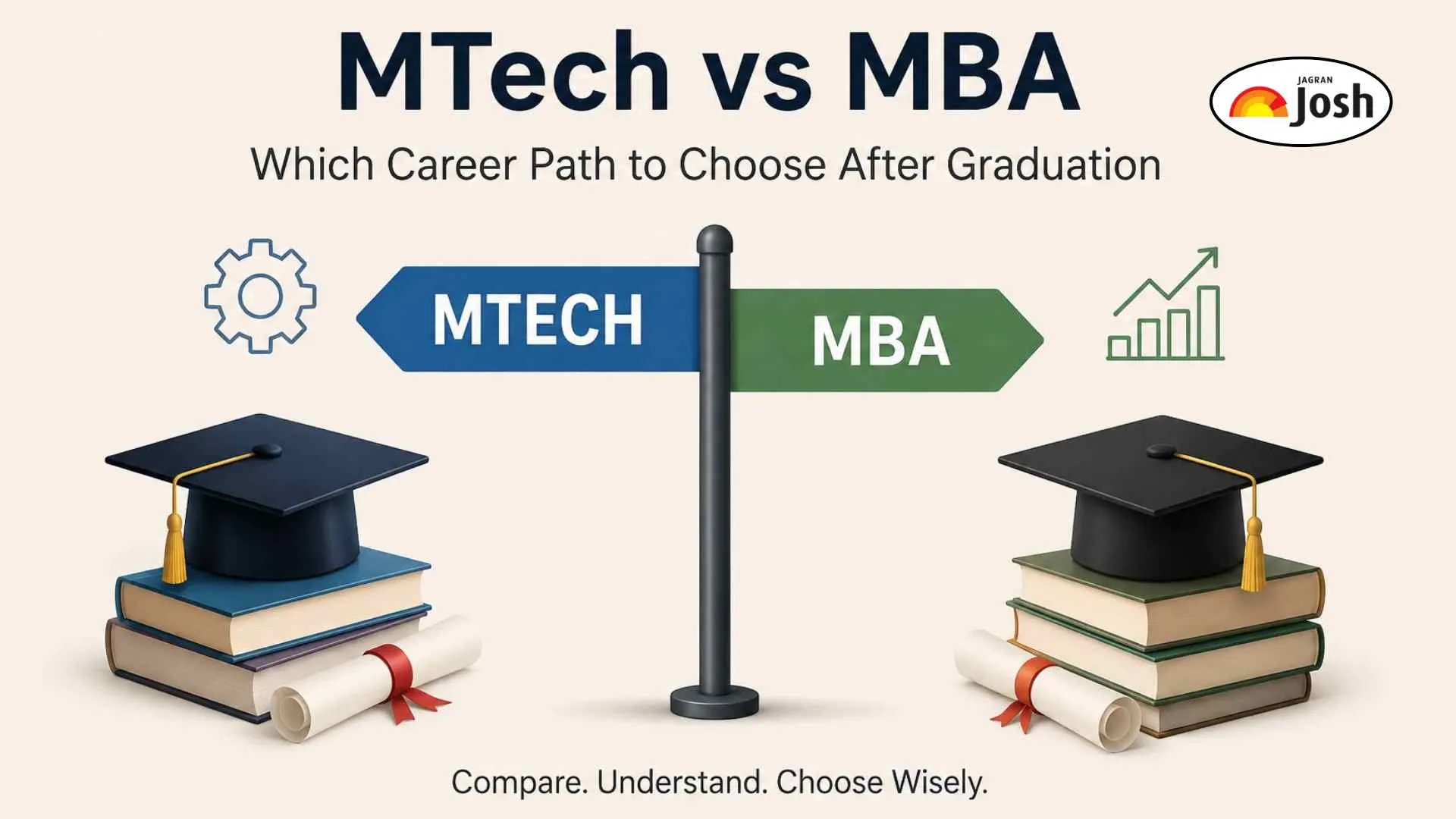
MTech vs MBA: Choosing the right postgraduate course after graduation is a most important part for your career, salary prospects and future opportunities. MTech, Master of Technology focuses on developing technical and engineering skills, MBA, Master of Business Administration prepares students for roles in management, business, consulting, finance, marketing and similar fields. For engineering and technology graduates, the MTech vs MBA debate can be confusing. The right choice depends on a student’s career goals, academic interests, skills and work environment preferences. Here’s a detailed comparison to help graduates decide whether MTech or MBA is a better career choice.
MTech vs MBA: What’s the difference?
MTech is a postgraduate technical degree for students who want to build their knowledge in engineering, technology, research or specialized technical areas. It is most appropriate for graduates who want to pursue careers in technical positions, research and development, academia or advanced technology. MBA, in contrast, is business and management oriented. Students can specialize in areas like Finance, Marketing, Human Resources, Operations, Business Analytics, International Business and Entrepreneurship.
| Factor | MTech | MBA |
| Primary focus | Technology and engineering | Business and management |
| Suitable for | Technical and engineering careers | Management and business careers |
| Popular specialisations | Computer Science, AI, Data Science, VLSI, Mechanical Engineering | Finance, Marketing, HR, Operations, Business Analytics |
| Career options | Engineer, Researcher, Data Scientist, Technical Specialist | Manager, Consultant, Business Analyst, Marketing Manager |
| Work profile | Mostly technical | Mostly managerial/business-oriented |
| Best suited for | Students interested in technology and research | Students interested in leadership and business |
MTech: Who Should Choose It?
MTech can be a strong option for graduates who enjoy technical subjects and want to specialise further in their engineering discipline.
Students interested in Artificial Intelligence, Machine Learning, Data Science, Cybersecurity, Computer Science, Electronics or advanced engineering technologies can consider MTech as a way to develop specialised expertise.
MTech may also be suitable for students planning careers in research and development or higher education. Those interested in teaching or pursuing doctoral studies may use MTech as a pathway towards a PhD.
Career Options After MTech
After completing MTech, graduates can explore roles such as:
| Job Profile | Average Salary in India |
| Software Engineer | INR 9.6 LPA |
| Data Scientist | INR 16 LPA |
| AI/ML Engineer | INR 18.8 LPA |
| Research Scientist | INR 10.4 LPA |
| Systems Engineer | INR 5.8 LPA |
| Technical Consultant | INR 12.6 LPA |
| Project Engineer | INR 5.5 LPA |
| R&D Engineer | INR 9.4 LPA |
| University or College Faculty | INR 17 LPA |
NOTE: The actual career opportunities depend heavily on the candidate's specialisation, technical skills, institute, experience and industry demand.
MBA: Who Should Choose It?
MBA can be a better choice for graduates who want to move towards management, leadership, strategy or business-related roles.
An MBA can be particularly useful for candidates who want to understand how organisations operate and develop skills in decision-making, communication, financial management, marketing and leadership.
Engineering graduates who do not want to remain in purely technical roles may also consider an MBA to transition into managerial or business-oriented careers.
Career Options After MBA
MBA graduates can pursue careers such as:
| Job Profile | Average Salary in India |
| Business Analyst | INR 10.1 LPA |
| Management Consultant | INR 28.9 LPA |
| Product Manager | INR 23.1 LPA |
| Marketing Manager | INR 13.3 LPA |
| Financial Analyst | INR 6.8 LPA |
| HR Manager | INR 11.3 LPA |
| Operations Manager | INR 11.3 LPA |
| Investment Banking Professional | INR 30 LPA |
| Business Development Manager | INR 8.1 LPA |
| Entrepreneur | INR 11.5 LPA |
NOTE: Career outcomes can vary significantly depending on the MBA institute, specialisation, prior work experience, skills and placement opportunities.
MTech Vs MBA: Which Has a Better Career Scope ?
There is no answer to whether MTech or MBA has better scope. Both qualifications lead to strong and better career prospects but they serve different professional goals. MTech is mostly more suitable for students who want to remain closely connected to technology and engineering. MBA will be more appropriate for students or graduates interested in management, business strategy, leadership and client facing roles.
MTech VS MBA: Top 10 Colleges in India
Check the table below to know the top 10 MTech and MBA Colleges with their fee structure:
Top 10 MTech Colleges in India
The list below broadly follows the latest available NIRF Engineering rankings, with fees shown as approximate figures. NIRF 2025 placed IIT Madras, IIT Bombay, IIT Delhi, IIT Kanpur and IIT Kharagpur among the leading engineering institutes.
| Rank | MTech College | Approx. 2-Year Fee |
| 1 | INR 1.0–2.0 lakh | |
| 2 | INR 1.5–3.8 lakh | |
| 3 | INR 1.0–2.5 lakh | |
| 4 | INR 1.0–2.0 lakh | |
| 5 | INR 1.0–2.0 lakh | |
| 6 | INR 65,000–1.5 lakh | |
| 7 | INR 1.0–2.0 lakh | |
| 8 | INR 1.0–2.0 lakh | |
| 9 | INR 1.0–2.0 lakh | |
| 10 | INR 1.0–2.0 lakh |
Note: MTech fees can differ considerably by programme and student category. For example, current published sources put IIT MTech fees anywhere from around INR 65,000 to several lakh rupees, depending on the institute and programme. IIT Hyderabad has also published a separate fee structure for the July–December 2026 semester.
Top 10 MBA Colleges in India
The following list is based primarily on the latest available NIRF Management rankings and overall reputation. NIRF 2025 ranked IIM Ahmedabad first, IIM Bangalore second and IIM Kozhikode third in management.
| Rank | MBA College | Approx. 2-Year Fee |
| 1 | INR 22–27.5 lakh | |
| 2 | INR 26 lakh | |
| 3 | INR 22–23.5 lakh | |
| 4 | INR 25–27 lakh | |
| 5 | IIT Delhi – DMS | INR 11–12 lakh |
| 6 | INR 20–22 lakh | |
| 7 | INR 20–25 lakh | |
| 8 | INR 24.1 lakh | |
| 9 | INR 18–20 lakh | |
| 10 | IIM Bangalore/IIM Calcutta-level alternative: FMS Delhi | INR 2–3 lakh |
NOTE: These are approximate figures and should not be treated as a fixed fee schedule. For example, IIM Bangalore's official fee for the 2026–28 PGP is INR 26 lakh for two years, excluding the refundable caution deposit. IIM Indore's published two-year fee for resident Indian students is about INR 24.12 lakh. IIM Ahmedabad recently announced a flagship MBA fee of INR 22 lakh, although total student expenditure can be higher depending on other charges.
Also Check: CAT Accepting Colleges
MTech vs MBA: Salary Prospects
Salary after MTech or MBA cannot be determined by the degree alone. Factors such as college reputation, specialisation, technical and soft skills, work experience, location, industry and job role play an important role.
Graduates from leading institutions can have access to stronger placement opportunities, while candidates with relevant work experience and in-demand skills may also command higher salaries.
Also Check: Top MBA Colleges in India Accepting CAT Scores 2026: Check Fee, Cutoff, Selection Process
MTech vs MBA: Entrance Exams
Students planning to pursue MTech in India commonly appear for GATE (Graduate Aptitude Test in Engineering), although admission requirements vary by institute and programme.
For MBA admissions, major entrance examinations include CAT, XAT, CMAT, MAT, GMAT and various institute-specific examinations. The eligibility criteria and admission process differ across business schools.
MTech vs MBA: Eligibility Criteria
MTech Eligibility: Candidates generally need a bachelor’s degree in engineering or technology from a recognised university. Many institutes require a valid GATE score for admission, although eligibility and entrance requirements vary by institution and programme.
Also Check: GATE 2026 Eligibility Criteria Explained
MBA Eligibility: Candidates need a bachelor’s degree in any discipline from a recognised university, with the minimum percentage set by the respective institute. Admissions are usually based on entrance exam scores including CAT, XAT, CMAT, MAT, etc., or merit-based admissions.
Also Check: CAT 2026 Eligibility Criteria Explained
The choice between MTech vs MBA after graduation should be based on long-term career objectives rather than the perceived popularity of either degree. Students who want to build deeper technical expertise may find MTech more suitable, while those interested in management and business careers may benefit from an MBA.
Before making a decision, graduates should compare course curricula, specialisations, college reputation, placement records, fees, career opportunities and their own interests. The right postgraduate degree is ultimately the one that aligns with the career a student wants to build.
Also Read: CAT 2026: 5 Admission Changes In Top IIMs Every MBA Aspirant Should Know

Apeksha Agarwal is an Education Journalist with over 3.5 years of experience. She covers a wide range of topics, including school board examinations, entrance tests, admissions, results, scholarships, and higher education updates. Over the years, she has closely tracked major examinations such as JEE Main, NEET UG, CUET, and various state-level entrance exams, helping students stay informed throughout their academic journey. Apeksha has a Master's degree in Journalism and Mass Communication and a certificate in Digital Journalism. She is passionate about transforming complex educational developments into clear, accessible, and useful information. Her reporting focuses on providing students, parents, and educators with accurate updates and practical insights on examinations, results, and policy changes. She believes that quality education journalism can make a meaningful difference by helping students make informed decisions about their future.


-1791887906062_t.webp)


![[यहां देखें] GDS 1st Merit List 2026 OUT: इंडिया पोस्ट जीडीएस पहली मेरिट लिस्ट जारी, ये रहा सर्कल वाइज रिजल्ट Direct Link](https://img.jagranjosh.com/images/2026/October/11102026/GDS-Merit-List-2026.jpg)
.jpg)
