Chipmunks vs Squirrels: What’s the Difference Between These Rodents?
Chipmunks vs squirrels often spark debate among nature enthusiasts and homeowners alike. While both belong to the same family, their unique survival tactics and physical markers set them apart. Recent ecological observations highlight how these rodents are adapting to urban expansion in distinct, fascinating ways.

Key Points
- Squirrels scatter-hoard nuts for winter; they don't hibernate, says NWF.
- Chipmunks have cheek pouches for hoarding; they often eat insects.
- Stripes on face = chipmunk. Large size & bushy tail = squirrel.
If you have ever spent a morning in a park or your own backyard, you have likely seen a furry tail darting across the grass. But was it a chipmunk or a squirrel? While they might look like cousins at a glance, the Chipmunks vs. Squirrels debate reveals two very different lifestyles.
Understanding the differences between chipmunks and squirrels is more than just a biology lesson; it is about knowing who is digging up your garden and who is performing acrobatics on your roof.
Once you get the hang of spotting these critters, be it a chipmunk or a squirrel, it becomes a hobby. Let’s not forget that both are members of the Sciuridae family, yet they have evolved with unique tools for survival.
What is a Squirrel?
A squirrel, specifically the tree squirrel most common in urban areas, is a medium-sized rodent known for its bushy tail and incredible climbing skills. These acrobats of the trees are primarily diurnal and can be seen leaping between branches with gravity-defying ease.
According to the National Wildlife Federation, tree squirrels do not hibernate; instead, they scatter-hoard, burying thousands of nuts in various locations to survive the winter.
Their bodies are typically 12 to 20 inches long, including that iconic fluffy tail, which they use for balance and communication.
They lack the facial stripes seen on their smaller relatives, usually sporting a solid grey, reddish, or brown coat.
Also Read - What is a Group of Rats Called?
What is a Chipmunk?
A chipmunk is essentially a pygmy version of the squirrel family, but with a few high-tech upgrades. These tiny rodents are famous for their chipmunk characteristics, most notably the black and white stripes that run down their backs and across their faces. Unlike their larger cousins, chipmunks are larder hoarders.
They possess expandable cheek pouches, which can stretch to three times the size of their heads, to carry food back to their underground burrows.
A single chipmunk can gather over 160 acorns in one day! They are true ground squirrels that prefer living in complex tunnel systems rather than high-up nests.
Also Read -List Animals that Hibernate the Longest on Earth
What is the Difference between Chipmunks and Squirrels?
The primary difference between chipmunk and squirrel species lies in their habitat and storage strategy.
Squirrels are the forgetful investors of the forest; they bury nuts all over the place, which actually helps grow new trees.
Chipmunks are the hoarders; they keep everything in one basement (their burrow).
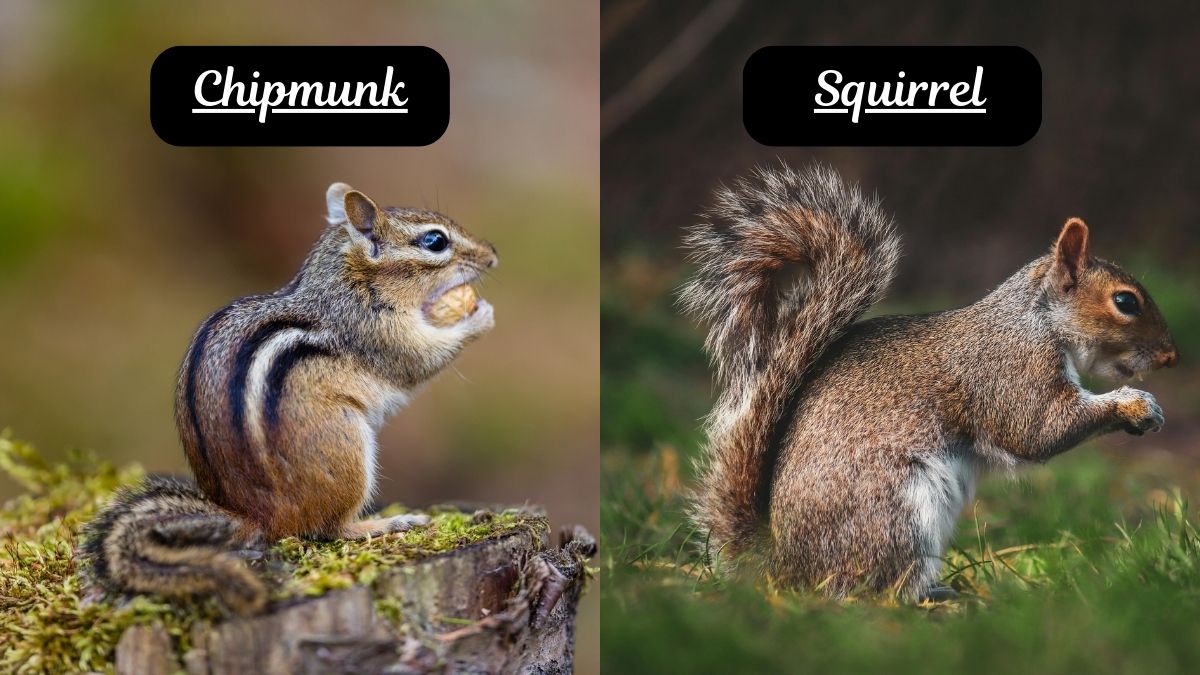
Physically, if it has stripes on its face, it is a chipmunk. If it is large, lacks stripes, and has a tail nearly the length of its body, it is a squirrel.
Furthermore, while squirrels are mostly herbivores, chipmunks are more aggressively omnivorous, often snacking on insects, bird eggs, or even small frogs.
How to Identify Chipmunks and Squirrels?
Identifying these critters quickly comes down to a few visual tells. Check for stripes first; if the stripes continue all the way to the eyes, you are looking at a chipmunk.
If you see a ground squirrel vs chipmunk, remember that ground squirrels have body stripes but usually lack the facial markings.
Also, watch their movement. Squirrels tend to run in long, bounding leaps, while chipmunks move in quick, erratic zips, staying close to ground cover.
| Feature | Chipmunk | Tree Squirrel |
| Size | Small (6–12 inches) | Large (12–20 inches) |
| Stripes | Present on the back and the face | Usually none (Solid color) |
| Tail | Shorter, less bushy | Long, very fluffy |
| Home | Underground burrows | Tree nests (Dreys) or cavities |
| Food Storage | Cheek pouches; single hoard | Carried in the mouth; scattered |
| Winter Activity | Hibernates/Torpor | Active all year |
Do You Know - What is a Group of Owls Called?
In conclusion, researchers have noted that squirrels are becoming increasingly bold in urban environments, with some city populations showing a 15% increase in human-interaction levels. Whether you are dealing with a scurry of squirrels or a bushel of chipmunks, these clever rodents remain the undisputed kings of the suburban wilderness.

Harshita Singh is an education and general knowledge journalist with over 5 years of experience in educational writing. Specializing in US affairs and GK, Harshita has a track record of breaking down intricate geopolitical and historical subjects into clear, digestible insights for learners. Her strong background in text analysis, coupled with a Bachelor of Arts (Hons) in English from the University of Delhi, helps her produce authoritative, thoroughly researched content that empowers readers to engage confidently with global current affairs. For inquiries or academic insights, you can reach out to her directly at harshita.singh@jagrannewmedia.com.

-1792026923912_t.webp)






![[यहां देखें] GDS 1st Merit List 2026 OUT: इंडिया पोस्ट जीडीएस पहली मेरिट लिस्ट जारी, ये रहा सर्कल वाइज रिजल्ट Direct Link](https://img.jagranjosh.com/images/2026/October/11102026/GDS-Merit-List-2026.jpg)