Supreme Court Cuts Practice Requirement for Civil Judge Exams From 3 Years to 1 Year
Supreme Court replaces the three year practice requirement with a one year rule for Civil Judge exams and waives it for transition candidates till March 31, 2027. Read the artcile for more details.
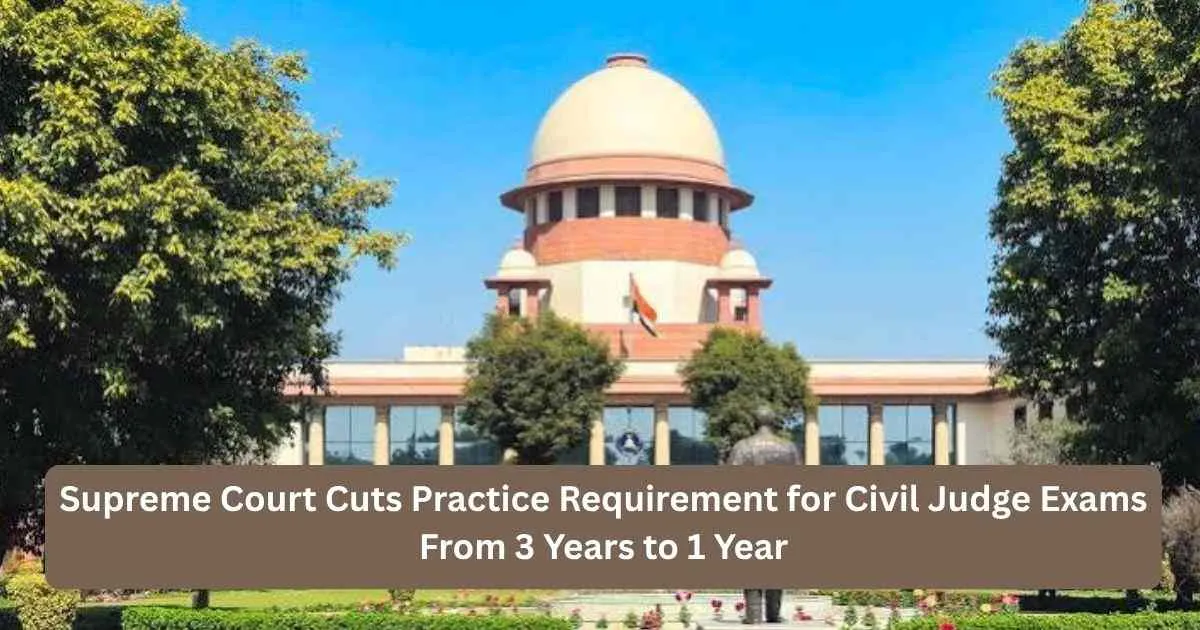
The Supreme Court has softened its stand on legal practice for judicial service. The court declined to review its May 2025 judgement on prior practice. But the bench replaced the three year practice requirement with a one year rule. Chief Justice Surya Kant and Justice Augustine George Masih delivered the verdict while Justice K Vinod Chandran dissented. The bench said a candidate must have exposure to the legal profession before joining the judiciary. Prior experience must hold a reasonable nexus so no hardship is caused. The sudden return of the old rule visited hardship on young lawyers and law graduates. A long wait would push away young lawyers and law graduates especially women and persons with disabilities. National Law Universities also opposed the old rule. One counsel asked for a uniform training framework while another suggested limited relaxations for special categories. So the court ordered a limited intervention with a smooth transition plan. Read the article to know more details.
Transition Period Relaxation for Civil Judge Junior Division Candidates
The practice requirement is fully waived for one transition window. Law graduates between May 20, 2025 and March 31, 3027 can sit for Civil Judge Junior Division exams without any practice certificate. They are deemed to have completed one year of active practice for their applications. No certificate of practice is demanded for that period. Selected candidates become Trainee Judicial Officers. They undergo one year of intensive training at the State Judicial Academy. Trainees get emoluments equal to half the gross remuneration of a Judicial Magistrate First Class. After training they have to serve one year structured law clerkship. The first six months are spent under a Principal District Judge or a Higher Judicial Service Member. The last six months are spent under a sitting High court judge. The supervising judge submits a reasoned evaluation report on progress and suitability. A satisfactory report brings appointment to the regular post with full pay and service benefits.
One Year Practice Rule and Clerkship After April 2027
For exams advertised on or after April 1 2027 the practice requirement stands at one year of active practice. A certificate of practice confirms this period. The certificate is issued only when presence in effective judicial proceedings is duly recorded. Selected candidates undergo one year of training at the State Judicial Academy. Then follow six months of law clerkship under a sitting high court judge. The court also heard pleas for relaxing the rule for persons with disability and for treating PSU law officer experiences as practice. The court may revisit the scheme after three years of operation based on relevant indicators, Justice Vinod Chadran did not concur with the arrangement. He simply pronounced that the review petitions are dismissed.
Faham is an education specialist and has over three years of experience in the education and edtech industry, specializing in digital and educational content creation. He holds an MBA in Marketing and Human Resources from Swami Vivekanand University. Throughout his career, Faham has developed expertise in creating engaging and informative content across diverse educational domains.
In addition to his edtech experience, he worked for two years as a Public Speaking and Creative Writing Expert, helping learners enhance their communication and writing skills. He has also been associated with Testbook and Adda Education as a Content Writer, where he created high-quality content for K–12 education, Management Entrance Examinations, UPSC, Law, and State Defence examinations. His strong understanding of educational content and exam preparation enables him to simplify complex topics and deliver valuable learning resources to students.