Article 19: The Six Fundamental Freedoms That Define Every Indian’s Democracy
Article 19 of Indian Constitution: Let us try and understand the sex fundamental rights guaranteed under Article 19 of the Indian Constitution. Let's explore them one by one here.
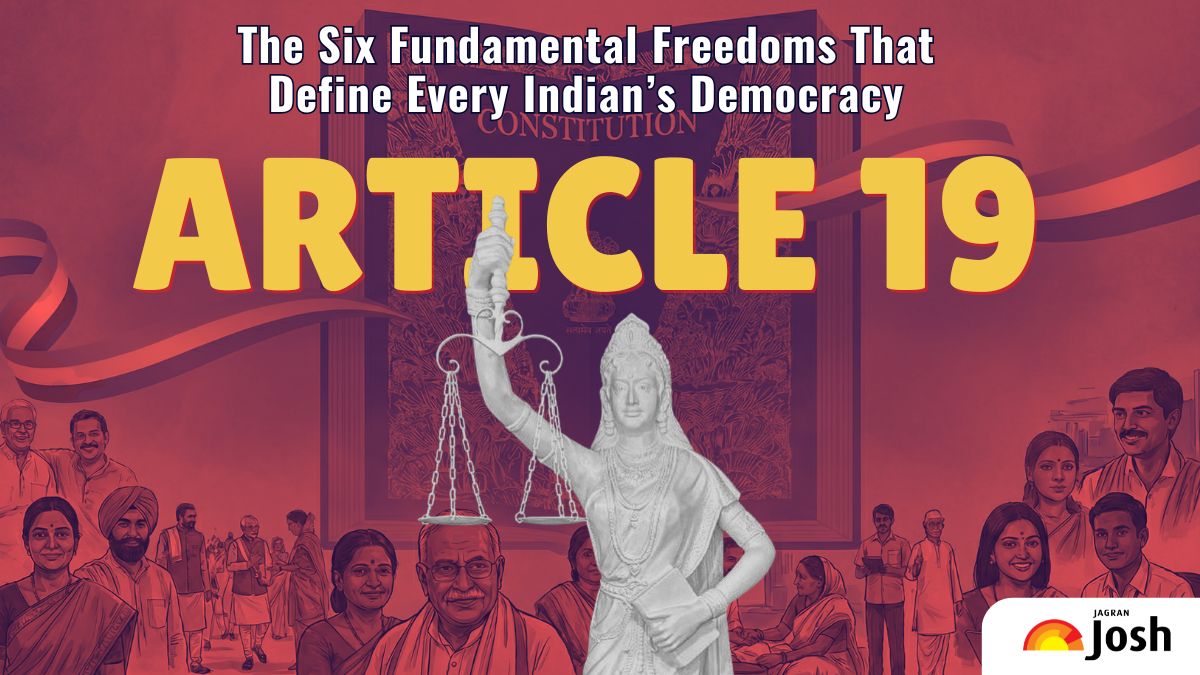
Article 19 of Indian Constitution: If democracy is the soul of the Constitution, then Article 19 is its heartbeat. It guarantees six essential freedoms to Indian citizens, ensuring the right to express opinions, assemble peacefully, move freely, and practice any profession.
It also allows the State to impose reasonable restrictions in the interest of national security, public order, morality, and sovereignty.
This article is one of the most frequently asked and analyzed provisions in exams, courts, media, and public debates.
Article 19 of the Indian Constitution
Article 19 of the Indian Constitution is titled “Protection of certain rights regarding freedom of speech, etc.” It has six provisions:
(1) All citizens shall have the right-
(a) to freedom of speech and expression;
(b) to assemble peaceably and without arms;
(c) to form associations or unions or co-operative societies;
(d) to move freely throughout the territory of India;
(f) sub-clause (f) shall be omitted;
(e) to reside and settle in any part of the territory of India;and
(g) to practise any profession, or to carry on any occupation, trade or business.
(2) Nothing in sub-clause (a) of clause (1) shall affect the operation of any existing law, or prevent the State from making any law, in so far as such law imposes reasonable restrictions on the exercise of the right conferred by the said sub-clause in the interests of the sovereignty and integrity of India, the security of the State, friendly relations with Foreign States, public order, decency or morality or in relation to contempt of court, defamation or incitement to an offence.
(3) Nothing in sub-clause (b) of the said clause shall affect the operation of any existing law in so far as it imposes, or prevent the State from making any law imposing, in the interests of the sovereignty and integrity of India or public order, reasonable restrictions on the exercise of the right conferred by the said sub-clause.
(4) Nothing in sub-clause (c) of the said clause shall affect the operation of any existing law in so far as it imposes, or prevent the State from making any law imposing, in the interests of the sovereignty and integrity of India or public order or morality, reasonable restrictions on the exercise of the right conferred by the said sub-clause.
(5) Nothing in sub-clauses (d) and (e) of the said clause shall affect the operation of any existing law in so far as it imposes, or prevents the State from making any law imposing, reasonable restrictions on the exercise of any of the rights conferred by the said sub-clauses either in the interests of the general public or for the protection of the interests of any Scheduled Tribe.
(6) Nothing in sub-clause (g) of the said clause shall affect the operation of any existing law in so far as it imposes, or prevent the State from making any law imposing, in the interests of the general public, reasonable restrictions on the exercise of the right conferred by the said sub-clause, and, in particular, nothing in the said sub-clause shall affect the operation of any existing law in so far as it relates to, or prevent the State from making any law relating to,- [The following clause was substituted through Constitution (First Amendment) Act, 1951]
(i) the professional or technical qualifications necessary for practising any profession or carrying on any occupation, trade or business, or
(ii) the carrying on by the State, or by a corporation owned or controlled by the State, of any trade, business, industry or service, whether to the exclusion, complete or partial, of citizens or otherwise.
What Is Article 19?
Article 19 grants deals with the Right to Freedom. It guarantees six freedoms only to citizens of India (not foreigners or legal persons). These freedoms form the backbone of a democratic society.
At the same time, the State can put reasonable restrictions to maintain public order, security, and morality.
The Six Fundamental Freedoms Under Article 19
Article 19(1) guarantees the following six freedoms:
Article 19(1)(a): Freedom of Speech & Expression
This includes the freedom to speak freely, express opinions, write articles/books/blogs, express dissent peacefully, display art, cartoons, films, etc. This covers:
-
Print media
-
Electronic media
-
Social media
-
Films and creative expression
The Constitution puts some reasonable restrictions on freedom of speech and expression. These restrictions will be applicable:
-
Sovereignty and integrity of India
-
Security of the State
-
Friendly relations with foreign states
-
Public order
-
Decency and morality
-
Contempt of court
-
Defamation
-
Incitement to an offence
Article 19(1)(b): Freedom to Assemble Peacefully
Every citizen can hold peaceful protests, organise rallies or dharnas, participate in public meetings. The assembly should be peaceful and without arms.The restrictions are imposed on Article 19(1)(b) if it violates:
-
Public order
-
Security of the State
-
Sovereignty and integrity of India
Article 19(1)(c): Freedom to Form Associations
Article 19(1)(c) offers the citizens the right to form trade unions, political parties, societies, clubs, NGOs, companies until they hamper thepublic order, morality, sovereignty and integrity of India.
Article 19(1)(d): Freedom to Move Freely
Article 19(1)(d) guarantees the citizens to move freely anywhere in the country. There are certain reasonable restrictions that are imposed on Article 19(1)(d) to protectpublic interest, protection of Scheduled Tribes, certain restricted areas (e.g., military or tribal zones)
Article 19(1)(e): Freedom to Reside and Settle
As per Article 19(1)(e), the citizens have the right to reside, purchase property (as per State laws), and settle anywhere in the country subject to certain restrictions.
-
Public interest
-
Protection of Scheduled Tribes (e.g., inner line permit areas)
Article 19(1)(g): Freedom to Practice Any Profession
Under Article 19(1)(g), the citizens are entitled to choose any profession or business of their choice, start a company, run a shop, take up employment of choice but with certain reasonable restrictions such as:
-
Professional qualifications
-
Licensing requirements
-
Monopolies in national interest
-
Regulation for public safety
For Example: Doctors, lawyers, drivers, teachers need licenses or professional qualifications.
Important Supreme Court Judgments on Article 19
Article 19 is a very important article of the Indian Constitution as it guarantees the freedom to speak up your mind, reside in the country, choose your profession, move across the country, form associations, and assemble peacefully. As these freedoms cover a wide area, therefore, there always remains scope for violation of rights of others. In such cases, the citizens can directly approach the Supreme Court. Here are some of the landmark judgements of the Supreme Court around Article 19.
1.Romesh Thappar vs State of Madras (1950):
The Supreme Court declared freedom of speech as the foundation of democracy. It clearly stated that “Freedom of Press” is a right under Article 19(1)(a). But this is not an absolute right, which means there are certain restrictions imposed on it.
2. Bennett Coleman vs Union of India (1973)
The Supreme Court held that the freedom of the press embodies the right of the people to free speech and expression. It was held that “Freedom of the press is both qualitative and quantitative. Freedom lies both in circulation and in content.”
3. Shreya Singhal vs Union of India (2015)
In this case, Section 66A of the IT Act was challenged. The Supreme Court struck down this section mentioning it as too vague and prone to misuse.
Why Article 19 Matters Today
In modern times, when there are cases regarding the social media regulation, students are protesting for their rights, journalism is being hampered, startups are affected because of Red-tapism, the need for Article 19 arises more than ever.
Citizens whether students or professionals, young or old, are affected by the continuous restrictions and policies being imposed on them. In such situations, they could take the help of the Supreme Court in invoking Article 19.
Article 19 At a Glance
| Clause | Freedom |
| 19(1)(a) | Speech & Expression |
| 19(1)(b) | Peaceful Assembly |
| 19(1)(c) | Form Associations |
| 19(1)(d) | Move Freely |
| 19(1)(e) | Reside & Settle |
| 19(1)(g) | Practice Profession |

Upasna is an education journalist and subject matter expert with an extensive background in the competitive exam landscape. Currently contributing to the Exam Prep Section of Jagran Josh, Upasna specializes in creating well-researched, aspirant-centric content and simplifying complex topics for competitive examinations. Her academic expertise, coupled with her own firsthand experience preparing for the UPSC Civil Services Examination, helps her provide strategic preparation insights and a comprehensive perspective to aspirants. She holds a Master's degree in Forensic Chemical Sciences. Apart from delivering valuable exam resources, Upasna is a passionate communications professional who also enjoys reading and writing.


.jpg)


![[OUT] UPSSSC PET Admit Card 2026 LIVE: यूपी पीईटी एडमिट कार्ड जारी, upsssc.gov.in पर Direct Link](https://img.jagranjosh.com/images/2026/October/15102026/UPSSSC-PET-Admit-Card-2026.jpg)