List of the local Winds in India
Explore the complete list of local winds in India. From the severe heatwaves Loo in north India to Nor’wester storms in Odisha and West Bengal and Mango Showers in South India. Learn how these winds impact Indian agriculture and current weather news.
Key Points
- Local winds like Loo pose health risks with temperatures reaching 45-50°C in May-June.
- Mango Showers in South India aid mango ripening, benefiting farmers at the end of summer.
- Kalbaisakhi storms in East India are vital for jute, tea, and rice cultivation.
Local winds in India like the Loo, Kalbaisakhi (Norwester), Mango Showers and Blossom Showers are regional atmospheric movements that play a pivotal role in the country’s economy and safety. These winds are essential for the ripening of crops like mangoes and tea but can also pose significant risks to health and infrastructure.
India’s vast geography stretching from the snow-capped Himalayas to the tropical shores of the Indian Ocean which creates a diverse range of atmospheric pressures, results in local winds, unique weather phenomena that can bring either a cool relief from the heat or a scorching reminder of summer’s intensity.
What are Local Winds?
Local winds are small-scale convective winds caused by regional differences in temperature and pressure not like the global winds such as the Trade Winds that blow across entire continents, local winds are confined to specific areas and often occur during certain times of the day or seasons.
In India, these winds are frequently influenced by the country’s unique topography like the proximity of the sea to the peninsula and the influence of the Himalayan range.
Formation of Local Winds:
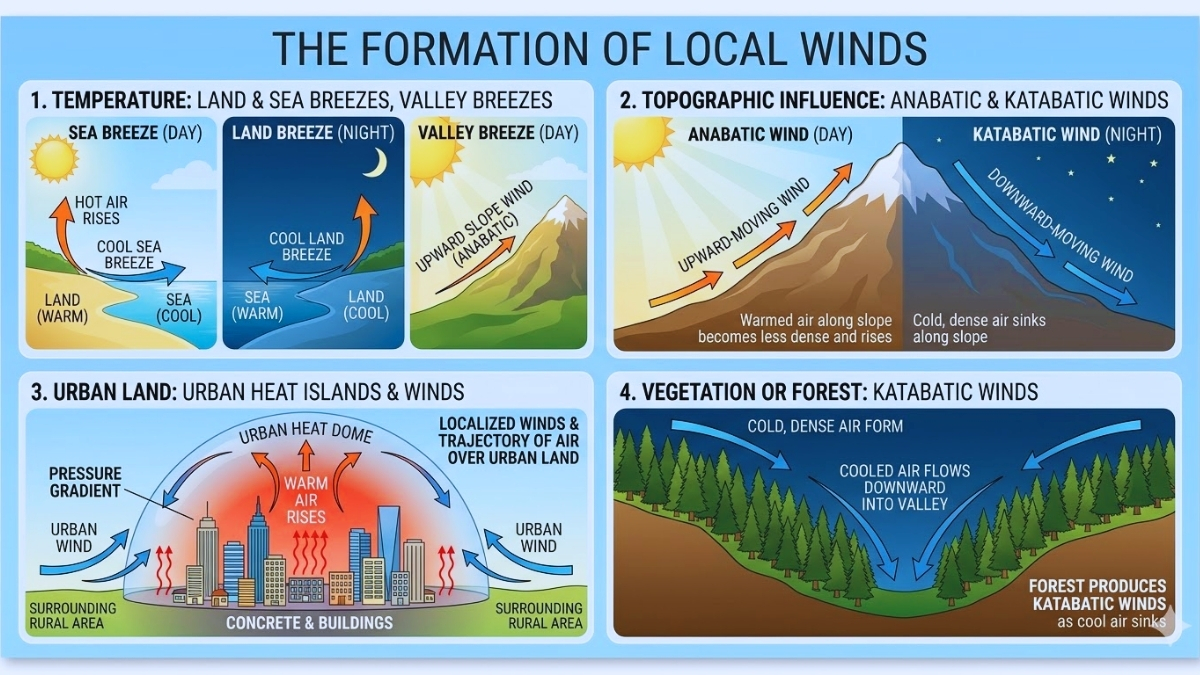
Local winds are primarily formed by differences between the temperature and pressure, geographical features, and environmental conditions such as vegetation, forest and urban areas. Their winds are not widespread like tradewinds, they are found in specific regions. However the factors are responsible for
-
Temperature: When temperature helps the heating of land and cools faster which leads to the formation of the sea breezes, land breezes and in the hilly areas valley breezes are found.
-
Topographic Influence: Slope and elevation of the hills and land cause the formation of the Anabatic winds(upward moving) and katabatic winds (downward-moving).
-
Urban land: Urban concrete formation creates the heat islands where hot air rises from buildings and trapped over the surroundings which creates a pressure and leads to the formation of localised winds or Urban Heat dome or Urban Heat Land.
-
Vegetation or Forest: Forest or dense vegetation can also produce katabatic winds as cooled air flows downward into the valley.
List of Local Winds in India
From the dusty plains of the North to the lush plantations of the South, here are the most significant local winds in India:
1. Loo (The Scorching Summer Wind):
-
Region: Indo-Gangetic Plain, North and West India.
-
Characteristics: Hot, dry, and dusty.
-
Impact: The Loo blows during May and June. Temperatures can soar between 45°C to 50°C, often leading to heatstrokes. It is a classic "heat wave" wind that dries up vegetation and makes outdoor activity dangerous during the afternoon of summer in North India.
2. Mango Showers (The Pre-Monsoon Catalyst):
-
Region: Kerala, Karnataka, and parts of Tamil Nadu.
-
Characteristics: Light rainfall accompanied by thunderstorms.
-
Impact: Occurring towards the end of summer, these winds are a blessing for farmers and help in the early ripening of mangoes in south India.
3. Kalbaisakhi (Nor'westers):
-
Region: West Bengal, Odisha and Assam.
-
Characteristics: Violent thunderstorms and heavy rain.
-
Impact: Kalbaisakhi is Known as "Calamity of the Month of Baisakh," these winds originate over the Chota Nagpur Plateau while they can be destructive to infrastructure but they are vital for jute, tea and rice cultivation in the eastern region.
4. Blossom Showers (Coffee Showers):
-
Region: Kerala and Karnataka.
-
Characteristics: Pre-monsoon rainfall.
-
Impact: These winds are critical for the coffee industry. The rain bring by winds help in the bloom of coffee flowers.
5. Bardoli Chheerha:
-
Region: Assam.
-
Characteristics: Strong winds and heavy rainfall.
-
Impact: Bardoli Chheerha are similar to Kalbaisakhi. These winds mark the transition into the monsoon season, important for the tea gardens of Assam.
6. Elephant Winds (Elephanta):
-
Region: Malabar Coast (Kerala/Karnataka).
-
Characteristics: Moist, southerly winds.
-
Impact: These usually occur at the end of the monsoon season, helping to provide the final burst of moisture needed for the Kharif crops.
Table: List of Local Winds in India
| Wind Name | Region Affected | Nature | Economic Impact |
| Loo | North India | Hot & Dry | Causes heatwaves |
| Mango Showers | South India | Moist/Rainy | Ripens mangoes |
| Kalbaisakhi | East India | Violent Storms | Good for Jute & Rice |
| Blossom Showers | Karnataka/Kerala | Light Rain | Coffee flowering |
| Bardoli Chheerha | Assam | Thunderstorms | Benefits Tea crops |
Local winds act as climate regulators as per geographical and agricultural standpoint while a wind like the Loo poses a health risk, the Mango Showers provide the economic backbone for thousands of farmers by nderstanding patterns of local winds to understand the livelihood and weather phenomena of Indian subcontinent

Manisha Waldia is a distinguished content strategist with 5 years of experience crafting premium educational content for UPSC and State PCS, with a focus on deep conceptual analysis across Polity, Geography, History, and Environment. She currently brings this expertise to Jagran Josh, where she covers major national and international events, current affairs, and static general knowledge. Over her career, Manisha's specialized insights have led her to curate high-impact materials and serve as a UPSC Mains answer-evaluator for India’s top institutes—including Drishti IAS, Shubhra Ranjan IAS, Study IQ, GS Score, and PWonlyIAS. She has also worked alongside leading NGOs like Oxfam India and Avani Kumaon.
Contact: manisha.waldia@jagrannewmedia.com