Which Planet has the Longest Day in the Solar System? Check List
Which planet has the longest day in our solar system? While Earth completes a rotation in 24 hours, celestial giants like Venus and Mercury defy our terrestrial clocks. Scientific data from NASA confirms that one single day on Venus actually outlasts its entire year, creating a bizarre cosmic calendar.

Key Points
- A sidereal day on Venus lasts approximately 243 Earth days.
- Venus rotates backwards, causing the Sun to rise in the West.
- Venus's day length varies by 20 minutes due to its dense atmosphere.
We often use the Earth's 24-hour rhythm to keep track of time, but time changes and bends as we move through space. There are eight planets in the solar system, and they all move in a delicate cosmic dance around the Sun to mark their years and spin on their axes to mark the cycle of a day. But these movements are not all the same.
Some worlds spin so fast that they make you dizzy, while others spin slowly in a way that makes you feel like you're in a trance. One planet in this celestial race moves so slowly that its day lasts longer than its year. So, which planet in the solar system has the longest day, and how does it go against the logic of our clocks?
Which Planet has the Longest Day?
Venus takes the longest time in the whole solar system to complete one rotation on its own axis; it has the longest day. It is the only planet that rotates backwards, with an exceptionally slow speed.
On Venus, a sidereal day takes about 243 Earth days. However, because the planet rotates in the opposite direction to its orbit (retrograde rotation), a solar day, the cycle of light and dark, takes approximately 117 Earth days. Regardless of the metric used, Venus remains the planet with the longest day.
According to NASA Space Place, this extreme rotation is likely due to the planet's incredibly dense atmosphere, which is 93 times heavier than Earth's, creating significant atmospheric tides that hamper its spin.
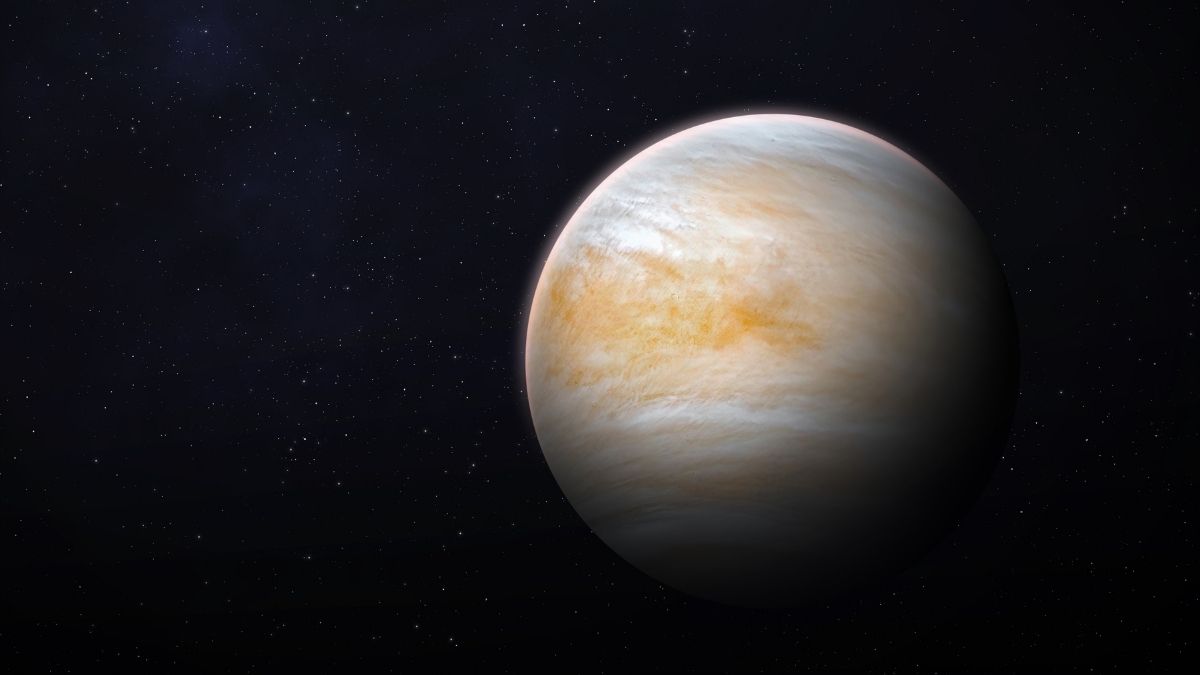
Venus - Plant with the Longest Day
How Long is a Day in Venus
Venus takes 225 Earth days to go around the Sun once. This gives you an idea of how long a day on Venus is. This means that a single sidereal day on Venus (243 days) is longer than the whole year! If you were standing on its scorching surface, you would see the Sun rise in the West and set in the East roughly every 117 days.
According to recent studies led by UCLA, this rotation isn't even constant; the heavy atmosphere sloshes against the surface, causing the length of a day to vary by about 20 minutes over time. This makes Venus one of the most unpredictable and sluggish rotators in our local space.
Also Read - List of 9 Incredible Animals that can Survive in Space: Revealed
How Long is One Day on Other Plants
While Venus takes its time, other planets in our solar system are in a massive hurry. The gas giants, in particular, spin at breakneck speeds despite their enormous size. Below is a comparative look at the length of a day (sidereal rotation) across the solar system:
| Planet | Length of Day (Earth Time) | Primary Characteristic |
| Mercury | 59 Days | Second-longest day; 176 days for a solar cycle. |
| Earth | 24 Hours | The standard for our biological clocks. |
| Mars | 24.6 Hours | Most similar to Earth; known as a Sol. |
| Jupiter | 9.9 Hours | The fastest rotator in the solar system. |
| Saturn | 10.7 Hours | Rapid spin causes a noticeable polar flattening. |
| Uranus | 17.2 Hours | Rotates on its side with retrograde motion. |
| Neptune | 16.1 Hours | Completes a spin in roughly two-thirds of an Earth day. |
Source: NASA Solar System Exploration / Exploratorium
Check Out - What is a Group of Ladybugs Called?
Knowing which planet has the longest day shows how beautiful and chaotic space is. The solar system shows that time is really in the eye of the beholder. For example, Jupiter has 10-hour sprints that go by in a flash, while Venus has afternoons that last for months. Venus is still the king of the long game, showing that in space, the slowest racer can tell the most interesting story.

Harshita Singh is an education and general knowledge journalist with over 5 years of experience in educational writing. Specializing in US affairs and GK, Harshita has a track record of breaking down intricate geopolitical and historical subjects into clear, digestible insights for learners. Her strong background in text analysis, coupled with a Bachelor of Arts (Hons) in English from the University of Delhi, helps her produce authoritative, thoroughly researched content that empowers readers to engage confidently with global current affairs. For inquiries or academic insights, you can reach out to her directly at harshita.singh@jagrannewmedia.com.