RSSB Computer Instructor Syllabus 2026: Check Latest Exam Pattern & Download Subject Wise Topic PDF
The RSSB Computer Instructor Syllabus 2026 includes topics from General Knowledge, Reasoning, Mathematics and Computer. Candidates preparing for the examination should check the latest syllabus and exam pattern given in this article to maximize their chances of selection.

Key Points
- RSSB announces 3951 vacancies for Basic & Senior Computer Instructor posts.
- The Computer Instructor exam is scheduled for August 22 and 23, 2026.
- Candidates must follow the latest syllabus and exam pattern for selection.
The Rajasthan Staff Selection Board commonly known as RSSB, conducts the examination for 2 posts, mainly the basic and senior computer instructor posts. This year a total of 3951 vacancies are available, which provide a chance for aspirants to secure a permanent state government job. The exam is set to be conducted on August 22 and 23, 2026. Candidates who will appear in the exam must follow the latest syllabus, exam pattern, and marking scheme to have a better chance of selection. Understanding of the examination components helps to focus on important topics and formulate an effective strategy. The computer instructor syllabus consists of important topics for the exam, which helps to prepare in a more focused and effective manner.
The RSSB Computer Instructor Syllabus 2026 is divided into different subjects. For Paper 1 there are topics like Art & Culture, History, Geography, General Science, and Current Affairs of Rajasthan. Paper 2 tests knowledge of computer subjects. Understanding of the syllabus is crucial to focus on a topic that is important from the exam perspective. In this article, we will be providing the latest syllabus and exam pattern released by the RSSB. Additionally, you can also download this in PDF format.
RSSB Computer Instructor Syllabus 2026
RSSB had earlier released the official notification, detailed syllabus, and examination pattern for the computer instructor posts on its official website at rssb.rajasthan.gov.in. Candidates who will be appearing in the exam should first understand the syllabus, as it is very important from an exam point of view. Regular practice and preparation will help to prepare better and formulate an effective study strategy. You can also check and download the syllabus PDF from the table given below.
| RSSB Computer Instructor Syllabus 2026 PDF |
RSSB Computer Instructor Exam Pattern 2026
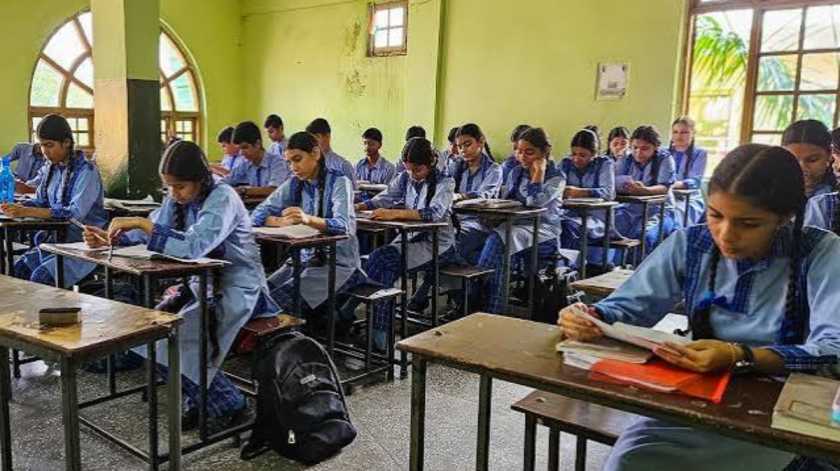
The RSSB Computer Instructor exam 2026 will be held in offline, pen-and-paper mode. There will be 2 papers. Papers 1 and 2 have a total of 100 questions for 100 marks. The total time given to complete the exam is 2 hours. The test will be conducted in an objective type mode (MCQ) based where every question carries one mark. There will be a negative marking of 0.33 marks in case you give a wrong attempt.
| Paper | Subject | Number of Question | Marks |
| Paper 1 | General Knowledge & Reasoning, Maths | 100 | 100 |
| Paper 2 | Computer & Mental Ability | 100 | 100 |
| Total | 100 | 100 |
RSSB Computer Instructor Subject-Wise Syllabus
The subject and topic wise syllabus for the RSSB Computer Instructor has been provided in this article. Candidates are advised to check the topics carefully to understand the syllabus better. Check the table below to know the detailed syllabus for Paper 1 and 2.
| Paper | Subject | Topics |
| Paper 1 | General Knowledge | Art & Culture, History, Geography, General Science and Current Affairs of Rajasthan |
| General Ability | Logical Reasoning and Analytical Ability, Decision Making and Problem Solving. General Mental Ability. . Basic Numeracy - Numbers and their relations, orders of magnitude, etc. (Class X level) Data Interpretation - Charts, Graphs, Tables, Data Sufficiency, etc. | |
| Paper 2 | Computer Subject | |
| Fundamentals of Computer | Number system, arithmetic operations, introduction to various categories of computer language, functional details of Input and Output devices | |
| Programming Fundamentals | C, C++, Java, DotNet, Artificial Intelligence (AI), Machine learning, Python and Block Chain, programming, data types (Built in and user defined), Scope of variables, precedence of operators, control flow, functions, arrays pointers, structures and unions, enumerated data-types and file handling, command line arguments | |
| Programming using C++ and JAVA | Objects and classes. Inheritance, polymorphism, event and exceptions handling, files and streams | |
| Data structures and Algorithms | Abstract data types, Arrays as data structures, linked list v/s array for storage, stack and stack operations, queues, binary trees, binary search trees, graphs and their representations, sorting and searching, symbol table | |
| Digital Logic Systems | Boolean expressions, K-maps, TTL and CMOS logic families, combinational logic design using half/full adders, Sub tractors, and multiplexer, synchronous sequential system design | |
| Computer Organization and Architecture | Von-Neumann architecture of computers. Registers and micro operations, control logic, processor addressing and bus organization. Processor input/output and DMA. Memory organization and cache coherence | |
| Operating Systems | CPU scheduling, Deadlocks, Memory management, file systems, disk scheduling. Concept of Client server architecture in distributed environment and RPC. Process, threads and their synchronization. | |
| Database Management System | E-R models, Relational algebra, calculus and databases, Integrity constraints, triggers, normalization, and indexing. Transaction processing, concurrency control and Relational Database Management System (RDBMS). | |
| Software Engineering | Phases of System Development Life Cycle. System modeling. Software requirement specifications and DFDs. Introduction to software testing, software project management. | |
| Data and computer networks | Evolution of Networking, Data Communication terminologies, Transmission media, Network devices. TCP/IP & OSI/ISO reference models, functions of different layers, characteristics of physical media, multiplexing in physical layer, medium access protocols, introduction to 802.3, 802.4, 802.5, 802.11 LAN technologies, IP protocol including routing and congestion control, TCP and UDP, DNS. | |
| Network Security | Groups, rings and fields in finite space, Euler and Fermat's theorem, primality testing, security services and mechanisms, symmetric and asymmetric encryption including DES, AES, IDEA, RSA algorithms, key management in symmetric and asymmetric encryption, message, authentication and hashing, email security, viruses and trusted systems, Networking (LAN&WAN), Security, Ethical Hacking | |
| Basics of communication | Channel capacity, attenuation, communication impairments, propagation of EM waves through free space (excluding free space models). PCM and delta modulation, WDM, brief introduction to GSM and CDMA based communication systems. | |
| Web Development | HTML/DHTML, Web Page Authoring Using HTML, Document Object Model Concept and Importance of Document Object Model, Dynamic HTML document and Document Object Model. Introduction to Cascading Style Sheet (CSS), Extensible Markup Language (XML), Basic of PHP and Java Script |
Candidates must start their preparation using the official syllabus and exam pattern provided below. Download the syllabus and start with a study plan according to your strengths and weaknesses.
Deepanshu Upadhayaya is an education journalist with expertise in covering recruitment examinations, government job notifications, and UPSC success stories. Over the course of his career, he has worked with leading media organizations such as Times Network Digital and is currently associated with Jagran New Media, where he covers competitive examinations, recruitment drives, admit cards, results, and exam preparation-related content. A graduate of Motilal Nehru College, University of Delhi, Deepanshu brings a strong understanding of the education sector, through his accurate, timely, and reader-friendly approach. He also holds Master's degrees in Economics and Mass Communication. Apart from covering education news, Deepanshu enjoys singing, playing cricket, and reading books. He can be reached at deepanshu.upadhayaya@jagrannewmedia.com.