NEET PG 2026: Aspirants Eye Answer Key, Response Sheet As They Allege Score Discrepancies


NEET PG 2026 aspirants have raised concerns over alleged discrepancies in their scores and sought clarity on the evaluation process. Candidates have urged the release of the answer key, individual response sheets and question papers, alleging differences of up to 100 marks in their results.
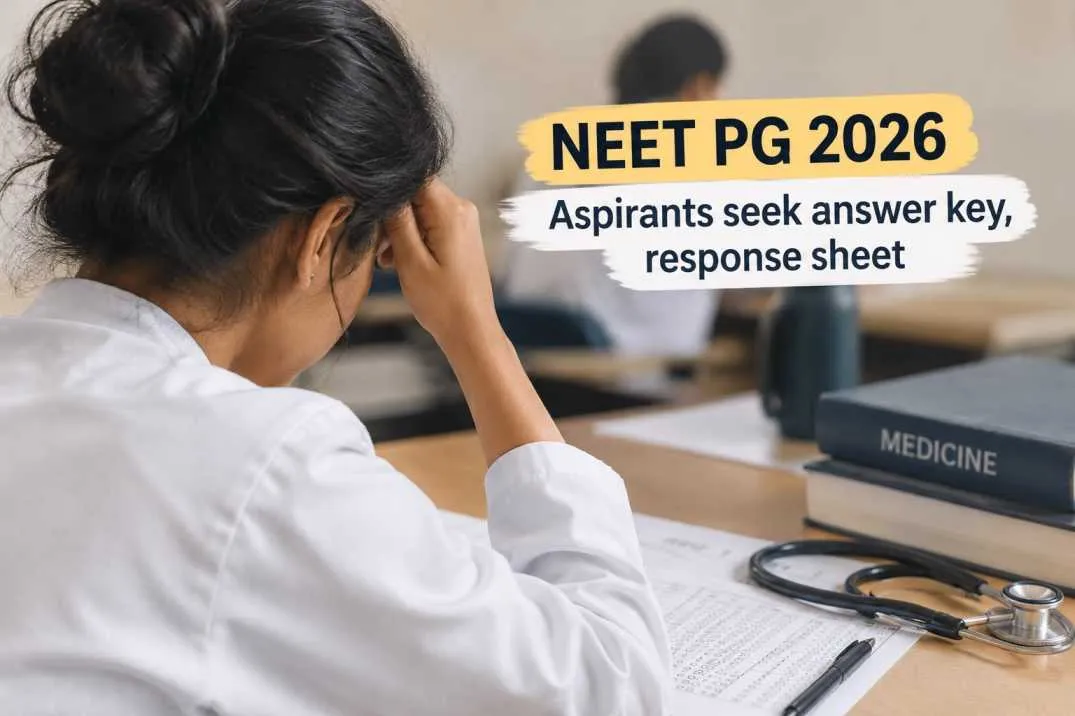
Medical aspirants have alleged discrepancies in their NEET PG 2026 results and sought clarity on the evaluation process used to award marks. Students have called for the urgent release of the answer key, individual response sheets and question papers, which are scheduled to be released on or after October 1.
These documents will help candidates calculate their expected scores independently by allowing them to review their recorded responses, compare them with the correct answers and understand the basis of their scores.
By calculating their expected scores, students will be able to identify and report any discrepancies to the competent authority, if required. The scorecards are also scheduled to be made available from October 1.
What Discrepancies Have Students Alleged?
Students who appeared for the NEET PG 2026 examination on August 30 and September 5 have alleged a “20 questions (80-100) marks difference in result score,” which could lead to a loss of around 8,000 to 9,000 ranks. Aspirants have sought the release of individual response sheets containing the questions and their correct answers.
One of the major concerns raised by students is that they may not be able to accurately calculate their scores even if the answer key is released. Candidates would likely require a comprehensive and readable master question paper booklet to enable independent cross-verification, as the absence of such a document could make the process tedious and prone to errors.
The All India Medical Students Association (AIMSA) said several NEET PG aspirants approached the organisation and expressed concerns over the marks obtained in the results, while seeking clarity on the evaluation process.
The medical student body wrote to Union Health Minister JP Nadda, requesting his intervention for the immediate release of the official NEET PG 2026 question paper, official answer key and recorded responses of candidates who appeared for the examination.
The Indian Medical Association Medical Student Network (IMA MSN), Madhya Pradesh, also wrote to the Union Minister and raised concerns over “discrepancies and inconsistencies perceived in the examination results.”
How Do Students Calculate Expected Marks Using Answer Key, Response Sheet?
To calculate their expected scores using the answer key and response sheet, candidates can count the number of correct and incorrect responses and apply the NEET PG marking scheme.
For instance, if a candidate has 140 correct answers and 20 incorrect answers, while leaving the remaining 20 questions unattempted, the expected score would be (140 × 4) - (20 × 1) = 540.
Under the marking scheme, candidates receive four marks for every correct answer, lose one mark for every incorrect answer and receive zero marks for unattempted questions.
NEET PG 2026 Cut-Off Lowest In Years
The NEET PG 2026 qualifying cut-off has been reported as the lowest in the last six years. For General/EWS candidates, the cut-off was 262 marks. The qualifying cut-off for General-PwBD and SC/ST/OBC, including PwBD candidates, was 244 and 226 marks, respectively, for the NEET PG 2026 examination.
| Year | General/EWS | General-PwBD | SC/ST/OBC, including PwBD |
| 2021 | 302 | 283 | 265 |
| 2022 | 275 | 260 | 245 |
| 2023 | 291 | 274 | 257 |
| 2024 | 50th percentile | 45th percentile | 40th percentile |
| 2025 | 276 | 255 | 235 |
| 2026 | 262 | 244 | 226 |
Sahil Behl is an education journalist at Jagran with over a year of experience in journalism. Prior to joining Jagran, he worked as a Sub-Editor in NDTV’s Education department, where he was responsible for writing and editing education-related content as well as managing the department’s social media presence. At Jagran, he covers a wide range of education topics, including board examinations, school updates, admissions, and job notifications, while leveraging his editorial expertise and strong understanding of digital content strategy. Sahil holds a Bachelor’s degree in Business Administration and has also completed an eight-month certification program in Data Science. Passionate about emerging technologies, particularly artificial intelligence, he closely tracks their growing role in journalism and explores how they are transforming shaping the future of the media industry.


