How Does RBI Manage the Rupee-Dollar Exchange Rate? Key Tools Explained
The RBI plays a crucial role in managing Rupee volatility. Learn how forex intervention, interest rates, capital flows, and monetary policy help stabilise the Rupee-Dollar exchange rate.
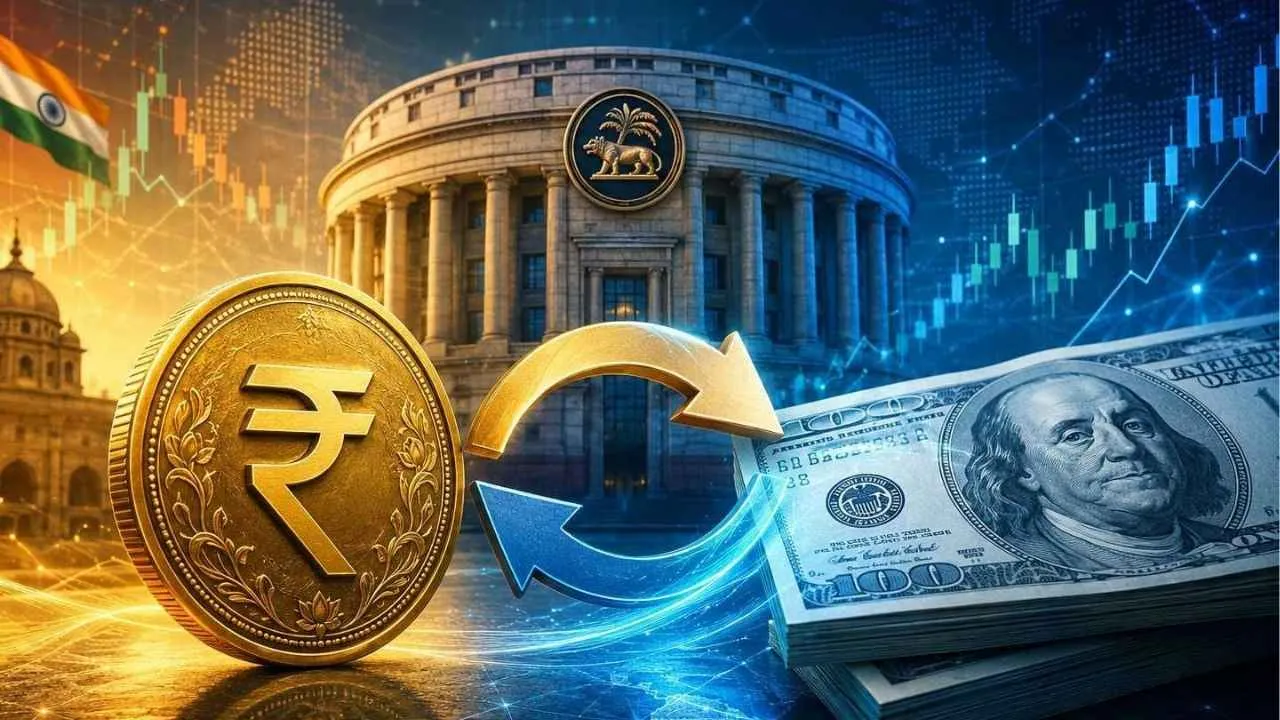
The value of money is extremely volatile, reacting to so many things happening in the economy. The Indian Rupee recently has been the highlight of the nation. The Rupee broke its falling trend, took the front seat, and stood stronger against the Dollar. According to many financial experts, this is basically a good move.
While behind all this is the saviour, the Reserve Bank of India (RBI). Although the value of the Indian Rupee is not solely decided by the RBI alone, many factors are in direct effect on the economic conditions in the nation. Countries like ours follow a basic managed float exchange rate system. The managed float exchange rate system might sound new to you, but it is the term used where market forces determine the value of the currency.
These market forces are demand and supply, foreign investments (FIIs), global crude oil prices, geopolitical conflicts, and diplomatic moves.
How Does The RBI Manage The Rupee-Dollar Exchange Rates?
The Reserve Bank of India plays the most crucial role in the Indian economic ecosystem. The RBI keeps a sharp watch over the monetary flow inside and outside the nation. RBI, as an institution, stands between all the odds. We can call the RBI the wall that holds back and controls the money that reaches you.
So now, if the Rupee falls or vice versa, the RBI looks into it and finds a solution to the problem. The RBI has and possesses a lot of power over many tools that help the institution stabilise the Rupee and maintain the sanity of the economy.
What the RBI basically does is that it can sell or buy Dollars, manage liquidity, use forex swaps, change and regulate interest rates, and control or manage foreign capital flows. The main focus of the RBI is not to pick one fixed Dollar-Rupee rate, but to stabilise other economic factors that will eventually support the currency and economy. These tactics and moves make the process smoother and do not create panic or sudden inflation threats for the nation.
How Does the Rupee-Dollar Comparison Work?
While we are talking about exchange rates, the meaning is very simple. The exchange rate is a basic barter system technique. It is a term used to address how many Indian Rupees do we need to buy one US Dollar. The standard exchange rate is compared to the Dollar because the Dollar is the central currency globally.
Right now, 1 US Dollar is equal to Rs 94.49. So, any Indian has to give 94.49 Rupees to buy one US Dollar.
The rule is: if the Indian Rupee increases, it has weakened. Why? Because we now have to give more Indian currency to buy a Dollar.
Good news would be if the Dollar falls to Rs 80. Why? Because now we have to give less money to buy one Dollar. That is a strong Indian Rupee, stable economy, and low inflation.
| Currency Metric | Value / Impact |
| 1 US Dollar (USD) | Rs 94.49 |
| Indian Rupee needed to buy $1 | Rs 94.49 |
| If the exchange rate rises | Rupee weakens (USD grows stronger) |
| If the exchange rate falls | Rupee strengthens (USD grows weaker) |
Key Ways The RBI Manages The Rupee-Dollar Exchange Rate
Direct Forex Intervention: The Reserve Bank of India recently took a major step in stabilising the economy and the Indian Rupee. That was only possible because the RBI has the power to buy and sell US Dollars in the spot and forward markets. The process is: the RBI sells from its forex reserves when the Rupee falls unexpectedly. The basic rule says: it sells when the Rupee falls and buys when the Rupee rises too quickly.
Forex Swap And Forward Contract: The RBI can buy or sell and vice versa to manage Dollar availability in its forex reserves. The institute can do this without permanently changing forex reserves.
Interest Rates and Monetary Policy: The biggest power the Reserve Bank of India has is that it can influence interest rates. The Monetary Policy Committee takes the most crucial decisions; they plan the flow and decide the repo rate. What happens after it is, higher interest rates can attract FIIs into Indian assets. This increases the demand for the Indian currency, Rupee. The RBI also watches the interest rate gap between India and the US.
Special Dollar Arrangements: During periods of heavy Dollar demand, especially from oil companies, special arrangements can reduce sudden pressure on the open currency market.
Verbal Intervention and Market Monitoring: It is not just paperwork. Even if the RBI gives a statement, it matters. RBI statements can calm investors and discourage speculation. The central bank also monitors banks and traders to prevent excessive speculative positions.
Capital Flow Regulations: The RBI and government regulate foreign investments, External Commercial Borrowings (ECBs), NRI deposits, and other cross-border money flows to manage the supply and demand for foreign currency.
Why Should Economics Students Know This?
According to me, Understanding Indian Rupee movement is a basic chapter any economics student should learn. It is because, with just currency movement, the learner can follow and connect how currency affects petrol prices, inflation, imports, exports, foreign investment, and India's economy. Why the RBI is important is because its actions explain how the country is using its money and how monetary policy and global events influence everyday prices. Doing a deep analysis of the dips and rise of the Rupee and the RBI’s role in it will help you answer complex questions. The first step to start learning economics should be to start with currency and who manages it.
Disclaimer: This article is for educational and informational purposes only. It should not be considered financial, investment, trading, or professional advice. Always conduct independent research before making financial decisions.

Aishwarya Samant is a journalist with over 4 years of experience navigating the fast-paced corporate media landscape. She specializes in decoding business news, world economy, personal finance, and stock market trends, often adding a subtle touch of political perspective to keep things interesting.
Having worked with reputed organizations like ZEE, TV9, News24, and NewsX, she is no stranger to the newsroom hustle and the demands of real-time storytelling. Her writing style is fast-paced, engaging, and crafted to connect seamlessly with diverse audiences across platforms. She approaches every story from the reader’s point of view, breaking down complex topics into clear, relatable narratives backed by solid facts and credible sources. While she’s confident in expressing strong viewpoints, she ensures balance with insights. Sharp, fact-driven content that informs, engages, and keeps readers coming back for more.