India-Russia Rail Link: Proposed Route, Connectivity, and Impact on Trade Explained
Explore Russia's proposed direct rail link to India via Central and South Asia. Learn about the proposed overland route, strategic goals, and potential impact on bilateral trade.
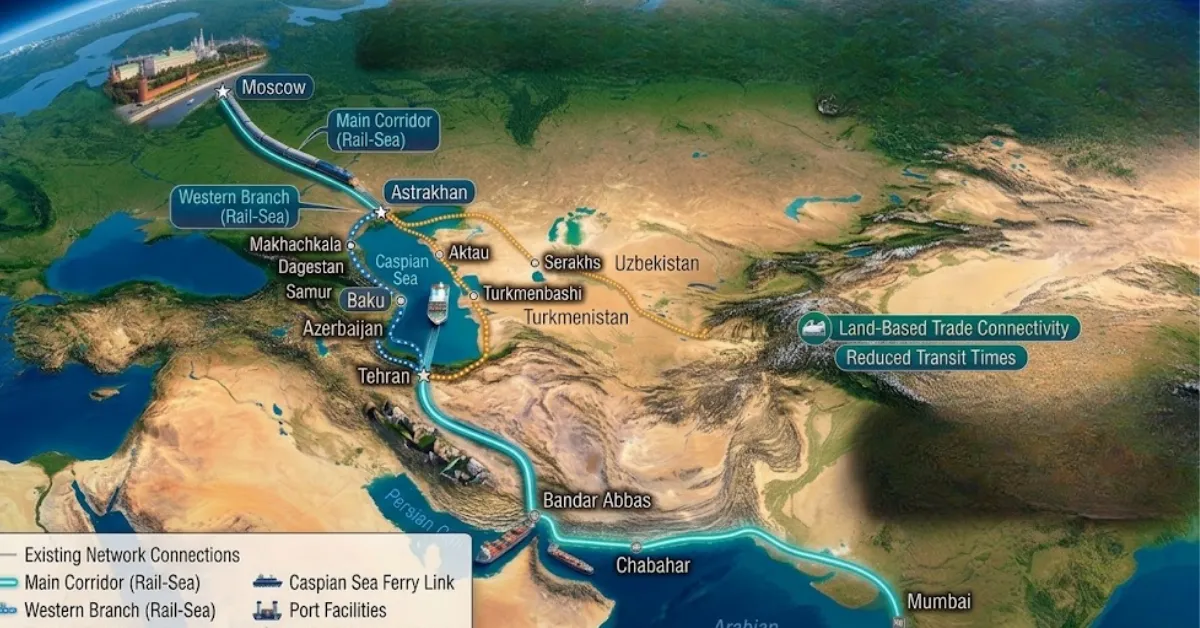
Moscow has proposed to establish a direct overland rail link to connect Russia to the Indian Ocean and India. It's a step towards establishing a land link between Russia and India. This plan aims to avoid sea bottlenecks and secure a continuous cargo transport corridor.
Considering contemporary challenges in the sphere of global supply chains from the perspective of security and increased tensions on a political level between the countries. It was decided to implement this project, integrating numerous states in Central and Southern Asia into a single economic framework for the sake of economic unity.
Objective of the India-Russia Railway Link
The fundamental goals for the establishment of this transcontinental railway corridor are as mentioned below.
-
Reducing Maritime Vulnerability: To create a safe and stable land route that will completely avoid high-risk geopolitical chokepoints like the Strait of Hormuz and the Bosphorus Strait.
-
Assuring Uninterrupted Supply Chains: To ensure the reliable shipments of commercial and industrial commodities including energy items, industrial goods and fertilizers despite conflicts in regions, military blockades or maritime sanctions.
-
Increasing Eurasian and South Asian Cooperation: To establish a commercial corridor connecting landlocked Central Asian countries and Russia with the growing consumer and productive market of South Asia.
-
Improving Transit Efficiency: To improve the logistics time of the transportation process as compared to the regular sea routes.
Main feature of the Corridor
-
Overland Line which crosses several countries: According to the plan, the railway line will run through Turkmenistan, Iran, Afghanistan and Pakistan.
-
Focus on Cargo Transportation: The main idea behind project is to construct a railway system for carrying cargo rather than for transporting passengers.
-
Change in Logistic Approach: The project represents a change in the approach of Russia and neighboring countries to logistics from dependency on sea corridors designed with the help of western technologies to the establishment of railway corridors in the land.
-
Development Stage: The project is still at the planning stage when many issues must be solved, for instance, the formulation of the principles for collaboration between different states, the determination of technical specifications of the railway gauge, and the finding of funds necessary for the construction of the infrastructure.
Route and Connectivity on Proposal
The Russian leadership has defined various possible land routes even though the plan is now in the research and feasibility phase.
-
Route of the Corridor: It can pass through Turkmenistan, Iran, Afghanistan, and Pakistan to reach the ports on the Indian Ocean, where the cargo can be sent to India.
-
Minimization of the risks associated with navigation: The purpose of this route routes are the Strait of Hormuz (crucial for oil and LNG transportation worldwide) and the Bosphorus Strait. The conflicts in West Asia and different blockades have made it evident that the sea routes cannot guarantee safe transportation.
-
Development of the Routes Existing Today: The newly proposed system helps implement the idea of the multi-modal transportation projects already proposed such as the International North-South Transport Corridor (INSTC), where many countries, including Russia, India, Iran and others intend to work together.
Challenges ahead
Should the long-term prospect materialize, the establishment of a direct route through rail link is likely to cause drastic changes in trade activity between South Asia and Eurasia.
-
Reduced constraints on freight transport: With routes avoiding classic maritime pathways, freight shipments will be less exposed to blockades by maritime fleets, international political issues, and more deliveries depending on weather conditions.
-
Speeded-Up time of arrival: Railroads mean a significant reduction of transport duration for certain types of products including industrial items, fertilizers, and energy parts.
-
Increased integration of economies: Introduction of the route will let landlocked markets of Central Asia enter the lucrative economy of South Asia, whereby India will be in a better position to access important resources and trade with Russia.

Manisha Waldia is a distinguished content strategist with 5 years of experience crafting premium educational content for UPSC and State PCS, with a focus on deep conceptual analysis across Polity, Geography, History, and Environment. She currently brings this expertise to Jagran Josh, where she covers major national and international events, current affairs, and static general knowledge. Over her career, Manisha's specialized insights have led her to curate high-impact materials and serve as a UPSC Mains answer-evaluator for India’s top institutes—including Drishti IAS, Shubhra Ranjan IAS, Study IQ, GS Score, and PWonlyIAS. She has also worked alongside leading NGOs like Oxfam India and Avani Kumaon.
Contact: manisha.waldia@jagrannewmedia.com