From Purna Swaraj to the Constitution of India: Journey of India as a Republic
From the historic call of Purna Swaraj in 1930 to the adoption of the Constitution in 1950, India’s journey as a Republic reflects democratic ideals, constitutional values, national unity, and the transformation of freedom into accountable self-governance. Explore more in detail about the Journey of India as a Republic from this article.

The Republic Day is one of the most historical events in India’s democratic celebration. It is celebrated every year annually on 26 January; it is the day on which the Constitution of India took effect in 1950, making the nation a Sovereign Democratic Republic.
While on 15 August 1947 colonial rule was over, the process of real self-governance only started when India replaced the British Constitution, that is, with the sovereignty in the hands of the people and governance was made through law, institutions and democratic accountability.
Let’s explore in detail, from Purna Swaraj to the Constitution of India, the journey of India as a Republic.
Why is Republic Day Important in India’s Democratic Journey?
Republic Day is the day that marks the end of the transition that India passed through, a struggle for freedom into a constitutional democracy.
From the Indian Constitution:
-
It established the Rule of Law
-
Guaranteed Fundamental Rights
-
Defined the Duties of Citizens
-
It also created independent constitutional institutions
-
It also ensured social justice, equality, and liberty
It transformed political liberty into a functioning democratic regime.
How is Republic Day Celebrated across India?
Republic Day is observed as a nationwide civic celebration to introduce constitutional values in the lives of the people.
There are many features of Republic Day celebrations, which include:
-
Flag hoisting ceremonies in all states and districts across India
-
Institutional and cultural programmes in schools.
-
Armed force parades and school children parades.
-
The involvement of people both in the country and the town.
The Republic Day Parade in Kartavya Path, New Delhi, is the main event of the celebrations, which embodies the union of India, its diversity and democratic power.
What is the significance of the Republic Day Parade?
The Republic Day Parade presents a coordinated display of:
-
Military discipline
-
Cultural heritage
-
Regional diversity
-
Institutional continuity
Highlights of the parade include:
-
Gathering columns of the Army, Navy, and Air Force.
-
States, Union Territories and Ministries Tableaux.
-
Performances concerning culture made their way into the procession.
-
Military open parades and mechanical columns.
The Republic Day Parade is a visual symbol of India being a united but diverse Republic.
What is the Theme of the 77th Republic Day?
The Theme of the 77th Republic Day is:
“150 Years of Vande Mataram”
This theme:
-
Connects the nationalism of culture with the struggle for freedom.
-
This theme also highlights the emotional and historical significance of Vande Mataram
-
It also connects India’s past sacrifices with present aspirations
The celebrations of Republic Day take pride in freedom, cultural identity, and self-reliance.
What are the major Highlights of the Republic Day Parade 2026?
Major Highlights of the Republic Day Parade 2026 will be:
-
30 tableaux by States, Union Territories, and Ministries
-
Themes:
-
Swatantrata ka Mantra – Vande Mataram
-
Samriddhi ka Mantra – Atmanirbhar Bharat
-
Participation of around 2,500 artists
-
Invitation to nearly 10,000 Special Guests, including:
-
Farmers and artisans
-
Scientists and innovators
-
Women entrepreneurs
-
Students and sportspersons
-
Frontline workers and scheme beneficiaries
The parade reflects inclusive national participation, not just ceremonial tradition.
How are Indian citizens involved in Republic Day Celebrations?
To expand the participation beyond Kartavya Path on Republic Day, the Indian Government has launched Citizen-Centric initiatives through MyGovand MY Bharat platforms.
What activities will be included for the public engagement through Citizen-Centric initiatives on Republic Day?
Public engagement activities include:
-
Essay competition on Swatantrata Ka Mantra – Vande Mataram
-
Painting competition on Samriddhi Ka Mantra – Atmanirbhar Bharat
-
Singing contests featuring Vande Mataram
-
Quizzes on:
-
History of Vande Mataram
-
India’s achievements in space and sports
-
National development initiatives
Selected participants are invited to be directly related to the events of the Republic Day, strengthening the association between the citizens and the Constitution.
Why was 26 January Chosen as Republic Day?
Now, we Indians know when is Rewpublic Day is celebrated. But why was only 26 January chosen as the Republic Day?
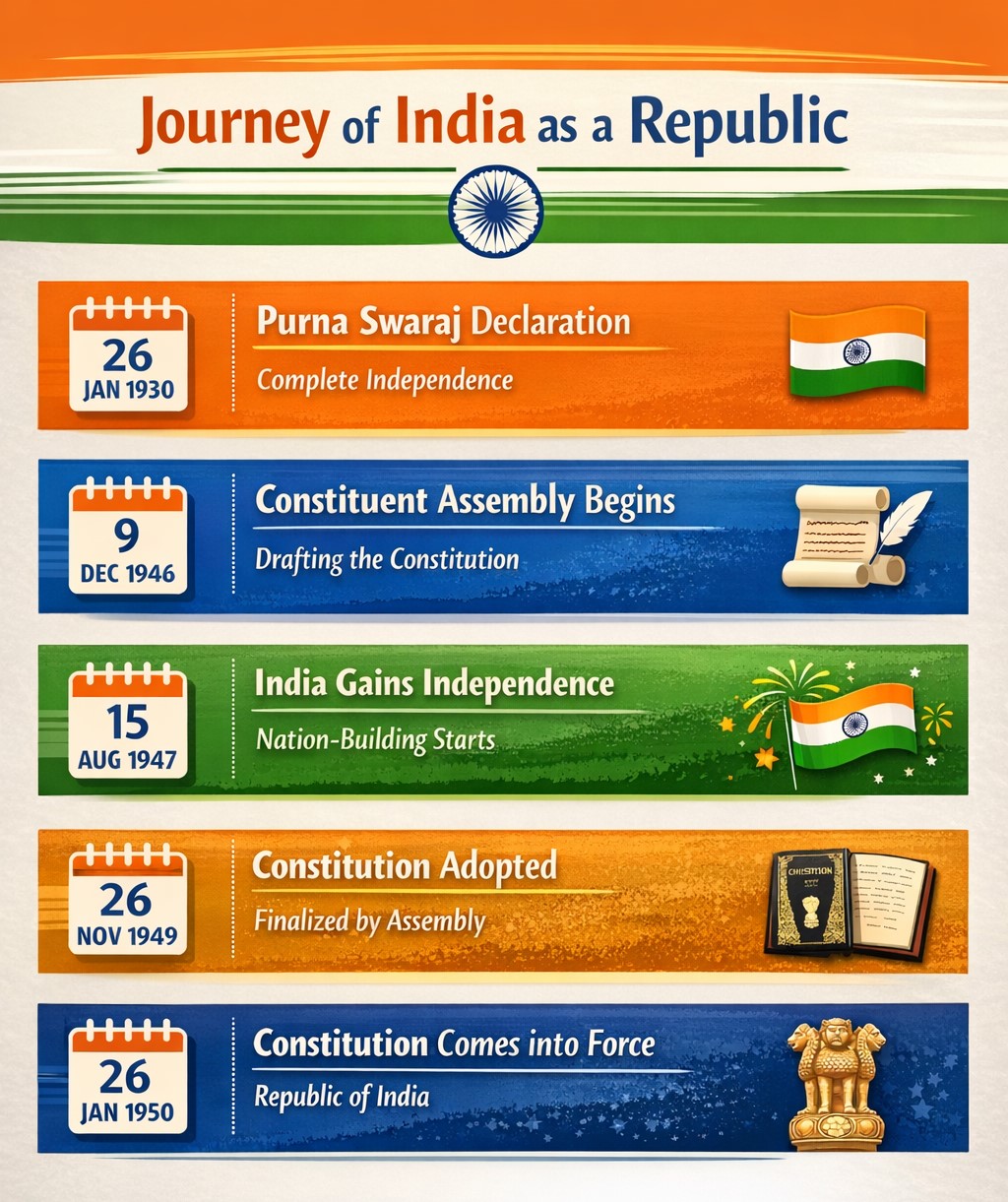
26 January was chosen as Republic Day is not by choice. Rathen then, this was the symbolic and 26 January lies in the movement of freedom of India.
It is the process of constitutional transformation of political aspiration into constitutional reality.
Let’s see why 26 January was chosen as Republic Day from the table given below:
| Date | Event | Significance |
| 26 January 1930 | Declaration of Purna Swaraj |
|
| Constituent Assembly Begins Work |
| |
| 15 August 1947 | India Gains Independence |
|
| Constitution Adopted |
| |
| 26 January 1950 | Constitution Comes into Force |
|
Data Source: PIB
The 42nd Constitutional Amendment (1976) later added the words Socialist and Secular to the Preamble.
How is Republic Day Observed Today?
Republic Day today is both a ceremonial event and a living democratic reminder.
The day begins with:
-
A solemn tribute at the National War Memorial
-
Homage to fallen soldiers by the Prime Minister
At Kartavya Path:
-
The President unfurls the National Flag
-
The National Anthem is played
-
A 21-gun salute marks the formal commencement
The celebrations conclude with:
-
Defence displays and Air Force flypast
-
Gallantry awards to military personnel and civilians
What is the Beating the Retreat Ceremony?
The Republic Day celebrations end with the ceremony of Beating the Retreat that occurs on the Republic Day on 29 January in Vijay Chowk.
This is a millennium-old military culture that symbolises:
-
Discipline and honour
-
Formal closure of celebrations
-
Respect for service and sacrifice
What does Republic Day truly represent in India?
Republic Day is more than a national holiday. It is a reminder that:
-
The Constitution is a living document
-
Democracy calls upon the active participation of every citizen of India.
-
If we have the fundamental rights, then we must ensure that all other duties are also fulfilled by us.
-
Constitutional values need to be observed and respected by each citizen of India.
Conclusion
The Journey of India as a Republic reflects India’s remarkable journey from the colonial rule of the British to Constitutional Governance.
Celebration of Republic Day in India not only glorifies the creation of the Republic, but also the ongoing responsibility of every Indian citizen and institutions to uphold the values of justice, liberty, equality and fraternity codified in the Constitution.
Prabhat Mishra is a Subject Matter Expert and digital journalist with an extensive background in the competitive exam landscape and over 4 years of experience in education, national and international news, and current affairs. Over his tenure with top knowledge platforms like Mentorship India, IAS BABA, IAS SARTHI, and now Jagran Josh, he has a deep understanding of government exams like UPSC and State PCS, including UP and Bihar, as he has already qualified for the UPPCS 2022 Mains and Bihar 68th Mains. With his core expertise in history, polity, geography & current affairs, he specialises in creating well-researched, aspirant-centric content and simplifying complex topics for competitive examinations.