Which major ports are part of the India–Middle East–Europe Economic Corridor?
The India-Middle East-Europe Economic Corridor (IMEC) is a multi-modal connectivity initiative signed during the G20 Leaders' Summit in 2023 is not merely a trade route but a modern Silk Route. In this article, we will learn which key seaports are a part of the IMEC corridor.
External Affairs Minister (EAM) S. Jaishankar, during the G7 Foreign Ministers' Meeting in France, spoke about the importance of the India-Middle East-Europe Economic Corridor (IMEC) in boosting global connectivity amid ongoing geopolitical tensions. He highlighted that the West Asia conflict reinforces the need for resilient trade routes and secure supply chains.
During his two-day visit to France for the two-day G7 Foreign Ministers' Meeting, EAM Jaishankar posted on the social media platform, X: "Shared views about IMEC at the second session of the G7 Foreign Ministers' Meeting with invited partners. The uncertainties arising from the conflicts in West Asia only make a stronger case for more resilient trade corridors and supply chains."
Shared views about IMEC at the second session of the @G7 Foreign Ministers’ Meeting with invited partners.
— Dr. S. Jaishankar (@DrSJaishankar) March 26, 2026
The uncertainties arising from the conflicts in West Asia only make a stronger case for more resilient trade corridors and supply chains.
At the same time, India’s FTAs…
What is the India-Middle East-Europe Economic Corridor?
The India-Middle East-Europe Economic Corridor (IMEC), a multi-modal connectivity initiative launched through a Memorandum of Understanding (MoU) signed on 9 September 2023 during the G20 Leaders' Summit in 2023, is not merely a trade route but a modern Silk Route. IMEC is a part of the Partnership for Global Infrastructure Investment (PGII), launched by the G7 in 2021.
Key signatories of the India-Middle East-Europe Economic Corridor include India, the United States, the United Arab Emirates (UAE), Saudi Arabia, France, Germany, Italy, and the European Union.
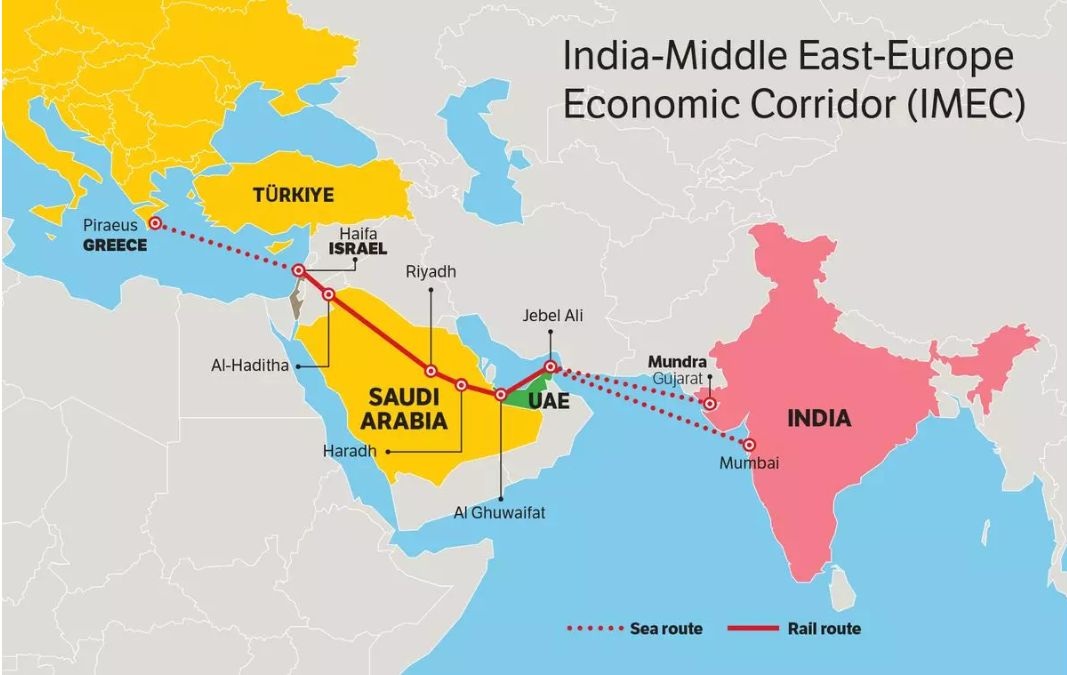
The IMEC corridor connects India to Europe through the Middle East using a network of roads, railways, maritime, and digital infrastructure. While reducing reliance on traditional trade routes, the IMEC will also aid in reducing the transit time of goods from India to Europe by 40 per cent and cost of transportation by 30 per cent. The corridor is also seen a counter to China's Belt and Road initiative.
The IMEC will comprise two separate corridors: the Eastern Corridor and the Northern Corridor. The Eastern Corridor connects India to the Arabian Gulf via sea routes while the Northern Corridor will connect the Gulf to Europe via road and rail network.
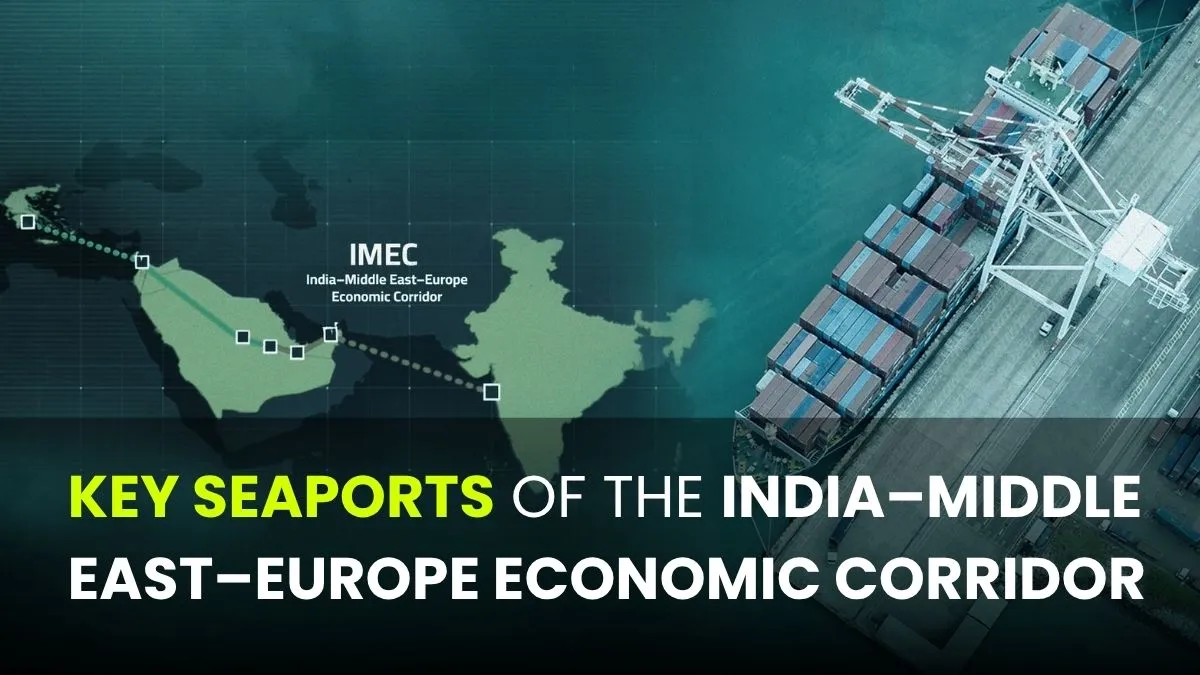
Which key ports are part of the India–Middle East–Europe Economic Corridor?
Below is the list of the major ports that are a part of the IMEC corridor, region-wise, from India, the Middle East (UAE and Saudi Arabia), Israel, and Europe (Greece, Italy, and France).
India: Mundra (Gujarat), Kandla (Gujarat), and Jawaharlal Nehru Port Trust (Navi Mumbai).
UAE: Fujairah, Jebel Ali, and Abu Dhabi
Saudi Arabia: Dammam and Ras Al Khair
Israel: Haifa
Greece: Piraeus
Italy: Messina
France: Marseille
Why is India-Middle East-Europe Economic Corridor important for India?

Roopashree Sharma is an experienced broadcast journalist with over 7 years of experience, specialising in beats including geopolitics, defence, and general awareness. She has worked in the roles of correspondent and producer for leading media houses, including Zee, WION, and Economic Times. Currently serving as Deputy Manager – Editorial at Jagran New Media, she produces explainer articles and videos for the General Knowledge (GK) section of the Jagran Josh (English) portal. For inquiries, contact her at roopashree.sharma@jagrannewmedia.com.