Who was the 1st Governor General of India?
Who was the 1st Governor General of India? Explore how Lord William Bentinck became the first official Governor-General of India after the Charter Act of 1833, and discover his transformative role in British Indian administration, social reforms, education policies, and legal restructuring that shaped modern India.
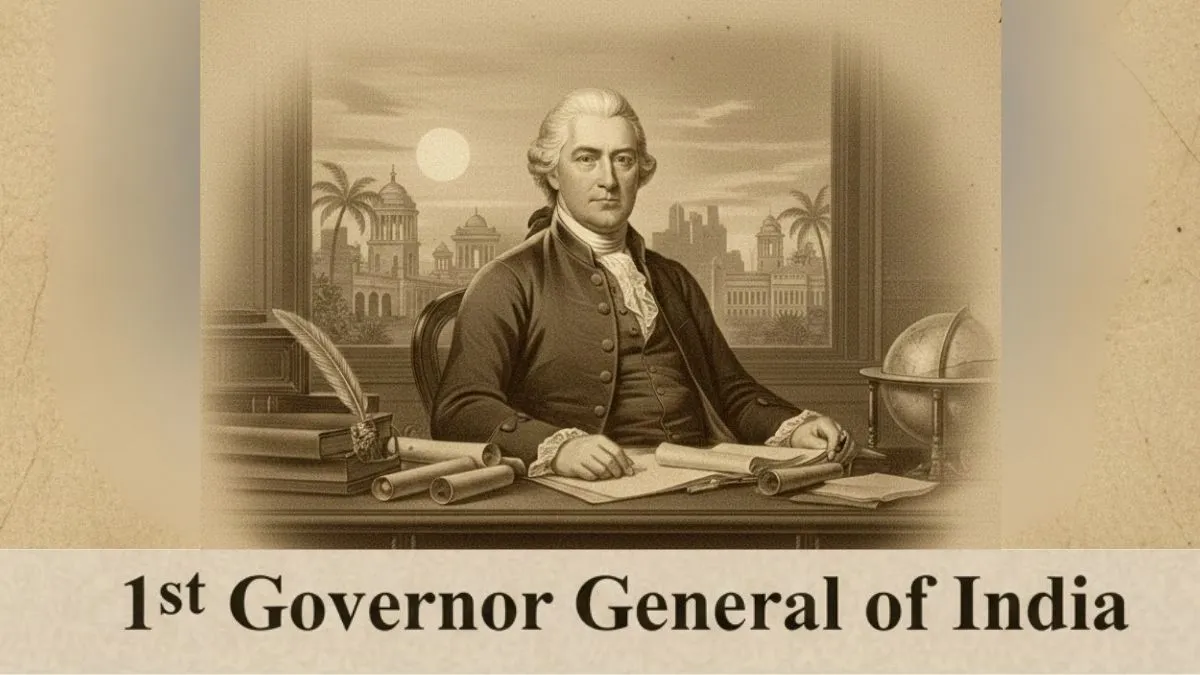
Key Points
- Lord William Bentinck, Governor-General (1828-1835), reformed Indian society, administration, and education.
- The Charter Act of 1833 redesignated Bentinck from Governor-General of Bengal to India.
- Bentinck's reforms included abolishing Sati (1829) and promoting English education (1835).
The British East India Company was established in 1600 as a trading company, but later, around 1765, it turned into a ruling body.
During this period, British want to establish their company after obtaining the Diwani Right to collect the revenue from Bengal, Bihar, and Orissa from the treaty of Allahabad.
But to establish a proper hierarchical governing structure, the British East India Company wanted re-shaping in Indian Society.
So, after the Treaty of Allahabad, the first Governor-General of Bengal was appointed under the Regulating Act of 1773, but in 1833, after the Charter Act of 1833, the British officially upheld the position of Governor-General of Bengal, and changed that to Governor General of India.
But the question is, who was the 1st Governor General of India?
So, let’s explore this article more in detail and know who the 1st Governor General of India was?
Who was the 1st Governor General of India?
The first official Governor-General of India was Lord William Bentinck, who served from 1833 to 1835. Before 1833, he was the Governor-General of Bengal.
Who Was Lord William Bentinck?
Lord William Henry Cavendish-Bentinck was one of the most influential administrators of British India.
He was Governor-General of both Bengal and India between 1828 and 1835.
He was a major figure in the redefinition of Indian society, administration and education in the early nineteenth century.
He was known not only as a source of revenue but also as a reform government.
Why is Lord William Bentinck considered a turning point in British Indian Administration?
The rule of Lord William Bentinck is known to be a reformist era in the governance of the colonies.
Unlike many of his predecessors, he actively intervened in social customs, restructured administration, stabilised finances, and promoted Western education.
His policies provided the institutional basis of modern India, particularly in law, education and social justice.
What was Lord William Bentinck’s Background and Early Career?
Lord William Bentinck was born into British nobility and politics:
-
He was the son of Prime Minister William Cavendish-Bentinck
-
Later on, he joined the British Army at the age of 16
-
In 1798, he became a Colonel in the British Army.
-
He also served as a Member of Parliament for over three decades
What Happened During His Term as Governor of Madras?
-
He was appointed as a Governor of Madras (1803)
-
He also faced the Vellore Mutiny (1806)
-
He took all the responsibility but recalled in 1807
Why is Lord William Bentinck Called the First Governor-General of India?
Lord William Bentinck Called the First Governor-General of India, because:
-
He was appointed as the Governor-General of Bengal in 1828.
-
After the Charter Act of 1833, the post was redesignated and changed to Governor-General of India.
-
Later on, he became the first Governor-General of India, with authority over all British territories
What were the major Educational Reforms introduced by Lord William Bentinck?
The major Educational Reforms introduced by Lord William Bentinck were:
-
English as the medium of instruction (1835)
-
In his time period, English replaced Persian in the higher courts
-
He also established a committee led by Thomas Babington Macaulay
Institutional Achievement
-
Calcutta Medical College (1835)
-
This medical college was the first modern medical college in Asia
-
He also introduced Western medical education and a scientific curriculum
What are the Social Reforms done by Lord William Bentinck?
Lord William Bentinck is known for many social reforms, many of which faced stiff resistance.
Abolition of Sati (1829)
-
He enacted Regulation XVII of 1829
-
Sati was declared illegal and punishable
-
And this was extended to Madras and Bombay (1830)
Suppression of Thuggee
-
He helps in organising a nationwide crackdown
-
This suppression was led by Captain William Sleeman
-
Effectively dismantled organised criminal networks
Ban on Female Infanticide
-
Declared the practice illegal
-
Criminalised human sacrifice and infanticide
How Did Lord William Bentinck Reform the Administrative System?
Bentinck aimed to reduce inefficiency and corruption.
Judicial Reforms
-
Abolished Circuit Courts
-
Transferred powers to collectors
-
Established:
-
Sadar Diwani Adalat
-
Sadar Nizamat Adalat at Allahabad
Codification of Laws
-
Set up the Law Commission
-
Laid the groundwork for:
-
Civil Procedure Code (1859)
-
Criminal Procedure Code (1861)
Police Reforms
-
Abolished the Superintendent of Police post
-
Police placed under the district magistrates
-
Though cost-effective, it weakened policing efficiency
What Financial Challenges Did Lord William Bentinck Inherit?
When Bentinck took office in 1828:
-
The government faced a ₹1 million deficit
-
The company treasury was nearly empty
Financial Measures Implemented
-
Reduced:
-
Officer salaries and allowances
-
Military expenditure
-
Abolished the double battalion system
Outcome
-
Achieved ₹1.5 million surplus by 1835
How Did Lord William Bentinck Reform Land Revenue Administration?
-
Improved the Mahalwari System
-
Revenue assessed collectively on villages (mahals)
-
Increased efficiency in North Indian provinces
Which Major Political and Military Events Occurred During His Tenure?
Here are some Major Political and Military Events Occurred During His Tenure was:
| Event | Year | Significance |
| Annexation of Mysore | 1831 | Taken over, citing misrule |
| Charter Act | 1833 | Centralised governance ended the company's trade |
| Coorg War | 1834 | Annexation after rebellion |
| Annexation of Cachar | 1834 | Absorbed after the ruler died heirless |
What is the Historical Significance of Lord William Bentinck’s Rule?
Under Lord William Bentinck’s governance, the governance system of the British was shifted from conservative colonial rule to reform-oriented administration. His actions:
-
He challenged all the social evils in India, which were regressive social practices at that time.
-
He also introduced Western education in India.
-
He helps in stabilising the colonial finances.
-
He also helps in strengthening the legal and administrative institutions of British East India.
In conclusion, despite operating within colonial constraints, his reforms made a significant mark on the Indian society and government, which made him one of the most influential Governors-General in Indian history.

Prabhat Mishra is a Subject Matter Expert and digital journalist with an extensive background in the competitive exam landscape and over 4 years of experience in education, national and international news, and current affairs. Over his tenure with top knowledge platforms like Mentorship India, IAS BABA, IAS SARTHI, and now Jagran Josh, he has a deep understanding of government exams like UPSC and State PCS, including UP and Bihar, as he has already qualified for the UPPCS 2022 Mains and Bihar 68th Mains. With his core expertise in history, polity, geography & current affairs, he specialises in creating well-researched, aspirant-centric content and simplifying complex topics for competitive examinations.