Difference Between Crude Oil, Petroleum Products, and Petroleum
Learn the difference between crude oil, petroleum products, and petroleum with simple explanations, examples, and EIA-based definitions. Understand how crude oil is refined into petrol, diesel, LPG, and other fuels.
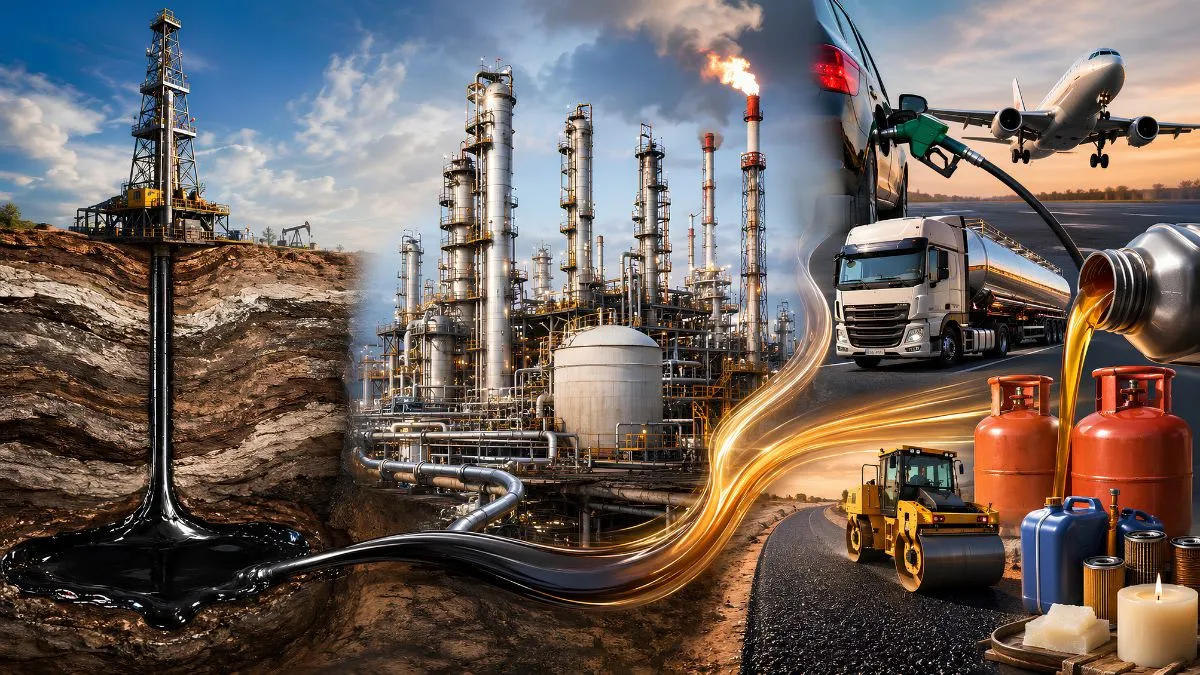
Many of you have heard about crude oil, petroleum products, and petroleum. But do you know what the difference is between all these three? These three terms are often confused by students when preparing for exams.
In this article, we will learn about all three terms in detail with their differences, based on information from the U.S. Energy Information Administration (EIA), which is the official energy data agency of the United States government.
What is Crude Oil?
Crude oil is a thick, dark liquid that is trapped between rocks deep in the earth. It consists of the microscopic remains of animals and plants of millions of years ago, before the time of the dinosaurs, in the seas and oceans. These remains, over millions of years, changed into the liquid that we know as crude oil due to the heat and pressure of the layers of sand, rock and mud.
According to the EIA, “Crude oil is a mixture of hydrocarbons that exists as a liquid in underground geologic formations and remains a liquid when brought to the surface.”
The word "petroleum" itself is derived from two Latin words, "petra", which means "rock", and "oleum", which means "oil". So petroleum simply means "rock oil" or "oil from the earth".
Important quick facts about crude oil:
-
It is typically black, dark brown or sometimes yellowish in colour.
-
Made primarily of hydrocarbons, chemical compounds composed of hydrogen and carbon atoms.
-
In-vehicle/household applications are not possible. Must be sent to a refinery first.
What are Petroleum Products?
After crude oil is brought into the refinery, it is subjected to a series of steps that involve heating, separation and treatment to create a wide variety of useful products. The products are known as petroleum products.
As per the EIA, “Petroleum products are produced from the processing of crude oil and other liquids at petroleum refineries, from the extraction of liquid hydrocarbons at natural gas processing plants, and from the production of finished petroleum products at blending facilities.”
Some common petroleum products that we use every day are:
-
Petrol (called gasoline in the United States)
-
LPG (cooking gas)
-
Kerosene
-
Jet fuel
-
Lubricants and grease
-
Asphalt (used to make roads)
-
Wax, used in candles
EIA data show that petroleum refineries convert crude oil into numerous petroleum products and the characteristics of crude oil dictate the way refineries convert it into higher value products.
Interestingly, the refining process does not only separate crude oil but can also slightly augment the total volume. A U.S. 42-gallon barrel of crude oil produces approximately 45 gallons of petroleum products at U.S. refineries due to refinery processing gain.
Where Do Petroleum Products Come From?
It is important to remember that petroleum products are not only made from crude oil. The EIA states that petroleum products are fuels derived from crude oil and the hydrocarbons found in natural gas but can also be produced from coal, natural gas, and biomass.
What is Petroleum?
This is the term that confuses students the most. Actually, the word "petroleum" is a broad umbrella term. It comprises crude oil (raw oil) and petroleum products (refined forms of oil).
According to EIA, “Petroleum is a broad category that includes both crude oil and petroleum products. The terms 'oil' and 'petroleum' are sometimes used interchangeably.”
So, whenever anyone says the word 'petroleum', they may be referring to the raw oil that's crude oil, or they may be referring to petrol and diesel, or they may be referring to the group as a whole. The specific meaning will vary with the context of the sentence.
Difference Between Crude Oil, Petroleum Products, and Petroleum
| Aspects | Crude Oil | Petroleum Products | Petroleum |
| What it is | Raw, unprocessed oil from underground | Items made after refining crude oil | Umbrella term covering both crude oil and petroleum products |
| Stage | Natural, before processing | Final or finished stage, after refining | Can refer to either stage |
| Examples | Liquid hydrocarbons taken out from oil wells | Petrol, diesel, LPG, kerosene, jet fuel, asphalt | Crude oil, petrol, diesel, LPG, all of it together |
| Where it is found or made | Underground geological formations | Refineries and blending facilities | Both underground and at refineries |
| Direct use possible? | No, must be refined first | Yes, ready for daily use | Depends on which form is meant |
How is this topic useful for UPSC and other competitive exams?
This is an important topic in the syllabus for UPSC and other government exam aspirants as it relates to many important points of the syllabus, including:
- Indian Economy: Most of the crude oil is imported and refined in refineries. Crude oil vs petroleum products is an important concept to understand India's import bill, crude oil basket prices and how fuel prices are determined.
- Geography: Crude oil is formed from marine organisms of millions of years ago relates to Sedimentary rocks and fossil fuel formation.
- Environment and Energy Security: Questions related to petrol, diesel, pollution, energy transition, India's effort for alternative fuels and ethanol blending.
- Current Affairs: These three terms are frequently used in the context of current affairs when describing oil prices internationally, OPEC decisions, and refinery capacity, so it is important to know the difference in order to read relevant news articles and editorials correctly.
So, in this article, we see that crude oil is the unprocessed oil extracted from the ground, petroleum products are the useful products that are derived from the crude oil after refining it, and petroleum is the collective term used for both crude oil and petroleum products.

Prabhat Mishra is a Subject Matter Expert and digital journalist with an extensive background in the competitive exam landscape and over 4 years of experience in education, national and international news, and current affairs. Over his tenure with top knowledge platforms like Mentorship India, IAS BABA, IAS SARTHI, and now Jagran Josh, he has a deep understanding of government exams like UPSC and State PCS, including UP and Bihar, as he has already qualified for the UPPCS 2022 Mains and Bihar 68th Mains. With his core expertise in history, polity, geography & current affairs, he specialises in creating well-researched, aspirant-centric content and simplifying complex topics for competitive examinations.