GK: What are the Differences Between Straits, Isthmuses, Bays, and Gulfs?
Explore the key differences between Strait, Isthmus, Bay, and Gulf in this Artcle. Understand how these "gateways" shape global trade and maritime logistics through detailed definitions, real-world examples like the Strait of Hormuz, Isthmus of Panama, Bay of Bengal, and the Gulf of Kutch with a clear comparison table.

In oceanography, the geographical terms Straits, Isthmuses, Bays, and Gulfs are often confuse to many readers. These terms encompass or are most closely related to coastal features or Marginal Seas/Landforms, where a marginal sea is partially enclosed by islands, archipelagos, or peninsulas. These terms describe the specific land and water features where large bodies of water (oceans/seas) meet the land. To understand global trade, geopolitical strategy, and environmental patterns, these features—Straits, Isthmuses, Bays, and Gulfs are not merely points on a map; they are the "bottlenecks" and "gateways" of the world, and the differences between Straits, Isthmuses, Bays, and Gulfs must be known, and the terminology of the land and water formations that shape our continents.
A Strait and an Isthmus represent narrow passages that facilitate movement, while Bays and Gulfs represent how the ocean carves into the land to create sheltered environments. Distinguishing between them requires looking at three key factors: composition (land vs. water), connectivity (what they link), and scale (their size and depth).
So, let’s understand the differences between Straits, Isthmuses, Bays, and Gulfs in detail with this article.
What is a Strait?
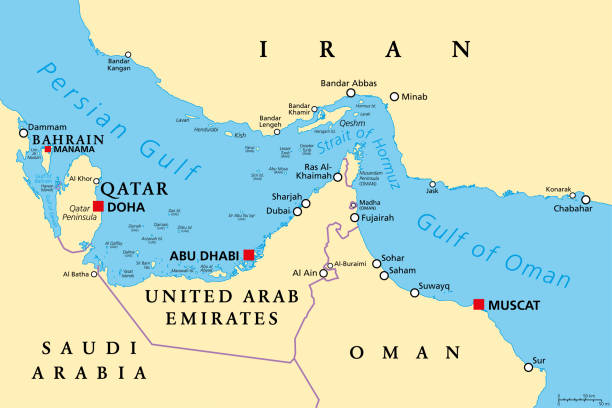
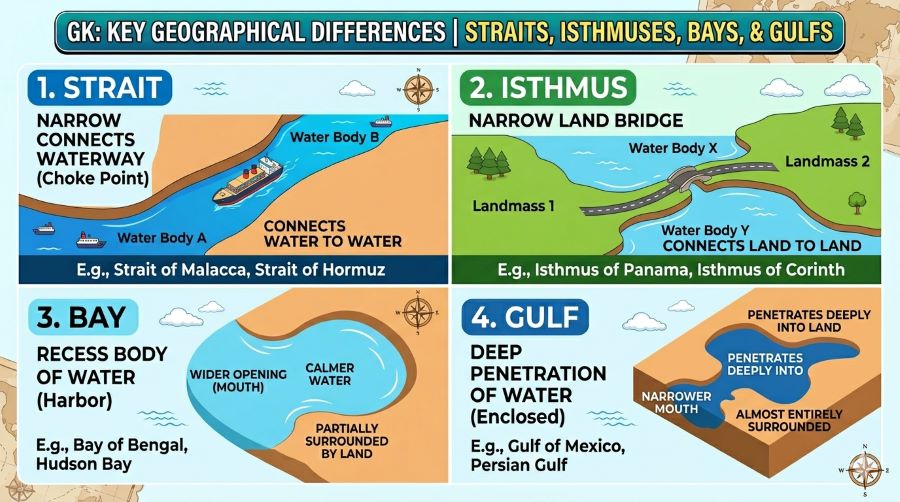
A Strait is a narrow, naturally formed waterway that connects two larger bodies of water. In the world of maritime logistics, straits are known as "choke points" because they control the flow of international shipping.
Source: iStock
-
Straits are created by tectonic shifts or rising sea levels that overflow low-lying land.
-
Example:
-
The Strait of Malacca, which connects the Indian Ocean to the Pacific Ocean, is one of the most important shipping lanes in the world.
-
The Strait of Hormuz, which connect the Persian Gulf to the west with the Gulf of Oman and the Arabian Sea to the southeast.
What is an Isthmus?
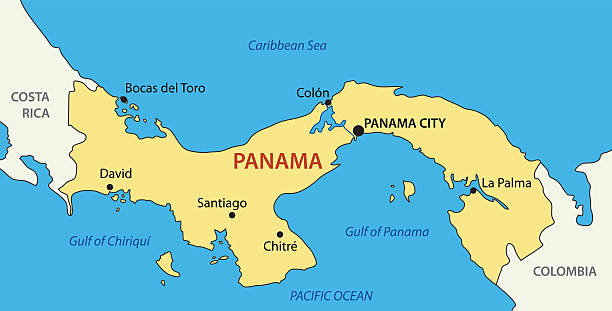
An Isthmus is a narrow strip of land bordered by water on two sides, connecting two larger landmasses. It acts as a "land bridge" for migration and transport.
Source: iStock
-
Because of their narrowness, isthmuses are the most common locations for man-made canals (like the Panama Canal) to save ships thousands of miles of travel.
-
Example:
-
The Isthmus of Corinth, which connects the Peloponnese peninsula to the rest of mainland Greece.
-
The Isthmus of Panama is a narrow strip of land connecting North and South America, separating the Caribbean Sea and the Pacific Ocean.
What is Bays?
A Bays is a recessed body of water partially surrounded by land. It is characterized by a wide, curving opening (mouth) where it meets the sea or a lake.
Source: shutterstock
-
Bays usually have calmer waters than the open ocean because the surrounding land blocks high winds and large waves, making them ideal for natural harbors.
-
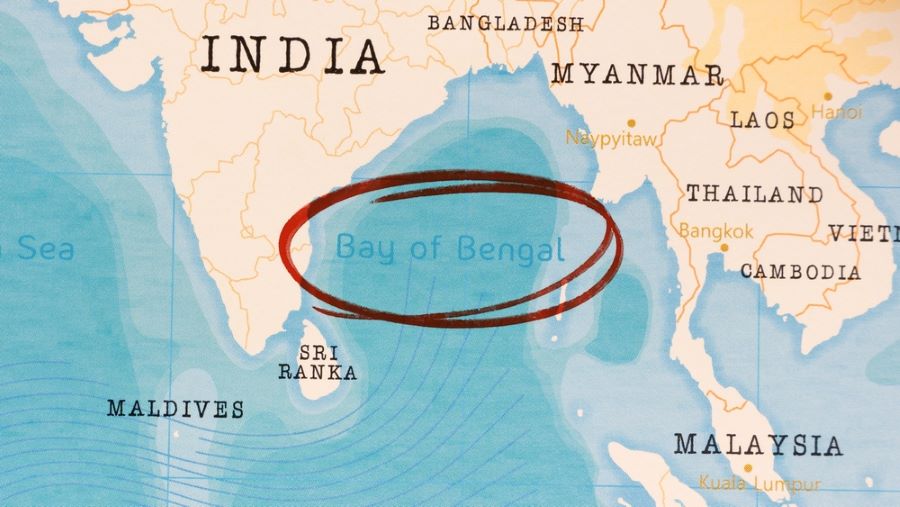
Example: The Hudson Bay in Canada or the Bay of Bengal of India.
What is a Gulf?
A Gulf is a large portion of the ocean that penetrates deeply into the land. It is typically much larger and more enclosed than a bay, often connected to the ocean by a narrow strait.

Source: NASA
-
Gulfs are often formed through the submergence of a rift valley or the flooding of a large basin. They are often significant sources of oil, gas, and diverse marine ecosystems.
-
Example: The Persian Gulf or the Gulf of Mexico, or the Gulf of Kutch of India.
Differences Between Straits, Isthmuses, Bays, and Gulfs
All the difference between Straits, Isthmuses, Bays, and Gulfs are given below in the table, including its physical form, its function, side borders, mouth width, and typical origin:
| Feature | Strait | Isthmus | Bay | Gulf |
| Physical Form | Water | Land | Water | Water |
| Primary Function | Connects Water to Water | Connects Land to Land | Indentation of Water | Deep Penetration of Water |
| Side Borders | Land on 2 sides | Water on 2 sides | Land on 3 sides (curved) | Land on 3 sides (enclosed) |
| Mouth Width | Narrow | N/A | Broad and Wide | Often Narrower than the body |
| Typical Origin | Tectonic / Sea Rise | Tectonic / Volcanic | Erosion / Glacial | Rifting / Flooding |
Source: AI Generated
Overview of the Differences Between Straits, Isthmuses, Bays, and Gulfs
The Connectivity Rule: The easiest way to remember the difference between a Strait and an Isthmus is to look at what they are connecting. If it bridges two oceans, it is a Strait. If it bridges two continents, it is an Isthmus. The Enclosure Rule: When distinguishing between a Bay and a Gulf, look at the shape. A Bay is like a "gentle curve" into the land with a very wide opening. A Gulf is like a "pocket" or a "sack" of water that is almost entirely surrounded by land, making it much more enclosed.
In conclusion, these four geographical terms Straits, Isthmuses, Bays, and Gulfs is the strategic passage to connect the different waterways and land portions. By understanding the narrowness of Straits and Isthmuses and the indentations of Bays and Gulfs, you can better interpret the physical world and its impact on global history. For more such GK articles, visit Jagran Josh!

Prabhat Mishra is a Subject Matter Expert and digital journalist with an extensive background in the competitive exam landscape and over 4 years of experience in education, national and international news, and current affairs. Over his tenure with top knowledge platforms like Mentorship India, IAS BABA, IAS SARTHI, and now Jagran Josh, he has a deep understanding of government exams like UPSC and State PCS, including UP and Bihar, as he has already qualified for the UPPCS 2022 Mains and Bihar 68th Mains. With his core expertise in history, polity, geography & current affairs, he specialises in creating well-researched, aspirant-centric content and simplifying complex topics for competitive examinations.