Who Are Dowry Givers? Supreme Court Explains Legal Protection and Rights
The Supreme Court of India has provided a landmark clarification regarding the legal status of dowry givers. Understand who dowry givers are under Indian law and what the Supreme Court of India says in its latest 2026 judgment
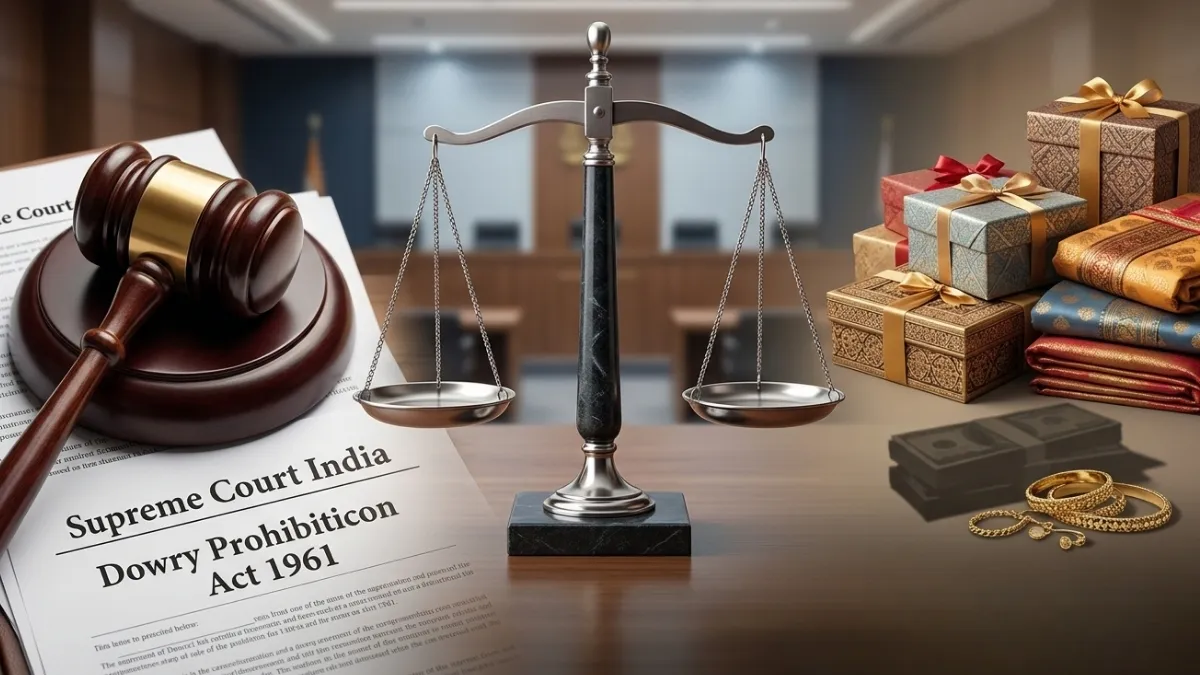
Dowry remains one of the most debated social and legal issues in India, raising critical questions about justice, accountability, and victim protection although laws strictly prohibit the giving and taking of dowry. A crucial question has emerged in recent years: who are dowry givers criminals or victims of social pressure?
In the recent development, the Supreme Court of India has clarified that dowry givers, especially the bride’s family, should not automatically be treated as offenders if they were compelled to give dowry under coercion or societal pressure which marks a significant shift towards a victim-centric approach under the Dowry Prohibition Act, 1961.
What is Dowry Under the Dowry Prohibition Act, 1961?
According to the Dowry Prohibition Act, 1961 under Section 2 of the Dowry Prohibition Act, 1961, "Dowry" is defined as any property or valuable security given or agreed to be given either directly or indirectly:
-
By one party to a marriage to the other party.
-
By the parents of either party to the marriage or by any other person to either party.
-
Direct or indirect payments.
This applies at or before or after the marriage uses consideration for the marriage of the said parties, but does not include dower or mahr in the case of persons to whom the Muslim Personal Law (Shariat) applies.
Who Are Dowry Givers?
A ‘Dowry Giver’ are generally the bride's parents, guardians, or relatives who provide assets to the groom’s side to facilitate a marriage. Under Section 3 of the Dowry Act, 1961 states that "giving" dowry is an offense, however, the legal position has evolved to recognize the element of "Unwilling Givers."
Unwilling Givers are those individuals who do not wish to give dowry but do so to protect their daughter’s future or succumb to the "demand" made by the other party.
Supreme Court of India on Dowry Givers: Victims or Offenders?
The Supreme Court’s 2026 observations have drawn a sharp line between voluntary giving and coerced giving.
-
The Victim Perspective: The Court noted that in a patriarchal setup, the bride's family is often at a disadvantage.
-
The recent Ruling: The SC held that when a giver provides dowry due to a "demand" which is punishable under Section 4, they are essentially victims of extortion treating them as criminals would discourage them from filing complaints against abusive in-laws.
Are Dowry Givers Punishable? What the Law Actually Says
In India, giving a dowry is unlawful that is prescribed a minimum of 5 years imprisonment but there is a powerful legal shield under Section 7(3) of the Dowry Prohibition Act, 1961 which explicitly states that any statement made by the person "aggrieved" (the giver) shall not be used to prosecute them under Section 3.
This means if a father admits to giving dowry while testifying against a groom who demanded it, the father is protected from being jailed for that admission.
Legal Protection and Rights of Dowry Givers in India
Immunity from Prosecution: Under Section 7(3), of the dowry Act 1961, givers who report harassment are protected.
-
Right to Recovery: Under Section 6 of the dowry Act 1961, if any dowry given must be transferred to the woman within 3 months. If not, the giver has the right to file for its recovery.
-
Anticipatory Protection: The 2026 SC guidelines suggest that police should not arrest the bride's parents automatically when a dowry-related FIR is lodged.
Differences Between Dowry and Gifts
It is essential to distinguish between illegal dowry and legal presents (Streedhan):
Feature | Dowry | Gifts (Presents) |
| Nature | Given as a condition/demand for marriage. | Given voluntarily without a demand. |
| Legal Status | Illegal under Section 3. | Legal under the 1985 Rules. |
| Documentation | Usually undocumented. | Must be entered in a signed list. |
| Ownership | Often seized by in-laws. | Remains the sole property of the bride. |
Key Supreme Court Judgments on Dowry Laws
-
P.V. Narasimha Rao Case: Discussed the immunity of those who are victims of a crime.
-
Arnesh Kumar vs. State of Bihar: Prevented arbitrary arrests in dowry-related cases (Section 498A).
-
S. Gopal Reddy vs. State of Andhra Pradesh: Defined the wide scope of "dowry" to include demands made even before the marriage is finalized.
-
Hira Lal vs. State Govt. of NCT Delhi: SC emphasized the "deeming fiction" of dowry death and the necessity of protecting the woman’s interests.
In the Recent judgement Supreme Court Clarification solidified the status of the bride’s family as "aggrieved persons" rather than "accomplices" in cases where a demand was initiated by the groom's side and protected under Section 7(3) when they report dowry demands.

Manisha Waldia is a distinguished content strategist with 5 years of experience crafting premium educational content for UPSC and State PCS, with a focus on deep conceptual analysis across Polity, Geography, History, and Environment. She currently brings this expertise to Jagran Josh, where she covers major national and international events, current affairs, and static general knowledge. Over her career, Manisha's specialized insights have led her to curate high-impact materials and serve as a UPSC Mains answer-evaluator for India’s top institutes—including Drishti IAS, Shubhra Ranjan IAS, Study IQ, GS Score, and PWonlyIAS. She has also worked alongside leading NGOs like Oxfam India and Avani Kumaon.
Contact: manisha.waldia@jagrannewmedia.com