Difference Between NEFT vs RTGS
Find out how NEFT and RTGS work, their main differences, and which payment method is suitable for small or large transactions.
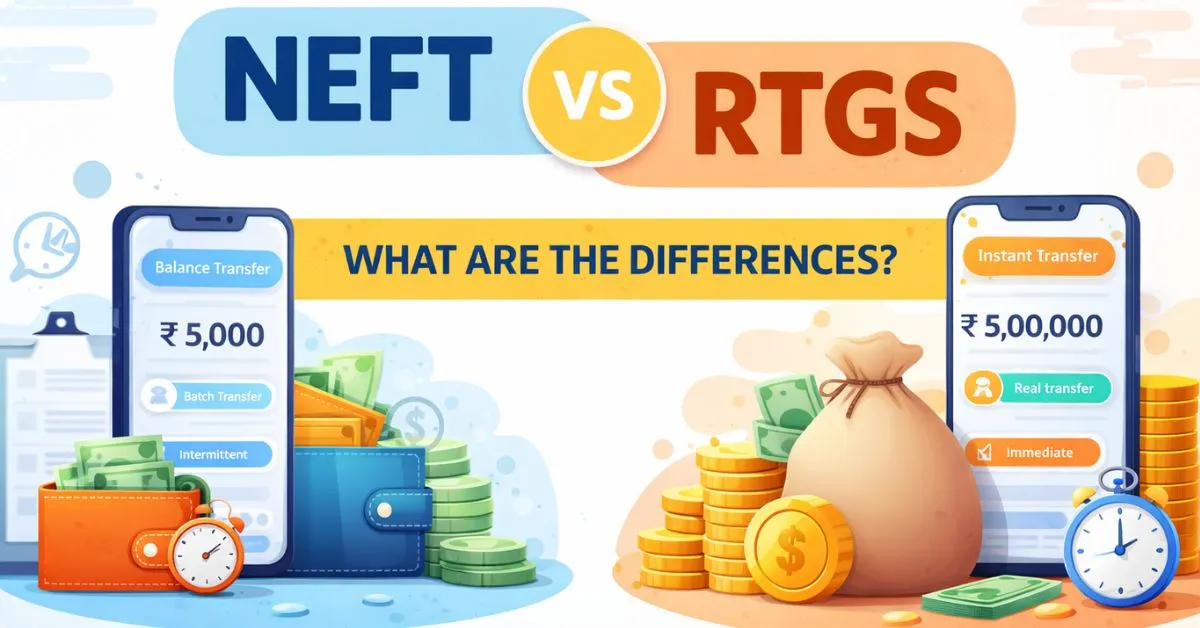
Transferring money has become an ordinary feature in our lives whether it is payment of bills, sending money to the family or even doing business payments. Digital banking has been developing rapidly in India, various methods of payment such as NEFT or RTGS are gaining traction.
On the surface, these two payment methods might appear to be similar since both of them allow you to move money between two banks. Yet, they are used differently and designed to suit different requirements.
Knowing the difference between NEFT and RTGS can help you select a more appropriate option and facilitate the process of your transactions.
What is NEFT?
The full form of NEFT is National Electronic Funds Transfer. It refers to a system in which transfer of money is done in batches. This implies that there is no immediate settlement of transactions but they are settled in intervals.
This system can be used by individuals and companies to transfer funds from one bank account to the other.
PayTM mentions: “NEFT stands for National Electronic Funds Transfer. It is an electronic payment system in India that enables individuals, companies, and organizations to transfer funds from one bank account to another. NEFT transactions are processed in batches and settled in hourly intervals throughout the day. It is a secure and convenient method for transferring money, widely used for various purposes such as salary payments, bill payments, and online purchases.”
It is a great option to use on a daily basis when you are transferring small or medium amounts. NEFT operates 24/7, which is convenient to the users at any time of an hour.
What is RTGS?
The acronym RTGS stands for Real Time Gross Settlement. Under this kind of system, the transaction is made on the spot and the money immediately credited into the account of the receiver.
It is mostly applied during giant transactions in which speed matters. RTGS is regarded as being among the quickest and safest transactions of money.
The RBI mentions: “The acronym 'RTGS' stands for Real Time Gross Settlement, which can be explained as a system where there is continuous and real-time settlement of fund-transfers, individually on a transaction-by-transaction basis (without netting). 'Real Time' means the processing of instructions at the time they are received; 'Gross Settlement' means that the settlement of funds transfer instructions occurs individually.”
NEFT vs RTGS: What are the Differences?
Here are the differences between the two of the widely used internet-based money transfer systems within. They are both controlled by the Reserve Bank of India and are safe to use.
| Aspect | NEFT | RTGS |
| Settlement | In batches | Real time |
| Minimum Amount | No minimum amount | Rs. 2 Lakhs |
| Time of settlement | Within Hours | Instant |
| Maximum Amount | Rs. 2 Lakhs | No maximum amount |
| Availability | 24/7 | 24/7 |
When Should You Use NEFT?
You can choose NEFT when:
-
The amount is not very large
-
Instant transfer is not very important.
-
You are paying usual bills such as rent.
When Should You Use RTGS?
RTGS is preferable in the event of:
-
You are shipping away a lot of money.
-
The payment is urgent
-
You want the money to reach you urgently.
Neft and RTGS are both safe and secure ways of transferring funds. This is because the right decision will be determined by the amount of money you are sending and the urgency in which you require the money to be received.
READ| What is the Difference Between Enquiry and Inquiry?
For more such interesting general knowledge, head over to Jagran Josh.

Nikhil is a dedicated digital journalist and communications professional with more than five years of experience, currently working within the General Knowledge section at Jagran Josh. He has established himself as a subject matter expert in Finance, Economy, History, Technology, and Trending News, consistently delivering accurate, engaging, and easy-to-read content for a wide global audience.
Over the course of his career, Nikhil has developed deep expertise in crafting informative listicles, viral trending stories. His editorial portfolio also spans finance, historical research, and technology reporting, making him a versatile and well-rounded content professional. Every piece he produces reflects a strong balance between factual accuracy and reader engagement.