Which Painting is known as the Indian Mona Lisa?
Do you know which painting is called the Indian Monalisa? This masterpiece of the Kishangarh school of art in Rajasthan features a woman with elegant features, long arched eyes, and a mysterious smile. It appeared on an Indian postage stamp in 1973. Can you guess? If not, let's discover the figure behind this painting.

Key Points
- Bani Thani, painted ~1750, is from the Kishangarh school of Rajasthani miniature painting.
- The painting depicts Vishnupriya, a poet and singer, with stylized, idealized features.
- In 1973, the Government of India issued a commemorative postal stamp featuring Bani Thani.
Paintings let people share stories and feelings in a unique way. For thousands of years, people everywhere have used colours to express themselves.
From the Mona Lisa in Europe to colourful murals in Asia, each country has its own style. These artworks show us history and the creativity of people around the world.
India is known for its rich and varied art. Every region has its own painting style. Some well-known types are Madhubani, Warli, Miniature Paintings, and Pattachitra.
Among these masterpieces, there is a famous portrait from Rajasthan. It is often called the "Indian Mona Lisa". Can you guess? In this article, we will explore its name, history, and why it is so special.
ALSO READ| List of 7 Oldest Cave Paintings in India
Which Painting is known as The Indian Mona Lisa?
Source: Exotic India Art
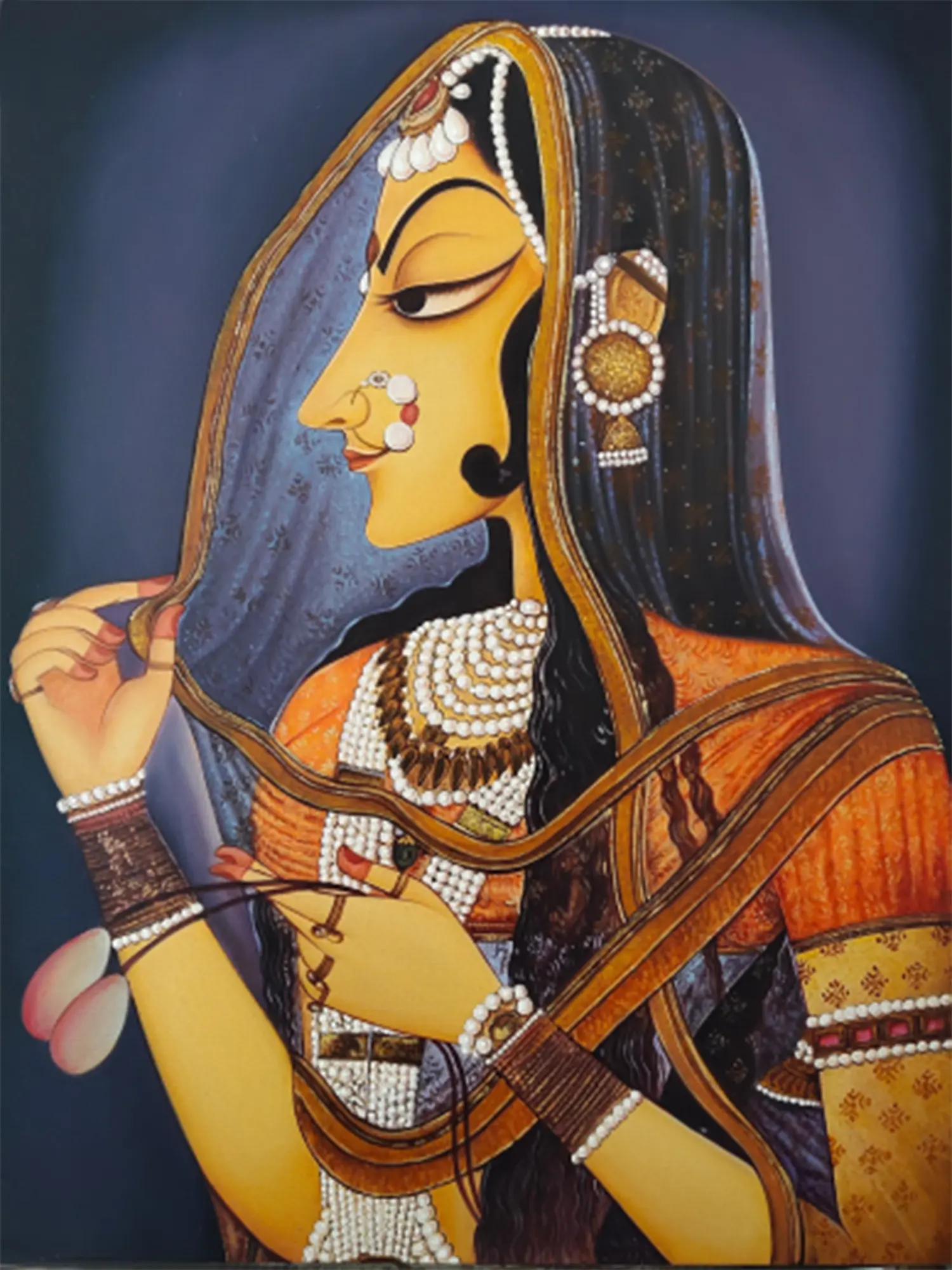
Bani Thani, often called the "Indian Mona Lisa", is a famous painting from the Kishangarh school in Rajasthan.
Painted around 1750 by Nihal Chand for Raja Sawant Singh, it shows Vishnupriya, a gifted poet and singer in the royal court who captured the King's heart. She is depicted with stylised features, such as an elongated face, arched eyebrows, and lotus-shaped eyes.
The painting is known for its fine details, such as her transparent veil decorated with gold designs and her heavy pearl jewellery. The name "Bani Thani" means "The Adorned Lady".
7+ Lesser-known Facts about Bani Thani
- The Government of India issued a 20-paise commemorative postal stamp featuring her face in 1973.
- The vibrant white in the original painting was achieved using lead white or zinc, while the gold details utilised actual 24-karat gold dust.
- The striking red on her lips and fingernails was derived from lac (insect resin) or cinnabar minerals.
- Her facial features follow a specific "idealised" ratio, in which the eyes are deliberately made longer than the mouth to signify divinity.
- To achieve its glossy finish, the finished painting was rubbed with a smooth agate stone to fuse the pigment layers.
- Both the King and Bani Thani wrote poetry under the pen names Nagari Das and Rasik Bihari, respectively, to conceal their royal identities in their spiritual works.
- The artwork is painted on Wasli, a unique handmade paper created by glueing multiple thin layers together to prevent ink bleeding.
- The finest details, such as the eyelashes, were painted using brushes made from a single hair of a squirrel’s tail.
Which Style Is Bani Thani Painting Related To?
The Bani Thani painting is the best-known work from the Kishangarh School of Art, a branch of Rajasthani Miniature Painting.
Although it began with Mughal influences, the Kishangarh style formed its own identity in the mid-18th century. It is categorised as follows:
1. The Kishangarh School (Principal Style)
This branch of Rajasthani art flourished in the princely state of Kishangarh and is distinguished by its departure from the realistic proportions characteristic of other Indian art from the same period.
2. Key Characteristics of the Style
The "Bani Thani" style set the main artistic standards for this school.
- Artists used exaggerated features, like very long eyes (sometimes called "lotus-shaped" or "fisheye"), arched eyebrows, and a pointed chin.
- Subjects are usually shown in side profile (Ek-chashma) to highlight the face's sharp, graceful lines.
- Artists became skilled at using fine lines to paint transparent veils (odhnis) with gold details.
- The backgrounds in these paintings often depict peaceful landscapes with marble palaces, calm lakes, and abundant greenery.
3. The Artist and Patron
The style attained its zenith during the collaboration between master painter Nihal Chand and ruler Raja Sawant Singh. This partnership marked a departure from the formal portraiture of the Mughal courts, leading to a more lyrical, romantic visual language.
IN CASE YOU MISSED| Top 10 Most Expensive Painting in the World, Check List
What makes Kishangarh School of Art Different from Other Rajasthani Painting Styles?
The Mewar style is known for its "boldness", while Kangra is recognised for its "softness". In contrast, the Kishangarh school stands out for its "stylised elegance".
Artists there transformed the human figure into an idealised beauty that was not found in real life. This is one reason the Bani Thani painting remains so iconic today.
| Feature | Kishangarh Style (Bani Thani) | Mewar Style | Kangra Style (Pahari) |
| Facial Features | Highly elongated, lotus-shaped eyes, pointed chin, and arched brows. | Large, protruding eyes, oval faces, and robust figures. | Soft, rounded faces with delicate, realistic features. |
| Color Palette | Uses soft pastels and cool colours with heavy use of gold and white. | Bold, bright, and contrasting primary colours (Red, Yellow, Blue). | Naturalistic, earthy tones with a focus on green landscapes. |
| Themes | Courtly elegance, poetic romance, and stylised beauty. | Historical scenes, hunting, and royal court ceremonies. | Nature, soft landscapes, and feminine grace. |
| Key Element | Focus on the profile view (side face) with transparent veils. | Flat backgrounds with thick, decorative borders. | Intricate backgrounds with hills, trees, and flowing water. |
Who is Known as the Indian Mona Lisa?
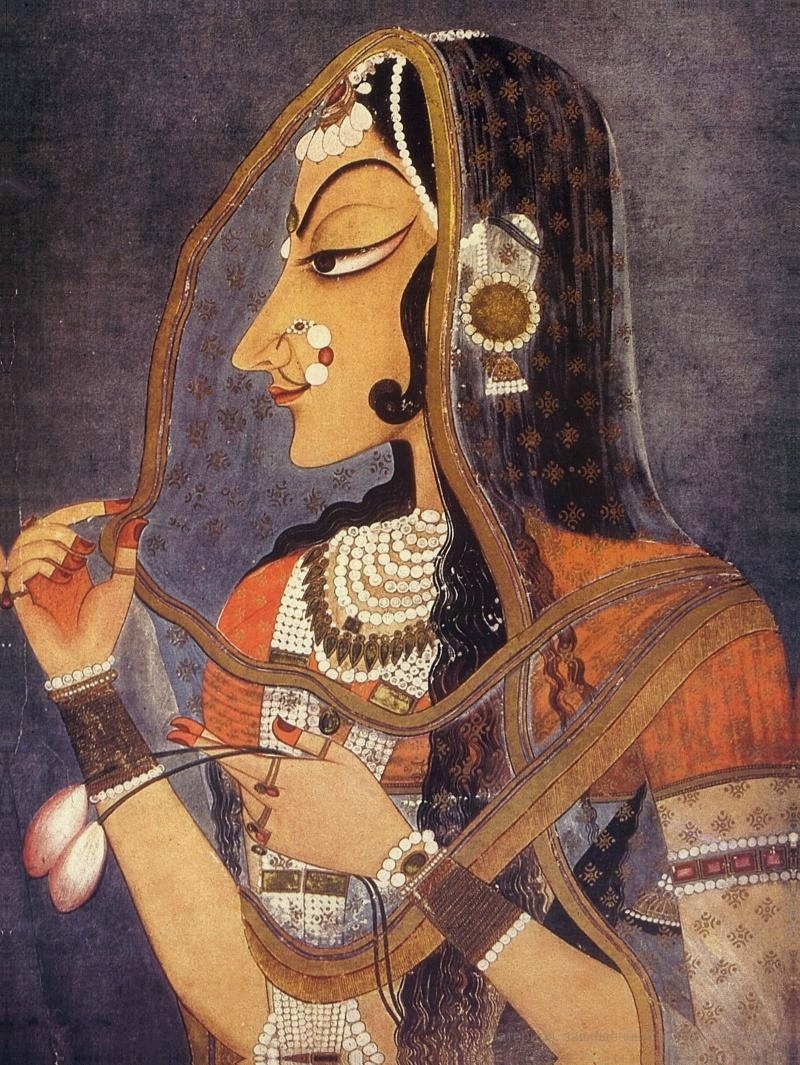
The painting known as the "Indian Mona Lisa" is actually Bani Thani, a famous 18th-century work. Beyond being a masterpiece, the woman in the painting was a real person with an interesting life story. The following presents the historical timeline of Bani Thani:
# The Life of Vishnupriya (Bani Thani)
- Origins: Her birth name was Vishnupriya. She was born in the early 18th century and originally served as a singer and poet in the Mughal Emperor's royal zenana (women's quarters) in Delhi.
- Move to Kishangarh: In the 1730s, she was brought to the kingdom of Kishangarh (in modern-day Rajasthan) by the mother of the crown prince, Sawant Singh, to serve as a court singer.
- The Name "Bani Thani": She earned the nickname "Bani Thani", which means "The Fashionable One" or "The Adorned Lady", because of her impeccable sense of style, unique jewellery, and elegant makeup.
- Artistic Influence: She was a highly educated woman and a talented poet. Her sophisticated features—curved eyes and pointed chin—became the "standard of beauty" for the Kishangarh School of Art, immortalised by the painter Nihal Chand.
- Political Shift: After a period of family dispute over the throne, Prince Sawant Singh eventually abdicated (gave up) his crown in 1757.
- Life in Vrindavan: Following the abdication, Vishnupriya accompanied Sawant Singh to Vrindavan, a major cultural and literary hub. She spent her later years there, focused on writing poetry and music.
- Death: She passed away in 1764, shortly after the death of Sawant Singh. Her legacy survives through her collection of poems and the world-famous portrait that bears her name.
Cultural Significance
This painting is important in Indian culture because it marked a departure from the usual Mughal style.
Rather than sticking to the stiff, formal portraits of that era, the artist chose exaggerated features to create a distinct Indian look.
The work highlights the best of Rajasthani craftsmanship and stands as a symbol of traditional Indian beauty.
Conclusion
The Bani Thani painting is more than a portrait. It represents the highest achievement of the Kishangarh School of Art.
It shows that great art often comes from the teamwork of a talented artist, a supportive patron, and an inspiring subject. While the Mona Lisa reflects the mystery of the Italian Renaissance, Bani Thani expresses the spirit of Rajasthani culture.
With its sharp lines, clear veils, and lotus-shaped eyes, the painting continues to fascinate art lovers worldwide. It is more than an 18th-century masterpiece; it is a lasting tribute to the "Adorned Lady" who changed Indian art forever.
WHAT'S NEXT| List of Top 10 Most Famous Paintings in the World

Kriti Barua is a skilled digital journalist and communications professional with 4+ years of experience, currently writing for the General Knowledge section at Jagran New Media. She has established herself as a subject matter expert in History, Geography, Trending National and International News, Sports, Science, and Defence, producing clear, reliable, and search-optimised content that connects with readers worldwide.
Kriti holds a BA degree from Delhi University and a one-year diploma in TV Production and Journalism, an academic background that adds research depth and strong storytelling instincts to her writing. Her experience spans brand writing, content marketing, and digital media, giving her a sharp understanding of what makes content both helpful to readers and visible in search.
At Jagran New Media, she applies this expertise to national and international news coverage, query-based articles, and in-depth pieces across her specialist subject areas. Her content is defined by easy language, factual accuracy, strong keyword strategy, and reader-friendly storytelling.