Who is Known as the Father of the Indian Space Program?
India’s rise in space exploration has a powerful beginning. Discover who is known as the Father of the Indian Space Program.
Each time the Indian Space Research Organisation (ISRO) achieves success, whether it is the Chandrayaan mission which successfully landed near the South Pole of the Moon or the Mangalyaan, which became the first Asian spacecraft to enter Mars orbit, they are all built on the shoulders of one man. Even before rockets and satellites were India's glory, there was a man who saw the vision.
Who is Known as the Father of the Indian Space Program?
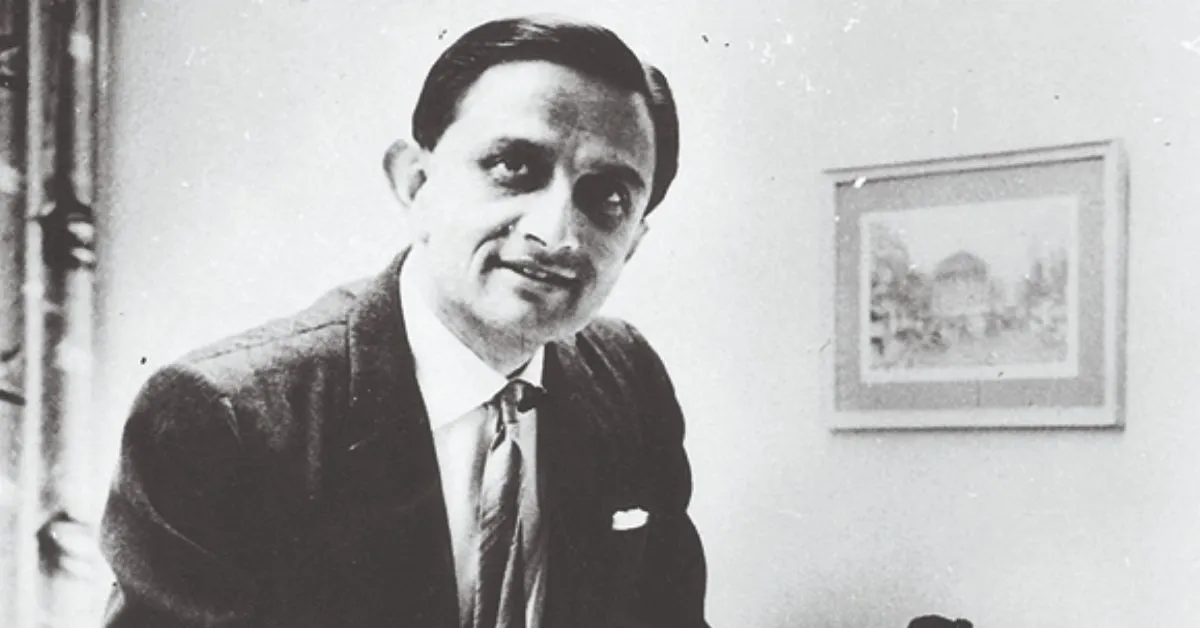
This title is given to Dr. Vikram Ambalal Sarabhai. He was a visionary academic who established and co-founded many institutions in a wide range of areas. ISRO mentions: “Dr.Sarabhai is considered as the Father of the Indian space program; He was a great institution builder and established or helped to establish a large number of institutions in diverse fields.”
Who Was Dr. Vikram Ambalal Sarabhai?
Vikram Sarabhai was born on August 12, 1919 in Ahmedabad in a rich family of enlightened industrialists. He was a scientist, an inventor, industrialist and a visionary. He was born to Ambalal and Sarla Devi.
He studied in a private school, ‘Retreat’ which was run by his parents. Later he proceeded to Cambridge and took his Tripos in Natural Sciences from St. John's College in the year 1940. He also joined as a research scholar under Sir C.V. Raman due to World War II and later returned to Cambridge and completed his PhD in 1947.
The Master Control Facility mentions: “Vikram Sarabhai was born on August 12, 1919 at Ahmedabad in an affluent family of progressive industrialists. He was one of the eight children of Ambalal and Sarla Devi. He had his early education in a private school, 'Retreat', run by his parents on Montessori lines.”
“After his matriculation, Vikram Sarabhai proceeded to Cambridge for his college education and took the tripos in Natural Sciences from St. John's College in 1940. With the beginning of World War II, he returned home and joined as a research scholar under Sir CV Raman at the Indian Institute of Science, Bangalore. His interest in solar physics and cosmic ray led him to set up many observation stations around the country. He built the necessary equipment and took measurements at Bangalore, Pune and the Himalayas. He returned to Cambridge in 1945 and completed his PhD in 1947,” it adds.
READ| Who is the Inventor of Radio?
How He Built India's Space Program From Scratch
Realising the potential of communication satellites with the live broadcast of the Tokyo Olympics across the Pacific Ocean by the American satellite Syncom-3, Dr. Vikram Sarabhai saw the advantages that space technologies could bring to India very soon.
ISRO mentions: “The space research activities were initiated in our country during the early 1960’s, when applications using satellites were in experimental stages even in the United States. With the live transmission of Tokyo Olympic Games across the Pacific by the American Satellite ‘Syncom-3’ demonstrating the power of communication satellites, Dr.Vikram Sarabhai, the founding father of Indian space programme, quickly recognized the benefits of space technologies for India.”
The Indian National Committee for Space Research (INCOSPAR) was established in 1962 by the Government of India, on the advice of Dr. Vikram Sarabhai. He then selected Thumba, a small fishing village near Thiruvananthapuram, to establish India's first rocket launching station, the Thumba Equatorial Rocket Launching Station (TERLS), because the area is close to the geomagnetic equator. It launched its first rocket on November 21, 1963.
ISRO mentions: “The Indian space science exploration started with the investigations of the Earth’s upper atmosphere and ionosphere. The initial scientific motivation was the study of equatorial objects. In the year 1963, the first sounding rocket was launched from Thumba Equatorial Rocket Launching Station (TERLS) near Thiruvananthapuram.”
Dr. Sarabhai realised that space technologies could be used in the development of the nation and he developed the Indian Space Programme after 1960, advocating the broadcast of education to the farthest corners of the country through satellite television. The Indian Space Research Organisation (ISRO) was formed on August 15, 1969.
He also started the project for construction and launch of a satellite. This paved the way for the launch of the first Indian satellite Aryabhata in 1975 which was four years after his demise.
He was awarded the Padma Bhushan in 1966 and the Padma Vibhushan in 1972. He passed away on December 30, 1971, aged 52 but the organisation he founded has gone on to achieve feats that made the entire world take notice.
ISRO's main launch centre in Thiruvananthapuram is named the Vikram Sarabhai Space Centre which is an eternal salute to the father who first looked towards the sky and knew India needs to be there.

Nikhil is a dedicated digital journalist and communications professional with more than five years of experience, currently working within the General Knowledge section at Jagran Josh. He has established himself as a subject matter expert in Finance, Economy, History, Technology, and Trending News, consistently delivering accurate, engaging, and easy-to-read content for a wide global audience.
Over the course of his career, Nikhil has developed deep expertise in crafting informative listicles, viral trending stories. His editorial portfolio also spans finance, historical research, and technology reporting, making him a versatile and well-rounded content professional. Every piece he produces reflects a strong balance between factual accuracy and reader engagement.