From Jammu To Silicon Valley: How Onkar Singh Batra Went From Building A Website At 7 To A $4.3 Million Space Startup
Jammu-born Onkar Singh Batra built his first website at seven, developed a satellite project at 16 and later founded Apolink, a space-tech startup that raised $4.3 million.
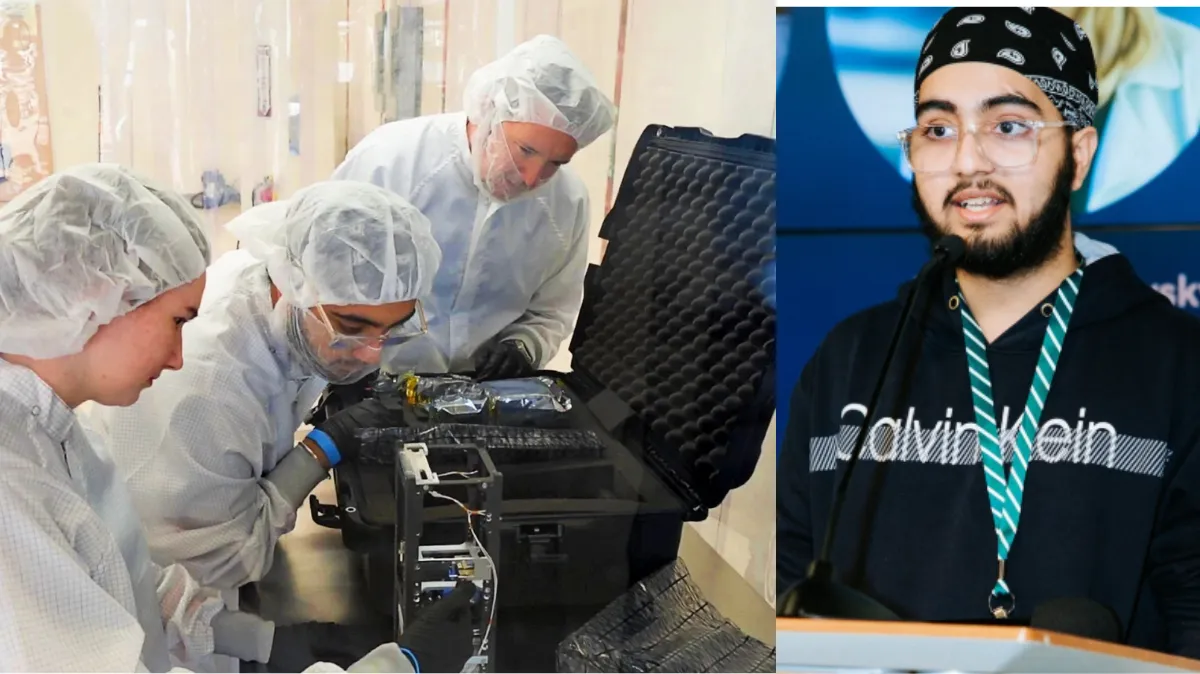
For most children, seven is an age of school, games and cartoons. For Onkar Singh Batra, it was the age when he built his first website.
Years later, that early fascination with technology has taken the Jammu-born entrepreneur into the space-tech industry. Batra, now 20, is the founder and CEO of Apolink, a Palo Alto-based startup working on satellite relay infrastructure for low Earth orbit (LEO).
The company raised $4.3 million in an oversubscribed seed round in 2025, when Batra was 19. The funding valued Apolink at $45 million post-money and was backed by investors including Y Combinator, 468 Capital, Unshackled Ventures, Rebel Fund and Maiora Ventures.
But the funding is only the latest chapter in a journey that began long before Apolink.
A website at seven, a satellite at 16
Batra’s interest in technology started early. At seven, he built his first website and was recognised as the world’s youngest male webmaster, according to the profile published this week. By 12, he had written a book, and at 13, he had started his own company. His interests eventually shifted towards space technology.
While still a school student in Jammu, Batra developed InQube, an open-source satellite project. His work on the project helped him understand a problem that would later become the foundation of his startup: satellites in LEO can lose contact with ground stations when they move outside their line of sight.
That gap in connectivity may sound like a small technical issue, but it can become important when satellites are collecting data that needs to reach Earth quickly.
The problem behind Satellites
Apolink was founded in 2024 with a specific goal: build a relay network that can provide continuous, real-time connectivity to satellites in LEO.
Satellites cannot always communicate directly with a ground station because their position changes constantly as they orbit Earth. Existing relay systems and ground-station networks can reduce these communication gaps, but they do not necessarily provide the continuous connectivity Apolink is targeting.
Apolink’s approach combines radio-frequency (RF) and optical inter-satellite links. The company says this hybrid architecture is designed to make its relay network compatible with a wider range of existing satellites. Y Combinator describes Apolink as a data-relay network designed for real-time, low-latency connectivity in LEO.
From Jammu to Silicon Valley
Batra eventually moved to the US and built Apolink in Palo Alto. The company joined Y Combinator’s Fall 2024 batch and has since continued developing its satellite relay technology.
The startup’s $4.3 million seed round was announced in July 2025. At the time, Batra was 19 and the company said it was working towards a demonstration mission that would test its technology in orbit.
The journey has since moved from plans to an actual space demonstration.
Apolink reaches orbit
In July 2026, Apolink launched its first demonstration satellite, IPoS, aboard SpaceX’s Transporter-17 mission. The satellite is intended to demonstrate the company’s backward-compatible RF relay technology in low Earth orbit. Satellite industry publication Via Satellite listed Apolink among its “10 Smallsat Startups to Watch in 2026” and highlighted the July launch as a major milestone for the company.
The milestone gives Batra’s story another significant turn. What started with a seven-year-old building a website has now evolved into a company developing infrastructure intended to keep satellites connected in space.
Apolink is still at an early stage, but its journey shows how an interest that began with writing code as a child eventually turned into an attempt to solve a real engineering challenge in one of the world’s fastest-growing technology sectors.
And for Batra, the journey from Jammu to Silicon Valley is no longer just about building technology. It is about building the communication infrastructure that could help other technologies work better once they reach space.

Sahil Behl is an education journalist at Jagran with over a year of experience in journalism. Prior to joining Jagran, he worked as a Sub-Editor in NDTV’s Education department, where he was responsible for writing and editing education-related content as well as managing the department’s social media presence. At Jagran, he covers a wide range of education topics, including board examinations, school updates, admissions, and job notifications, while leveraging his editorial expertise and strong understanding of digital content strategy. Sahil holds a Bachelor’s degree in Business Administration and has also completed an eight-month certification program in Data Science. Passionate about emerging technologies, particularly artificial intelligence, he closely tracks their growing role in journalism and explores how they are transforming shaping the future of the media industry.


