Which Country is the Largest Producer of Coal in the World?
Which country is the largest producer of coal in the world? Discover about the largest coal producing countries in the world, types of Coal and critical role role of the coal in the global energy market. Explore the top coal producing countries in the world.
Key Points
- coal production at 4.8 billion tonnes annually in 2026.
- India aims for 1.5 billion tonnes by 2030, investing in clean coal.
- Indonesia is a key coal exporter, fueling power plants in Asia.
In the rapidly changing landscape of global energy market, one resource remains a centerpiece of industrial power that is Coal despite the rise of renewables coal continues to fuel massive portions of the global economy, particularly in the Asia-Pacific region. As we move through 2026, understanding which nations lead the charge in coal mining is essential for grasping the complexities of international trade, energy security, and environmental policy.
Which Country is the Largest Producer of Coal in the World?
China is the largest producer of coal in the world. In 2025 and moving into 2026, China’s coal production has reached historic highs, hovering around 4.8 billion tonnes annually. Its largest coal reserve is concentrated in Inner Mongolia and Xinjiang provinces.
China produces more coal than the rest of the world combined and China is also a world leader in installing wind and solar power. Coal remains the primary reliable source for China’s heavy manufacturing and steel industries.
2nd Largest Coal Producing Country in the world
India is the second coal producing country in the world with a goal of reaching 1.5 billion tonnes by 2030. The government of India is aggressively auctioning new mines and investing in Clean Coal technologies like Coal
Gasification to power its massive population.
3rd largest Coal Producing Country in the World
Indonesia is known as the export house of coal although Indonesia ranks third in production. Its much of the coal produced here is shipped to fuel power plants in India and Southeast Asia.

Top 10 Largest Coal Producers Countries in the World
While China holds the top spot, other nations are significant players. Here are the largest coal producing countries in the world
| Rank | Country | Annual Production (Approx. MT) | Primary Use / Market Role |
| 1 | China | 4,805 | World's largest consumer; fuels 58% of domestic power. |
| 2 | India | 1,085 | Rapidly expanding to reduce reliance on energy imports. |
| 3 | Indonesia | 836 | Global leader in coal exports, primarily to Asia. |
| 4 | United States | 465 | Production declined due to a shift toward natural gas. |
| 5 | Australia | 463 | Key exporter of high-quality metallurgical (steel) coal. |
| 6 | Russia | 427 | Significant producer, though facing export sanctions. |
| 7 | South Africa | 235 | Primary energy source for the African continent. |
| 8 | Kazakhstan | 113 | Major supplier for Central Asia and regional industry. |
| 9 | Mongolia | 106 | Rapidly growing production to feed Chinese demand. |
| 10 | Germany | 92 | Primarily lignite (brown coal) for domestic electricity. |
Types of Coal:
Here is the Four major types of coal:
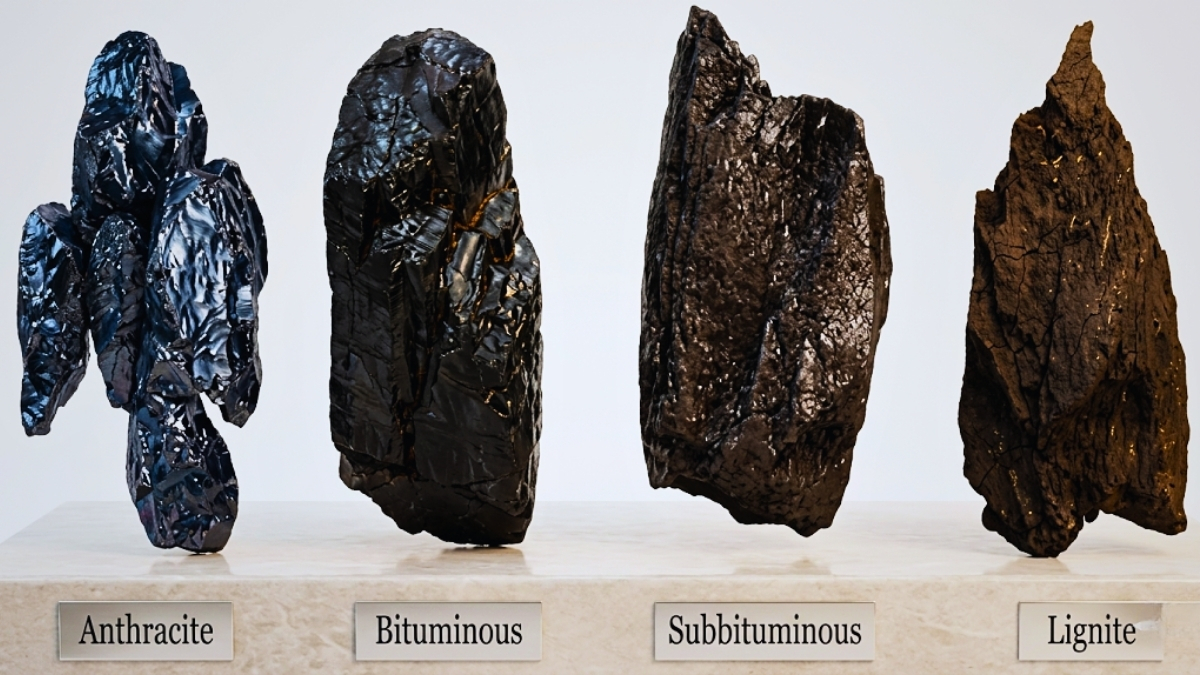
1. Anthracite (Hard Coal): Anthracite is the highest rank of coal. It is distinguished by its hard, brittle texture and a semi-metallic, lustrous sheen.
- Carbon Content: 86% to 97%
-
Characteristics: It burns slowly with a clean, blue flame and produces the most heat with the least smoke or soot.
-
Primary Uses: Mostly used in the metals industry and for specialized high-heat industrial applications. It is the rarest form of coal.
2. Bituminous (Soft Coal): Bituminous coal is the most abundant and widely used variety globally. It is a middle-rank coal that often appears blocky with alternating shiny and dull layers.
-
Carbon Content: 45% to 86%
-
Characteristics: It has a high heating (calorific) value. Because it contains "bitumen" (a tar-like substance), it can be used to create coke.
-
Primary Uses: Essential for electricity generation (thermal coal) and steel making (metallurgical or coking coal).
3. Sub-bituminous: This coal is transitionary between lignite and bituminous. It is generally dark brown to black and has a duller appearance than the higher ranks.
-
Carbon Content: 35% to 45%
-
Characteristics: It contains more moisture than bituminous coal, which makes it slightly less efficient, but it often has a lower sulfur content, making it "cleaner" to burn in terms of emissions.
-
Primary Uses: Primarily used as fuel for steam-electric power generation.
4. Lignite (Brown Coal): Lignite is the lowest rank of coal. It is geologically the "youngest" and was subjected to the least amount of heat and pressure.
-
Carbon Content: 25% to 35%
-
Characteristics: It has a high moisture content (up to 45%) and a crumbly texture. Because of the water weight, it is inefficient to ship long distances and is usually burned in power plants located very close to the mines.
-
Primary Uses: Almost exclusively used for electric power generation.
Significance of Coal in the 2026 Global Energy Market:
-
Energy Security and Reliability: In 2026, Coal will remain the primary source of power for major economies like China and India.
-
Coal provides a steady, 24/7 electricity supply, shielding nations from the price volatility of imported natural gas and ensuring grid stability during peak industrial demand.
-
Industrial Foundation for Infrastructure like metallurgical coal is an indispensable raw material for global steel and cement production.
-
Coal is the most affordable pathway to eliminate energy poverty for developing nations where coal acts as a critical economic bridge
-
Coal provides low-cost energy that fuels GDP growth.
This domestic availability reduces reliance on complex international supply chains and strengthens national economic resilience.China remains the world's largest coal producer, reaching 4.8 billion tonnes annually by 2026, with India and Indonesia following.
Coal continues to be a crucial energy source globally, particularly in the Asia-Pacific, ensuring energy security and fueling industrial growth. Despite renewable advancements, it remains vital for heavy manufacturing and economic stability, especially for developing nations.
Also Read: Which Country is the Largest Manufacturer of Semiconductors in the World?

Manisha Waldia is a distinguished content strategist with 5 years of experience crafting premium educational content for UPSC and State PCS, with a focus on deep conceptual analysis across Polity, Geography, History, and Environment. She currently brings this expertise to Jagran Josh, where she covers major national and international events, current affairs, and static general knowledge. Over her career, Manisha's specialized insights have led her to curate high-impact materials and serve as a UPSC Mains answer-evaluator for India’s top institutes—including Drishti IAS, Shubhra Ranjan IAS, Study IQ, GS Score, and PWonlyIAS. She has also worked alongside leading NGOs like Oxfam India and Avani Kumaon.
Contact: manisha.waldia@jagrannewmedia.com