What is the chemical name and formula of Epsom salt?
Chemical names, unlike the common names of substances, describe the elemental makeup and structure of the compound. These are governed by international standards, such as IUPAC guidelines. While common names are used in everyday use, chemical names are used in the fields of science, industry, and medicine. Today, we will learn the chemical name of what is commonly known as Epsom salt.
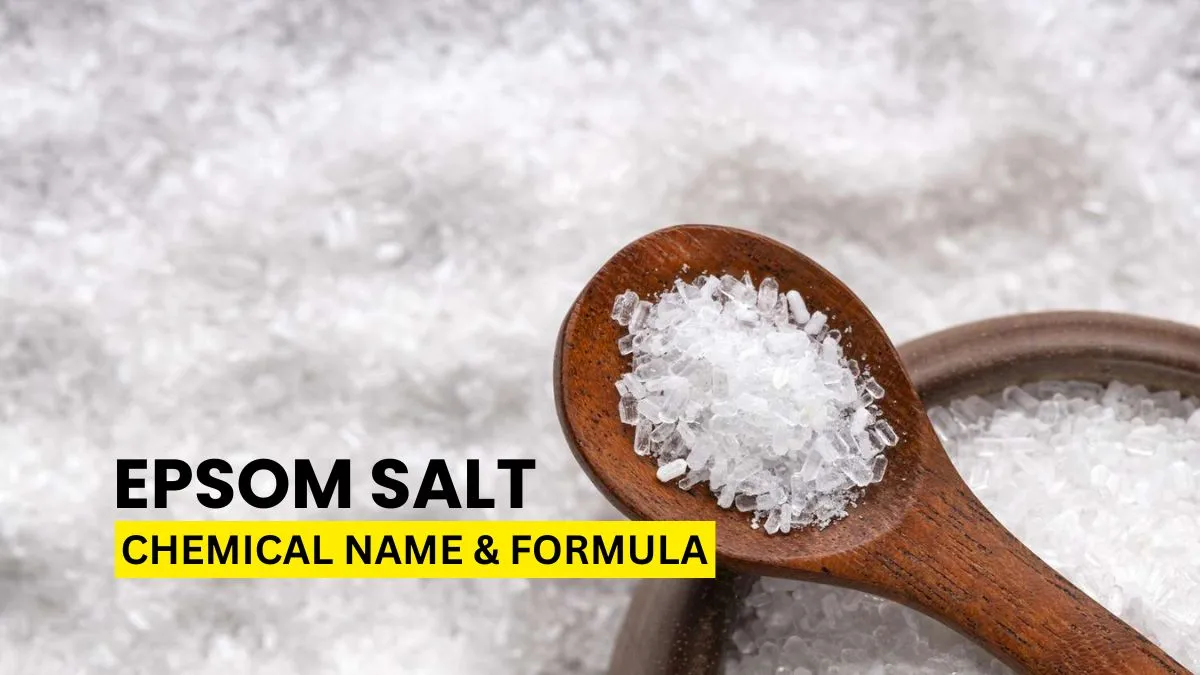
Chemical names, unlike the common names of substances, describe the elemental makeup and structure of the compound. These are governed by international standards, such as IUPAC guidelines. While common names are used in everyday use, chemical names are used in the fields of science, industry, and medicine.
The need for a clear, universal system of scientifically naming elements in the late 18th century established the modern chemical naming. This system led to three principles in chemistry:
- Each substance should have a single, unambiguous name.
- The chemical name should reflect the substance's chemical composition.
- Names were to be based on Latin and Greek roots.
The new system was widely adopted in the 19th century with further developments. In the early 1800s, the modern system of one- or two-letter chemical symbols (like 'Fe' for iron or 'O' for oxygen) to denote elements was developed.
Today, the chemical names of elements and compounds are governed by the International Union of Pure and Applied Chemistry (IUPAC), which was established in 1919.
In this article, we will learn the chemical name of Epsom salt. Many people confuse it with rock salt, but it is a completely different compound. Epsom salt is chemically different from table salt and rock salt. In our previous articles, we have shared the chemical name for table salt.
What is the chemical name and formula for Epsom salt?

The chemical name for Epsom salt is magnesium sulphate. There are forms of Epsom salt. The most common are:
Anhydrous (dry, absorbs water): MgSO₄
Heptahydrate (common form): MgSO₄·7H₂O
Properties of Epsom Salt
Appearance: White, crystalline granules or powder.
Odour: Odourless.
Taste: Bitter and saline.
Solubility: Highly soluble in water.
Density (Heptahydrate): Around 1.68 g/cm³
Molar Mass (Heptahydrate): Approximately 246.47 g/mol.
Hygroscopic: Anhydrous (dry) form attracts and retains moisture from the air, potentially resulting in clumping.
pH: Neutral
Uses of Epsom salt
Epsom salt is usually used for muscle pain relief, stress reduction, salt baths, and foot soaks. It acts as a natural relaxant, exfoliant, anti-inflammatory agent, and laxative.
It is also used in agriculture (as a fertiliser to raise the magnesium and sulfur content of the soil. It is also used in hydroponics).
It is also used in construction (to make cements and concretes).
Also, while Epsom salt is not typical table salt, the food-grade Epsom salt is used in food preparation, such as brewing, food additives, tofu production, and fermentation processes.

Roopashree Sharma is an experienced broadcast journalist with over 7 years of experience, specialising in beats including geopolitics, defence, and general awareness. She has worked in the roles of correspondent and producer for leading media houses, including Zee, WION, and Economic Times. Currently serving as Deputy Manager – Editorial at Jagran New Media, she produces explainer articles and videos for the General Knowledge (GK) section of the Jagran Josh (English) portal. For inquiries, contact her at roopashree.sharma@jagrannewmedia.com.