What is the Old Name of the Chenab River?
Discover what is the old name of the Chenab River? Known as Asikni in the Rigveda and Chandrabhaga in the Mahabharata, the Greeks called it Acesines. This historic river originates at Baralacha Pass, serving as a key Indus tributary today.
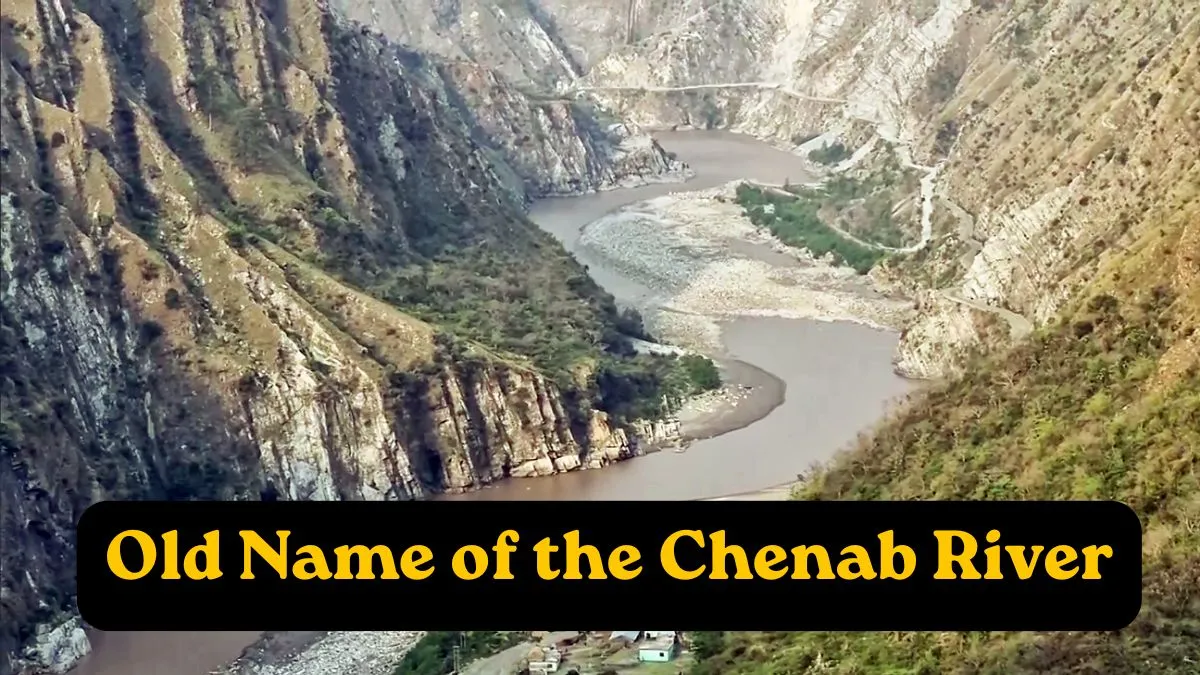
Old Name of the Chenab River: The Chenab River is one of the five great rivers in the Punjab area that has an ancient history, which dates back to the Indian civilisation. Probably, the Chenab River had many different names prior to the fact that it came to be known as the Chenab. In the Vedic scriptures, the Sanskrit epics, and the historical archives of the ancient Greeks, another name was mentioned. So, let’s explore the Old Name of the Chenab River with its geographical location, route, its tributaries, and major dams & hydroelectric projects on the Chenab River
What is the Old Name of the Chenab River?
The oldest recorded name of the Chenab River is “Asikni”, as mentioned in the Rigveda. Later on, it was known by name as “Chandrabhaga” in the Mahabharata, and “Acesines” by the ancient Greeks. Chenab is a Persian word (Chandrabhaga) signifying.
Source: riversinsight
Key Facts about the Chenab River
| Feature | Details |
| Origin | Confluence of Chandra & Bhaga rivers at Tandi, Lahaul & Spiti, Himachal Pradesh |
| Elevation at Origin | It is located at an altitude of about 4,891 m (area of Baralacha Pass). |
| Total Length | ~974 km |
| Catchment Area (India) | 29050 sq. km up to the international boundary. |
| Drains Into | Sutlej River → Panjnad → Indus River |
| States Covered (India) | Himachal Pradesh, Jammu & Kashmir |
| Vedic Name | Asikni (Rigveda) |
| Sanskrit/Epic Name | Chandrabhaga (Mahabharata) |
| Greek Name | Acesines |
| Treaty | Indus Waters Treaty, 1960 |
Old Names of the Chenab River
1. Asikni — The Vedic Name (Rigveda)
The oldest and ancient name of the Chenab River is Asikni, which is mentioned in the Rigveda, and it is one of the oldest sacred texts in the world. It is mentioned in Rigveda hymn XVIII.20.25 and X.75.5 (the Nadistuti Sukta, or the Hymn to the Rivers). The name Asikni is believed to mean "dark-coloured waters," reflecting the river's appearance as observed by Vedic sages. Another form is that of Iskamati, which is also present later on in Vedic literature. This river is also referred to as Krishana by the Atharvaveda.
2. Chandrabhaga — The Epic Name (Mahabharata)
This river of the Mahabharata and classical Sanskrit literature is known as Chandrabhaga. The naming has been after the physical geography of the river itself - the river is created when the Chandra River and the Bhaga River merge at the Tandi, which is situated in Himachal Pradesh. Chandrabhaga literally means "Moon River" (Chandra = Moon, Bhaga = portion/river). The modern name Chenab is a simplified, Persian-influenced contraction of Chandrabhaga, a transition likely occurring in the early medieval period and first recorded by the scholar Alberuni.
3. Acesines — The Ancient Greek Name
The river was later documented in the career of Alexander the Great in 326 BCE as the Greek historian crossed over the Indian subcontinent and as the Acesines, which is a Hellenised version of the Sanskrit Asikni. Greek which varies are Sandrophagos, Sandabaga and Cantabra of Chandrabaga. Historian Arrian, one of the people quoted by eyewitness Ptolemy Lagides, wrote that the river was around 2 miles (3.2 km) across where Alexander crossed.
Summary of Ancient Names of the Chenab River
| Old Name | Source / Era | Meaning |
| Asikni | Rigveda — Vedic Period | Dark-coloured waters |
| Chandrabhaga | Mahabharata / Classical Sanskrit | Moon River (Chandra + Bhaga) |
| Acesines (Ἀκεσίνης) | Ancient Greek records, 326 BCE | Greek form of Asikni |
| Chenab | Early Medieval (Persian influence) | Contracted form of Chandrabhaga |
Source: sciencedirect
Geographical Location and Course of the Chenab River
Origin: The Chenab River originates in the Higher Himalayas of Himachal Pradesh. Both the streams, the Chandra River and the Bhaga River, are raised on the other side of the Baralacha Pass at an elevation of approximately 4,891 metres.
-
The Bhaga River originates from Suryatal Lake, west of Baralacha La pass, flowing southwest through the Lahaul valley for about 80 km.
-
The Chandra River originates from glaciers near Chandra Taal, east of Baralacha La pass, flowing southeast for about 115–125 km before making a sweeping 180° turn toward the southwest.
The two streams meet at Tandi, approximately 8 km southwest of Keylong, in the Lahaul and Spiti district of Himachal Pradesh, at an elevation of about 2,286 metres. After combining these both stream is called Chenab (or Chandrabhaga in its upper reaches).
Course through India
Upper Course —
Himalayan Mountain Stage: Chenab flows to the North-West of Tandi, in the Pangi Valley of Chamba district, Himachal Pradesh, to the Union Territory of Jammu and Kashmir. It cuts the long valleys in the Greater Himalayas along with the Pir Panjal Range that cuts through the Kishtwar, Doda, Ramban, Reasi and Jammu districts. The characteristics of this region are steep slopes, deep gorges and very high hydropower potentials.
Middle Course —
This river passes through the Shivalik Hills and flows into the plains, and is on the Pakistan border, bordering Sialkot. This changes the gradient to a lower one, and the river is considerably broad, and meanders begin to appear.
Course Through Pakistan
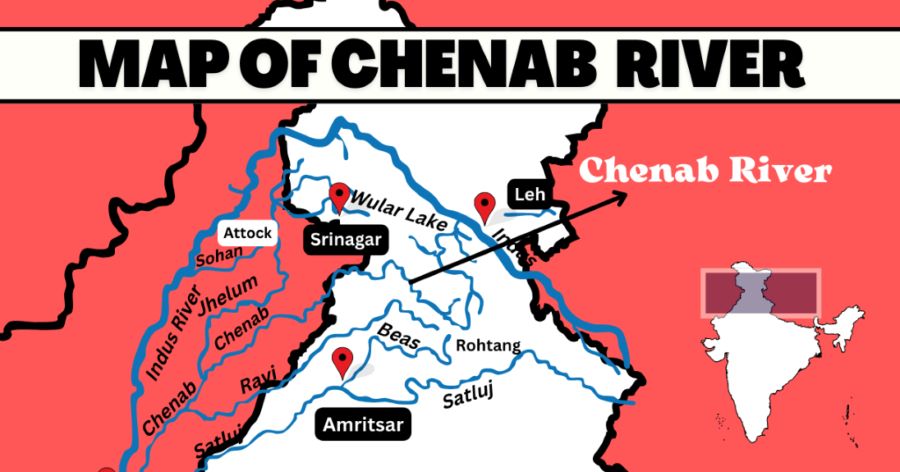
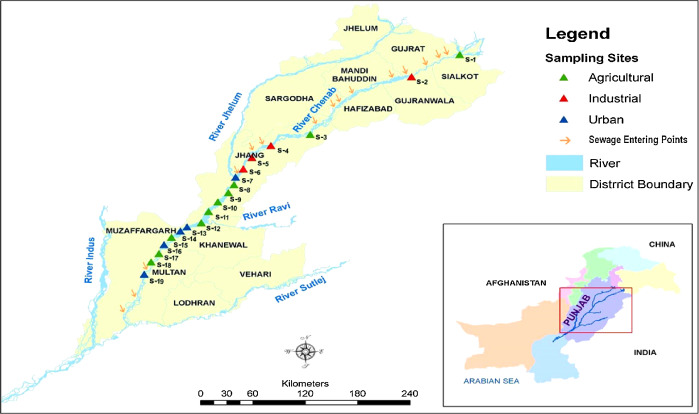
The chenab is a river that passes in the Punjab plains in Pakistan, which starts at Trimmu at which the river Jhelum meets the river chenab and flows to the Southwest to merge with the river Sutlej to form the Panjnad (Panchnad). The Panjnad is eventually drained into the Indus River at Mithankot in the Sindh and the Indus is drained to the south of Karachi at the Arabian Sea.
Major Tributaries of the Chenab River
As per the India WRIS (Water Resources Information System), Ministry of Jal Shakti, Government of India, the principal tributaries of the Chenab are:
Right Bank Tributaries
| Tributary | Key Facts |
| Miyar Nalla | Originates near Lopen Jot at ~5,100 m; flows ~60 km; joins Chenab opposite Udaipur, Himachal Pradesh |
| Marusudar (Warwan River) | Largest right bank tributary; originates at ~5,175 m; formed by Batkot and Gumbar streams |
| Ans River | Joins Chenab on the right bank, upstream of the Salal Hydroelectric Project, J&K |
| Bhut Nalla | Right bank tributary in the Chamba/Lahaul region of Himachal Pradesh |
| Bichleri | Right bank stream in the Jammu & Kashmir section |
Left Bank Tributaries
| Tributary | Key Facts |
| Thirot | Left bank tributary in Chamba district, Himachal Pradesh |
| Tawi River | Flows through Jammu city; culturally and agriculturally significant; a major source of irrigation |
| Neeru River | Left bank tributary in the Kishtwar region, J&K |
| Lidrari | Drains parts of Doda district, J&K |
Major Dams and Hydroelectric Projects on the Chenab River
The Government of India has developed significant hydroelectric infrastructure on the Chenab, all operating as run-of-the-river projects under the Indus Waters Treaty:
| Project | Capacity | Location |
| Baglihar Hydroelectric Project | 900 MW | Near Ramban, J&K |
| Salal Dam | 690 MW | Near Reasi, J&K |
| Dul Hasti Hydroelectric Plant | 390 MW | Kishtwar, J&K |
| Ratle Hydroelectric Plant | 850 MW (under construction) | Drabshalla, Kishtwar, J&K |
| Kiru Hydroelectric Project | 624 MW (proposed) | Kishtwar, J&K |
| Pakal Dul Dam | Proposed | On the Marusudar tributary, Kishtwar |
Source: Central Electricity Authority, Government of India, 2024
In conclusion, the old name of the Chenab River in the Rigveda is Asikni and in the Mahabharata, Chandrabhaga. In the names of this river, in an antiquity of thousands of years, lies Indian civilisation. Chenab is a geographically one of the largest rivers of the Indian subcontinent. It originates in the high Himalayas in Himachal Pradesh at the Baralacha Pass, flows through the deep valley of Jammu & Kashmir, is fed by other major rivers like the Marusudar, Miyar Nalla, as well as Tawi and empties into the system of the Indus River. It is a river of historical, geographical and strategic permanence to India due to the hydroelectric capacity, its Vedic religious name and strategic position as a component of the Indus Waters Treaty.

Prabhat Mishra is a Subject Matter Expert and digital journalist with an extensive background in the competitive exam landscape and over 4 years of experience in education, national and international news, and current affairs. Over his tenure with top knowledge platforms like Mentorship India, IAS BABA, IAS SARTHI, and now Jagran Josh, he has a deep understanding of government exams like UPSC and State PCS, including UP and Bihar, as he has already qualified for the UPPCS 2022 Mains and Bihar 68th Mains. With his core expertise in history, polity, geography & current affairs, he specialises in creating well-researched, aspirant-centric content and simplifying complex topics for competitive examinations.


-1792292078791_t.webp)
-1792288684857_t.webp)


![NIOS Hall Ticket 2026 [OUT] LIVE: Download Class 10th, 12th October Theory Admit Card at sdmis.nios.ac.in, Direct link here](https://img.jagranjosh.com/images/2026/October/16102026/NIOS-Hall-Ticket-2026.jpg)

![[OUT] UPSSSC PET Admit Card 2026 LIVE: यूपी पीईटी एडमिट कार्ड जारी, upsssc.gov.in पर Direct Link](https://img.jagranjosh.com/images/2026/October/15102026/UPSSSC-PET-Admit-Card-2026.jpg)


