Which Planet is known as the Green Planet?
Do you know which planet is known as the 'Green Planet' in the Solar System? This planet appears as a pale, cyan-coloured, or blue-green disc. It is also famously known as the planet that rotates on its side, with an axial tilt of about 98°. Can you take a guess? If not, let's discover this methane-rich ice giant.
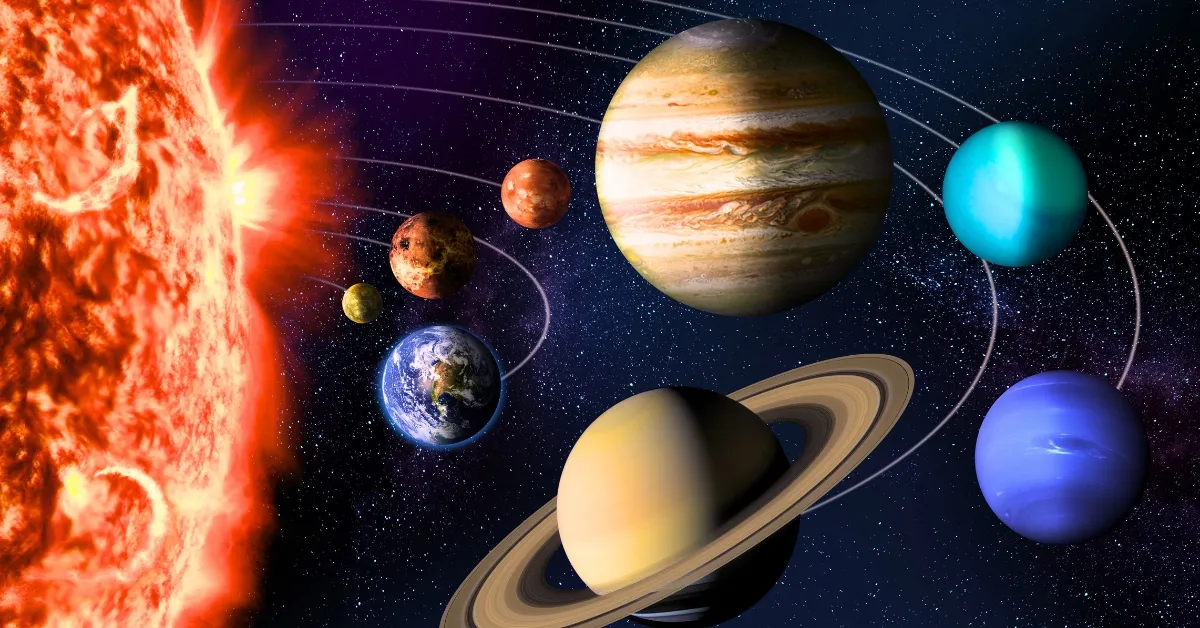
The solar system is home to many different worlds. Mars is often called the Red Planet because of its rusty dust. Earth is known as the Blue Planet, and Venus is sometimes called the Morning Star or the Evening Star.
But have you ever thought about which planet is called the Green Planet? This planet is a giant made of gas and ice, and it tilts oddly on its side. In this article, we will take a closer look at this colourful world and discover what makes it special.
ALSO READ| Which planet in the solar system is known as the "Red Planet"? Find Out Now!
Which Planet is known as the Green Planet?

Uranus is the 7th planet from the Sun and is often called the Green Planet. This distinct blue-green colour comes from the methane gas in its atmosphere.
When sunlight hits the planet, the methane absorbs red light and reflects back a cool, greenish-cyan hue.
It is an ice giant made of water, methane, and ammonia ices. The atmosphere is mostly hydrogen and helium. Uranus has 27 known moons, including Miranda and Ariel.
Its environment is extremely cold and windy, with temperatures dropping to -224°C. Unlike other planets, it rotates on its side, making it look like a rolling ball.
Did you know?
- Uranus is the only planet in the solar system that rotates on its side at an angle of nearly 98 degrees.
- High pressure deep inside the planet may cause "diamonds" to form and rain down through the atmosphere.
- It was the first planet discovered using a telescope, found by William Herschel in 1781.
Why is Uranus called the Green Planet?

Source: Generated by AI
Uranus is known as the "Green Planet" (or sometimes the "Blue-Green" planet) primarily because of the specific gases found in its atmosphere. Although it is an ice giant composed of water, ammonia, and methane, its outer atmosphere determines its colour.
| Planet | Dominant Color | Primary Reason for Colour | Key Element/Gas |
| Mars | Red | Iron oxide (rust) in the soil | Iron |
| Earth | Blue | Sunlight scattering off liquid oceans | Water (H₂O) |
| Uranus | Green-Cyan | Methane gas absorbs red light | Methane (CH₄) |
| Neptune | Deep Blue | Higher concentration of methane | Methane (CH₄) |
How Uranus Gets Its Colour
The process of how Uranus becomes the Green Planet is quite simple:
- Sunlight hits the planet: White light from the Sun contains all colours (the rainbow).
- Methane acts as a filter: The methane gas in the upper atmosphere "soaks up" the red part of the light.
- Reflecting the rest: Since the red is gone, only the blue and green light bounce back to our eyes.
IN CASE YOU MISSED| Which Planet Is Known as the Blue Planet?
The Role of Methane
The most important factor is methane gas. Even though Uranus is mostly made of hydrogen and helium, the small amount of methane in its upper atmosphere acts like a filter.
- Absorption: When white sunlight hits Uranus, the methane molecules absorb the red wavelengths of light.
- Reflection: The blue and green wavelengths are not absorbed; instead, they are reflected back into space.
Atmospheric Conditions
Because Uranus is so far from the Sun, its atmosphere is incredibly cold. This extreme cold causes the methane to condense into a thin cloud layer. This layer scatters light, giving the planet its signature cyan or pale green appearance.
Unlike Earth, which gets its blue colour from liquid oceans, Uranus gets its colour strictly from these chemical reactions in its gassy outer layers.
In a Nutshell
- Location: 7th planet from the Sun.
- Atmosphere: Mostly Hydrogen and Helium, with a layer of Methane.
- Temperature: One of the coldest places in the solar system, reaching -224°C.
WHAT'S NEXT| Which Planet Rotates Sideways?

Kriti Barua is a skilled digital journalist and communications professional with 4+ years of experience, currently writing for the General Knowledge section at Jagran New Media. She has established herself as a subject matter expert in History, Geography, Trending National and International News, Sports, Science, and Defence, producing clear, reliable, and search-optimised content that connects with readers worldwide.
Kriti holds a BA degree from Delhi University and a one-year diploma in TV Production and Journalism, an academic background that adds research depth and strong storytelling instincts to her writing. Her experience spans brand writing, content marketing, and digital media, giving her a sharp understanding of what makes content both helpful to readers and visible in search.
At Jagran New Media, she applies this expertise to national and international news coverage, query-based articles, and in-depth pieces across her specialist subject areas. Her content is defined by easy language, factual accuracy, strong keyword strategy, and reader-friendly storytelling.