Which Language Is Most Spoken In Europe After English?
Do you know which language is most spoken in Europe after English? This language has the most native speakers, but another is the most widely spoken second language in the world. With more than 100 million speakers, its impact is huge. Let’s find out.

There are more than 7,100 languages spoken worldwide. Tamil, for example, is one of the oldest still in use today, while Esperanto is a much newer creation. Some languages, like Mandarin, are known for being difficult, while others, like Spanish, are considered easier to learn. Many languages also have unique nicknames. With so much variety in Europe, can you guess which language has the most speakers? In this article, we’ll explore which language stands out as the most widely spoken in Europe.
ALSO READ| Which Language is known as the Mother of All Languages?
Which Language is Most Spoken in Europe?
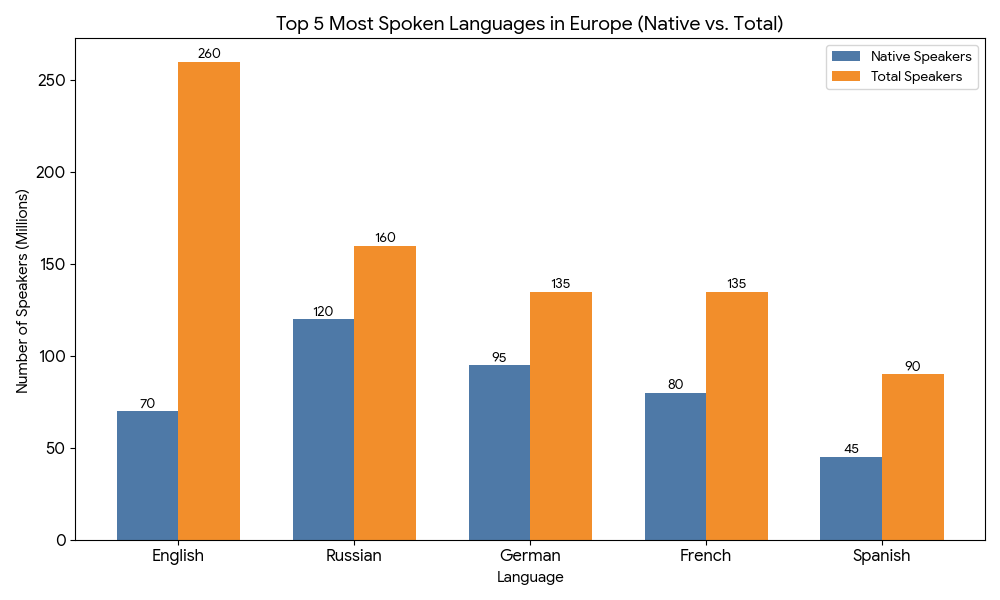
The most widely spoken language in Europe is Russian, with the most native speakers. More than 120 million people in Europe speak Russian as their first language, making it the largest by native speakers. Russian is mainly spoken in Russia, Belarus, and parts of Ukraine and the Baltic states.
Its widespread use stems from Russia's large population and its former status as a common language in the region. About 15% to 18% of Europeans are native Russian speakers. If you include people who speak a language as a second language, though, English comes out on top.
5 Lesser-Known Facts About the Russian Language
- Due to technical systems, every astronaut visiting the ISS must learn Russian; it is scientifically classified as a "critical" survival language.
- Science shows that Russian speakers may perceive colours differently; they have two distinct words for "blue" (sinis and goluboy), and studies suggest their brains categorise these shades faster than English speakers'.
- Linguistically, Russian is famous for 'akanie', in which the unstressed 'o' is pronounced as 'a', changing the word’s phonetic structure depending on emphasis.
- Surnames in Russian are scientifically linked to genetics and gender; they change suffixes (e.g., -ov for males and -ova for females) to provide immediate biological context.
Top 7 Most Spoken Languages in Europe (2026)
Russian has the most native speakers in Europe, but English is spoken by more people overall. More than 190 million Europeans have learned English as a second language, so it is the main language for international communication, business, and travel in the region.
| Rank | Language | Native Speakers (Approx.) | Total Speakers in Europe | Primary Countries |
| 1 | English | 70 Million | 260 Million | UK, Ireland, Malta |
| 2 | Russian | 120 Million | 160 Million | Russia, Belarus, Ukraine |
| 3 | German | 95 Million | 135 Million | Germany, Austria, Switzerland |
| 4 | French | 80 Million | 135 Million | France, Belgium, Switzerland |
| 5 | Spanish | 45 Million | 90 Million | Spain |
| 6 | Italian | 65 Million | 82 Million | Italy, Switzerland, San Marino |
| 7 | Turkish | 78 Million | 80 Million | Turkey, Cyprus, Bulgaria |
Conclusion: Which Language is Truly the "Most Spoken"?
The answer depends on how you measure it. For native speakers, Russian leads with 120 million speakers, mainly due to Russia's large population. For total speakers, including those who learnt it as a second language, English comes first with 260 million. English is the bridge language for business, science, and travel. While most Europeans were not born speaking English, almost half the continent now understands and uses it daily.
WHAT'S NEXT| Which is the Most Spoken Language in the World?

Kriti Barua is a skilled digital journalist and communications professional with 4+ years of experience, currently writing for the General Knowledge section at Jagran New Media. She has established herself as a subject matter expert in History, Geography, Trending National and International News, Sports, Science, and Defence, producing clear, reliable, and search-optimised content that connects with readers worldwide.
Kriti holds a BA degree from Delhi University and a one-year diploma in TV Production and Journalism, an academic background that adds research depth and strong storytelling instincts to her writing. Her experience spans brand writing, content marketing, and digital media, giving her a sharp understanding of what makes content both helpful to readers and visible in search.
At Jagran New Media, she applies this expertise to national and international news coverage, query-based articles, and in-depth pieces across her specialist subject areas. Her content is defined by easy language, factual accuracy, strong keyword strategy, and reader-friendly storytelling.