Types of Taxes In India: Classification, Features, Direct Tax & Indirect Tax
India’s taxation system is a federal structure divided into direct and indirect taxes. the article highlights the New Income Tax Act, 2025 and GST 2.0 reforms, aiming for transparency and simplified compliance. Read more about the types of taxes in India and their classification and features.
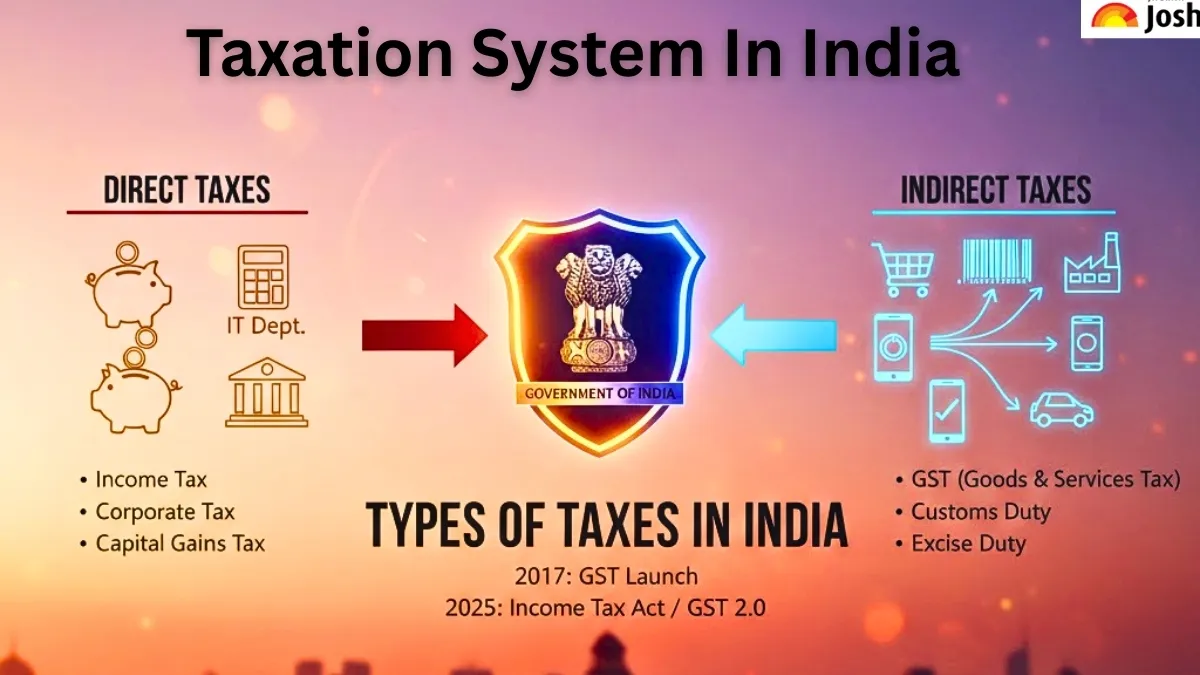
Taxation in India is the primary tool for the government to generate revenue, which is subsequently used for infrastructure development, social welfare, and national security. The system is a progressive tax system, direct taxes and consumption-based indirect taxes.
As of April 1, 2026, the Indian tax regime has entered a "New Era of Transparency." The introduction of the New Income Tax Act, 2025 and GST which is based on the digital-first approach designed to reduce litigation and ease the compliance burden for taxpayers.
Taxation System In India
In India, taxes are categorized into two primary buckets such as Direct Taxes and Indirect Taxes based on the point of levy and the transferability of the tax burden. Tax is collected and levied by different authorities and levy taxes are derived from the Constitution of India. It follows a three-tier federal structure:
-
Central Government: Authorized to levy taxes on income except agricultural income, customs duties, and central GST.
-
State Government: Authorized to levy agricultural income tax, state GST, stamp duty, and land revenue.
-
Local Bodies: Authorized to levy property tax and local utility fees.
New Income Tax System 2025:
The Union Budget 2026 introduced the Income Tax Act, 2025, which replaces the legacy Income Tax Act of 1961. This change is aimed at reducing the number of sections, simplifying language, and integrating automated, digital-first assessment procedures to provide clarity and transparency to all taxpayers.
Types of Taxes In India
The Indian taxation system is a multi-tier structure governed by the Constitution, which allocates the power to levy taxes between the Central and State Governments. Taxes are primarily classified into two categories: Direct Taxes and Indirect Taxes.
Direct Tax
In India, a Direct Tax is a levy where the incidence (legal liability) and impact (economic burden) fall on the same person or entity. The taxpayer pays this tax directly to the government, and its burden cannot be shifted to anyone else. The direct taxes generally levied by the Centre government, state government and local bodies. An administrative body is the Central Board of Direct Taxes (CBDT), functioning under the Department of Revenue, Ministry of Finance.
Types of Direct Taxes Levied by Central Government
1. Personal Income Tax:
It is levied on the annual income of Individuals, Hindu Undivided Families (HUFs), and Association of Persons.
-
Progressive in Nature: Rates increase as the income level rises, promoting social equity.
-
Recent Reform: The Income-tax Act, 2025 is set to replace the Income Tax Act 1961 from April 1, 2026. It aims to simplify the code, reduce the number of sections from 819 to 536, and replace "Assessment Year" and "Previous Year" with a unified term: "Tax Year".
2. Corporate or Corporation Tax:
Levied on the net profit earned by companies (both domestic and foreign) from their business operations.
-
Minimum Alternate Tax (MAT): To prevent companies with substantial profits from paying zero tax through various exemptions, MAT ensures a minimum contribution.
-
2026 Update: The Union Budget 2026-27 proposes making MAT a final tax, reducing the rate from 15% to 14% starting April 1, 2026.
3. Capital Gains Tax (CGT):
Levied on the "gains" or profits made from the sale of a capital asset (e.g., real estate, stocks, gold).
-
STCG (Short-Term): For assets held for a shorter duration (e.g., 12-36 months depending on the asset).
-
LTCG (Long-Term): For assets held for longer periods, often taxed at concessional rates (e.g., 10% or 20% with indexation).
-
Key Change: Budget 2026 mandates that share buybacks will now be taxed as Capital Gains in the hands of all shareholders.
4. Securities Transaction Tax (STT):
Introduced in 2004 to curb capital gains tax evasion. It is levied on every purchase and sale of securities (shares, derivatives, mutual funds) on recognized stock exchanges.
-
Latest Hike: As of 2026, STT on Futures has been raised to 0.05% and on Options to 0.15%.
5. Equalization Levy ("Google Tax"):
Introduced in 2016 to tax digital transactions of non-resident e-commerce/advertising companies (like Google, Facebook) that earn revenue from India without having a physical permanent establishment here.
II. Direct Taxes Levied by States Governments
1. Professional Tax:
A state-level tax on professions, trades, and employment.
-
Under Article 276 of Indian Constitution, the maximum limit is ₹2,500 per year.
-
It is deductible from the individual’s gross income for the purpose of calculating Central Income Tax.
2. Agricultural Income Tax:
The Constitution empowers State Governments to levy tax on agricultural income. Currently, most states do not levy this tax, or do so only on specific plantation crops.
III. Direct Taxes Levied by Local Bodies
1. Property Tax:
Also known as House Tax, it is a direct tax paid by the property owner to the local municipal body (e.g., BMC, MCD). It is non-transferable and based on the annual rental value or unit area value of the property.
Abolished Direct Taxes
-
Wealth Tax: Abolished in 2015 (replaced by an additional surcharge on high-income groups).
-
Gift Tax: Abolished in 1998; however, gifts above ₹50,000 are now treated as "Income from Other Sources" under the Income Tax Act.
-
Estate Duty: Abolished in 1985.
-
Dividend Distribution Tax (DDT): Abolished in 2020; dividends are now taxable directly in the hands of the shareholders.
Features of Direct Taxes:
-
These are levied directly on the earnings of individuals Income Tax or the profits of companies (Corporate Tax or wealth Tax).
-
Direct tax is based on progressive nature, as a person’s income increases, the tax rate also increases (Slab system). This ensures that those with the "ability to pay" contribute more to the nation's treasury.
-
It creates a direct bond between the citizen and the state. Taxpayers are more conscious of how the government spends their money because they see the deduction from their earnings.
-
Direct taxes are highly elastic when the economy grows and incomes rise, the government's tax revenue increases automatically without needing to change tax rates.
-
Direct taxes are a tool for controlling inflation, the government can hike direct taxes to reduce the "disposable income" in the hands of the public, thereby cooling down excess demand and controlling inflation.
-
To maintain the equity and social justice by taxing the rich at higher rates and providing exemptions to the poor (e.g., no tax up to ₹12 lakh in the New Regime), it helps reduce the gap between the haves and the have-nots.
Indirect Tax
Indirect taxes are consumption-based levies This tax is usually imposed on goods and services where the incidence (the entity responsible for paying the tax to the government) and impact (the person who actually bears the cost) are different. These taxes are collected by intermediaries (like retailers) from the final consumer.
In India Indirect Taxes are managed by the Central Board of Indirect Taxes and Customs under the Ministry of Finance
For your UPSC preparation, understanding the features of both Direct and Indirect taxes is essential for answering questions on fiscal policy, social equity, and economic stability.
Below are the comprehensive features for both categories, following the structure and official terminology used by top-tier resources like Vision IAS and Vajiram & Ravi.
I. Goods and Services Tax (GST) 2.0
Introduced as the "One Nation, One Tax," GST subsumed 17 major indirect taxes and 13 cesses under the GST 2.0 reforms (effective late 2025), the system has moved toward a simplified structure to reduce litigation.
1. The Three-Tier Structure
-
CGST (Central GST): Collected by the Centre on intra-state sales.
-
SGST/UTGST (State/Union Territory GST): Collected by the State/UT on intra-state sales.
-
IGST (Integrated GST): Levied on inter-state trade and imports. The Centre collects it and shares it with the destination state.
2. Revised Tax Slabs (2026) Under the GST 2.0
The GST Council has rationalized the previous four-slab system into a primarily two-rate system:
-
0% (Exempt): Unpackaged food, 33 lifesaving drugs, and now Health & Life Insurance premiums (a major 2026 reform).
-
5% (Merit Rate): Packaged food, diagnostic kits, and renewable energy devices.
-
18% (Standard Rate): Most manufactured goods, small cars, TVs, ACs, and construction materials like cement (reduced from 28%).
-
40% (Demerit/Sin Rate): Tobacco, aerated drinks, and super-luxury cars.
II. Customs Duty
Customs duty remains a separate indirect tax levied on goods entering (Import) or leaving (Export) the country. It is governed by the Customs Act, 1962.
-
Basic Customs Duty (BCD): The standard rate applied to imports.
-
Rationalization 2026: The Budget 2026-27 removed several BCD exemptions to support "Make in India." However, BCD was exempted for capital goods used in Lithium-ion cell manufacturing and Critical Minerals processing to boost the green economy.
-
Social Welfare Surcharge (SWS): Usually 10% on the aggregate of customs duties.
III. Central Excise Duty
While mostly subsumed by GST, the Central Government still levies Excise Duty on products that are outside the GST ambit:
-
Petroleum Products: Petrol, Diesel, Crude Oil, Natural Gas, and Aviation Turbine Fuel (ATF).
-
Tobacco: Tobacco and tobacco products carry both GST and Central Excise.
-
Biogas Reform: To promote green energy, the 2026 Budget excludes the value of biogas when calculating excise duty on biogas-blended CNG.
IV. State-Level Indirect Taxes (Outside GST)
States retain the power to levy taxes on specific items to protect their revenue:
-
State Excise Duty: Primarily on Alcoholic Liquor for human consumption.
-
Stamp Duty & Registration Fees: Levied on the transfer of immovable property (real estate).
-
Electricity Duty: Tax on the consumption and sale of electricity.
-
Entertainment Tax (Local): While the state entertainment tax is subsumed, local bodies (Panchayats/Municipalities) can still levy a small local entertainment tax.
Features of Indirect Taxes:
-
Indirect taxes are consumption-based and affect the general price level.
-
Tax on Consumption: It is levied on the sale, manufacture, or provision of goods and services rather than on wealth or income.
-
Paid Indirectly: The consumer does not pay the government directly. Instead, intermediaries manufacturers/retailers collect the tax and remit it to the state.
-
Indirect taxes are regressive in nature since the tax rate is the same for a specific product (e.g., a packet of biscuits), a poor person pays the same amount of tax as a rich person. This results in a higher "burden" on the poor relative to their income.
-
Broad tax base, indirect taxes reach everyone from a child buying a chocolate to a corporation buying machinery ensuring a massive revenue base for the government.
-
Impact on pricing and spending, the tax is included in the Maximum Retail Price (MRP), any hike in indirect taxes (like GST) leads to immediate inflation and can reduce overall consumer demand.
List of Direct Taxes & Indirect Taxes
| Type of Tax | Direct Taxes | Indirect Taxes |
| Primary Body | CBDT (Central Board of Direct Taxes) | CBIC (Central Board of Indirect Taxes & Customs) |
| Central Level | Personal Income Tax: Based on slabs in the Income Tax Act, 2025. | GST 2.0 (CGST/IGST): Unified tax on goods/services (5%, 18%, 40% slabs). |
| Corporate Tax: Tax on company profits (Reduced rates for new mfg. units). | Customs Duty: Tax on imports/exports (BCD, SWS, Anti-dumping). | |
| Capital Gains Tax (CGT): On sale of assets like Shares, Real Estate, Gold. | Central Excise: Only on non-GST items (Petrol, Diesel, Tobacco). | |
| Securities Transaction Tax (STT): On stock market trades. | Cess & Surcharge: e.g., Compensation Cess on sin goods. | |
| Equalization Levy: Tax on digital/online ads from foreign entities. | ||
| State Level | Professional Tax: On employment (capped at ₹2,500/year). | SGST/UTGST: State portion of the Goods & Services Tax. |
| Agricultural Income Tax: Levied by specific states on plantation crops. | State Excise: Primarily on Alcoholic Liquor for human consumption. | |
| Stamp Duty & Registration: On property transfers and legal docs. | ||
| Electricity Duty: Tax on power consumption. | ||
| Local Level | Property Tax: Paid by owners to Municipalities/Panchayats. | Toll Tax / Entry Tax: (Where not subsumed by GST). |
Also Read: What is Direct Tax & Indirect Tax?

Manisha Waldia is a distinguished content strategist with 5 years of experience crafting premium educational content for UPSC and State PCS, with a focus on deep conceptual analysis across Polity, Geography, History, and Environment. She currently brings this expertise to Jagran Josh, where she covers major national and international events, current affairs, and static general knowledge. Over her career, Manisha's specialized insights have led her to curate high-impact materials and serve as a UPSC Mains answer-evaluator for India’s top institutes—including Drishti IAS, Shubhra Ranjan IAS, Study IQ, GS Score, and PWonlyIAS. She has also worked alongside leading NGOs like Oxfam India and Avani Kumaon.
Contact: manisha.waldia@jagrannewmedia.com