Which is the First City in India to Install Removable Solar Panels Between Railway Tracks?
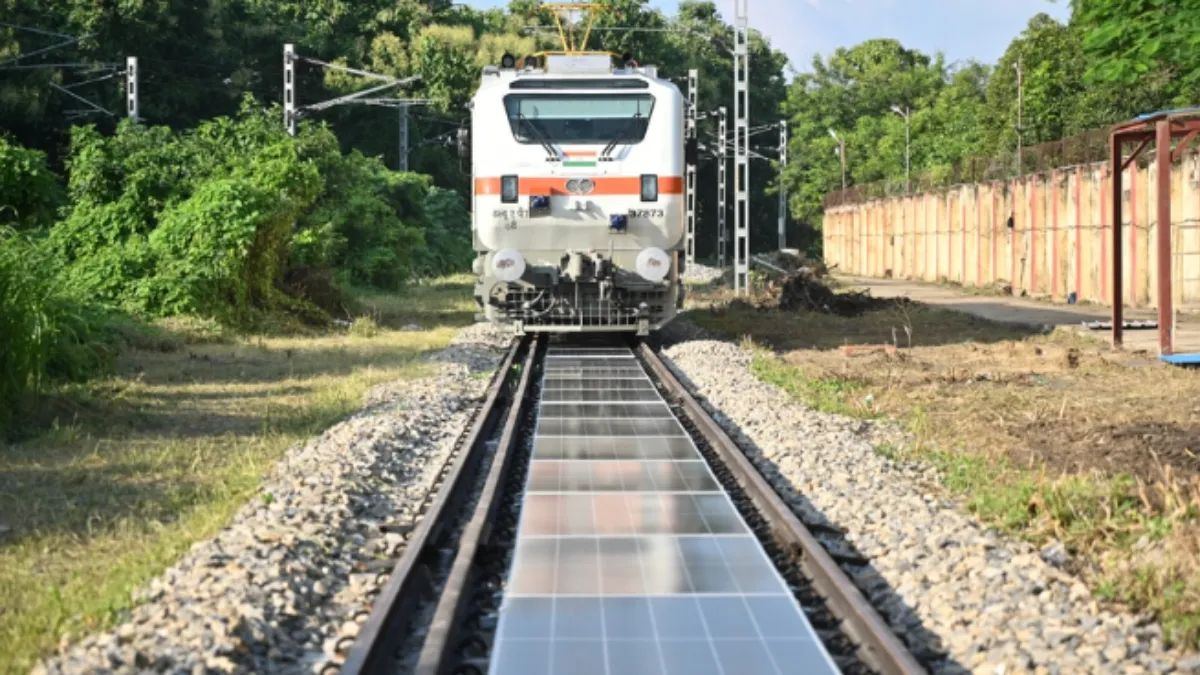
Varanasi has become the first city in India to install removable solar panels between railway tracks, launched by Banaras Locomotive Works (BLW). This innovative project generates renewable energy using unused track space, supports India’s Net-Zero 2070 target, and showcases a scalable, eco-friendly model for Indian Railways’ sustainable future.
India is surging in achieving Net-Zero Carbon emissions, which is to be achieved by 2070 and 70% by 2030. Indian Railway has taken a significant step toward achieving to complete it target.
Recently, Varanasi (Uttar Pradesh) has become the first city in India to install removable solar panels between railway tracks.
This initiative was launched by Banaras Locomotive Works (BLW). This project not only promotes renewable energy in India but also makes use of unused track space, avoiding the need for land acquisition.
Which Is The First City In India To Install Removable Solar Panels Between Railway Tracks?
On August 18, 2025, Varanasi (Uttar Pradesh) became the first city in India to install removable solar panels between railway tracks.
🚆 Indian Railways marks a historic first!
— Ministry of Railways (@RailMinIndia) August 18, 2025
Banaras Locomotive Works, Varanasi commissioned India’s first 70m removable solar panel system (28 panels, 15KWp) between railway tracks—a step towards green and sustainable rail transport. pic.twitter.com/BCm2GTjk7O
Highlights of the Project
Location: It is located in the Banaras Locomotive Works (BLW), Varanasi
Type of Project: This is India’s first removable solar panel system between railway tracks
Length of Installation: Approx 70 metres
Number of Panels: It has 28 panels
Capacity: It has a capacity of 15 kWp
Power Density: 2It has 40 kWp/km power Density
Energy Generation: ~960 units per km per day
Potential Output: 3.5 lakh units per km per year
What are the technical features of the solar panels
Technical features of the solar panels
Technology Used: Half-cut mono-crystalline PERC bifacial cells
Efficiency: 20.15%
Voltage (mp): 41.78 V
Current (mp): 13.24 A
Durability: Removable design for maintenance & seasonal adjustments
Junction Box: IP68 (waterproof & dustproof)
Technical Details of the Pilot Project
| Parameter | Details |
| Track Length Covered | 70 metres |
| No. of Panels | 28 |
| Total Capacity | 15 kWp |
| Power Density | 240 kWp/km |
| Daily Energy Generation | 960 units/km/day |
| Annual Energy Potential | 3.5 lakh units/km |
What is the significance of the solar panels between the railway tracks?
-
No Land Acquisition: Uses existing track space.
-
Eco-Friendly: Reduces dependence on fossil fuels.
-
Scalable Model: With 1.2 lakh km of railway track in India, the potential is massive.
-
Supports Net-Zero Goal: A step toward Indian Railways’ 2030 target.
-
Innovative Design: Removable solar panels for flexible maintenance.
Conclusion
Toward the Net-Zero Carbon Emmison, India is now moving towards the cut of emissions of carbon by the installation of portable solar panels in Varanasi, marking a historic first for Indian Railways. If replicated nationwide, this model could revolutionise renewable energy generation in India, making rail transport cleaner and more sustainable.

Prabhat Mishra is a Subject Matter Expert and digital journalist with an extensive background in the competitive exam landscape and over 4 years of experience in education, national and international news, and current affairs. Over his tenure with top knowledge platforms like Mentorship India, IAS BABA, IAS SARTHI, and now Jagran Josh, he has a deep understanding of government exams like UPSC and State PCS, including UP and Bihar, as he has already qualified for the UPPCS 2022 Mains and Bihar 68th Mains. With his core expertise in history, polity, geography & current affairs, he specialises in creating well-researched, aspirant-centric content and simplifying complex topics for competitive examinations.