IISER Bhopal Study Finds Unusual Time-Reversal Behaviour In A Type-I Superconductor


IISER Bhopal researchers have found evidence of unusual time-reversal behaviour in a Type-I superconductor, marking a significant development in physics as unconventional behaviour has generally been associated with Type-II superconductors.
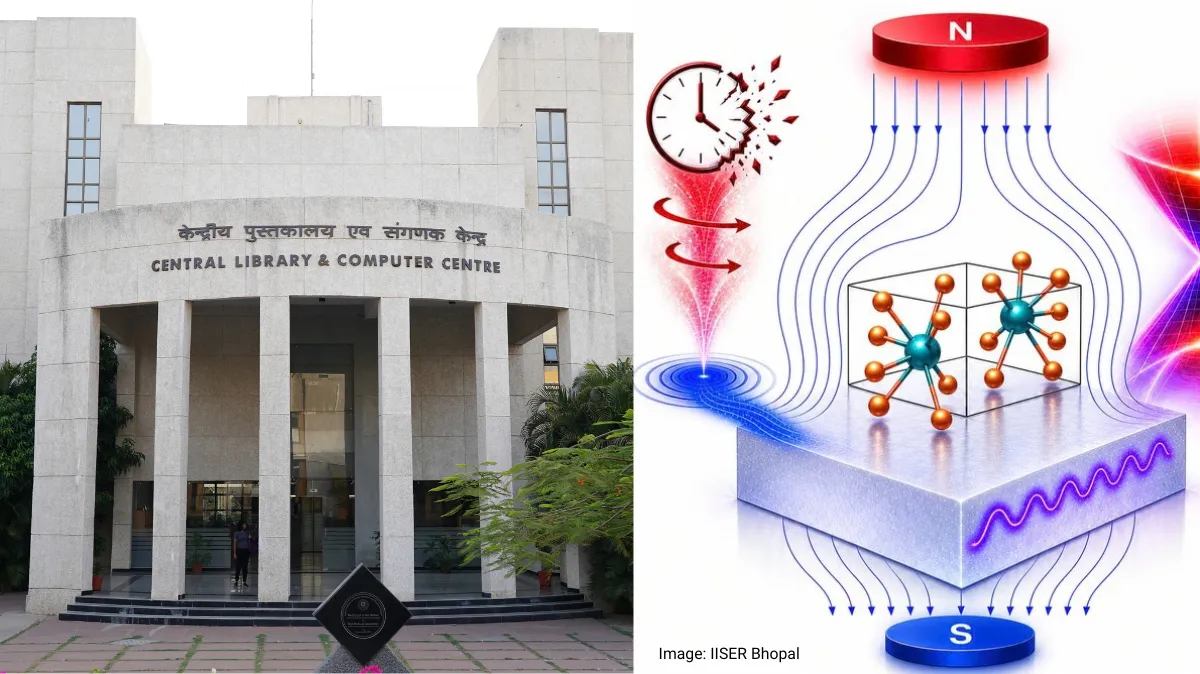
An Indian Institute of Science Education and Research (IISER) Bhopal study has found evidence of unusual time-reversal behaviour in a Type-I superconductor. Type-I superconductors are generally considered a simpler class of superconducting materials, while Type-II superconductors are more commonly associated with unconventional superconducting behaviour.
The finding involves the breaking of time-reversal symmetry, which means the physical behaviour of the material changes when the direction of time is mathematically reversed. Such behaviour has generally been associated with more complex superconducting systems, making its observation in a Type-I superconductor particularly notable.
The researchers describe YbSb₂ as the first known Type-I example showing this behaviour. The finding could provide a cleaner platform for studying exotic electron pairing, as well as the links between superconductivity, magnetism and topology. Researchers may also investigate whether such materials can support unusual quantum states, including Majorana modes, which are of interest in research on quantum computing.
What is time-reversal symmetry?
In physics, time-reversal symmetry refers to the idea that the basic behaviour of a physical system should remain unchanged if the direction of time is mathematically reversed. When this symmetry is broken, the system shows a difference between its behaviour in the forward and reversed-time descriptions. In superconductors, observing such a break can provide clues about how the superconducting state is formed.
Anshu Kataria of the IISER Bhopal team, in collaboration with researchers from the Indian Institute of Technology Kanpur (IITK) and the ISIS Neutron and Muon Source, observed spontaneous internal magnetic fields when YbSb₂ entered its superconducting state. In simple terms, the material appeared to generate tiny magnetic fields within itself as it became superconducting, without an external magnetic field being applied.
The observation provides evidence that YbSb₂ breaks time-reversal symmetry in its superconducting state. This is significant because time-reversal symmetry breaking is associated with unconventional forms of superconducting pairing - the way electrons pair up to produce superconductivity.
According to IISER Bhopal, the finding provides a new platform for studying the relationship between superconductivity, magnetism and topology. In other words, the material could help researchers better understand how the unusual magnetic properties of a superconductor may be connected to the way its electrons behave and to the underlying topological properties of the material.
𝗜𝗜𝗦𝗘𝗥 𝗕𝗛𝗢𝗣𝗔𝗟 | 𝗥𝗘𝗦𝗘𝗔𝗥𝗖𝗛 𝗕𝗥𝗘𝗔𝗞𝗧𝗛𝗥𝗢𝗨𝗚𝗛
— IISER Bhopal (@iiserbhopal) September 28, 2026
𝗧𝗶𝗺𝗲-𝗥𝗲𝘃𝗲𝗿𝘀𝗮𝗹 𝗦𝘆𝗺𝗺𝗲𝘁𝗿𝘆 𝗕𝗿𝗲𝗮𝗸𝗶𝗻𝗴 𝗗𝗶𝘀𝗰𝗼𝘃𝗲𝗿𝗲𝗱 𝗶𝗻 𝗮 𝗧𝘆𝗽𝗲-𝗜 𝗦𝘂𝗽𝗲𝗿𝗰𝗼𝗻𝗱𝘂𝗰𝘁𝗼𝗿
What happens when a phenomenon usually associated with unconventional… pic.twitter.com/bxPk2O42uv
What Are Superconductors?
Superconductors are materials that can carry electric current with zero electrical resistance when cooled below a particular temperature called the critical temperature. This means that, under suitable conditions, electricity can flow through them without the energy loss normally associated with electrical resistance.
Superconductivity is also linked to another important phenomenon called the Meissner effect, in which a superconductor expels magnetic fields from its interior as it enters the superconducting state.
Scientists broadly classify superconductors into Type-I and Type-II based on how they respond to magnetic fields.
What Is The Difference Between Type-I And Type-II Superconductors?
Type-I superconductors generally show a simpler response to magnetic fields. Below a particular critical magnetic field, they can remain superconducting and expel the magnetic field. Once that limit is exceeded, superconductivity can be lost.
Type-II superconductors, on the other hand, can tolerate much stronger magnetic fields. They have two critical magnetic-field limits and can enter an intermediate state where magnetic flux passes through the material in tiny regions while the material continues to remain superconducting.
This difference makes Type-II superconductors particularly important in applications involving strong magnetic fields. They are also commonly studied in research into unconventional superconductivity.
ALSO READ| NCERT Class 9 Social Science Part 2 Textbook To Be Available Today: What Students Need To Know
Sahil Behl is an education journalist at Jagran with over a year of experience in journalism. Prior to joining Jagran, he worked as a Sub-Editor in NDTV’s Education department, where he was responsible for writing and editing education-related content as well as managing the department’s social media presence. At Jagran, he covers a wide range of education topics, including board examinations, school updates, admissions, and job notifications, while leveraging his editorial expertise and strong understanding of digital content strategy. Sahil holds a Bachelor’s degree in Business Administration and has also completed an eight-month certification program in Data Science. Passionate about emerging technologies, particularly artificial intelligence, he closely tracks their growing role in journalism and explores how they are transforming shaping the future of the media industry.

-1790659220163_t.webp)

