Explained: Asahi Illusion and how it sheds light on the evolution of the eye
Asahi Illusion is a bright optical illusion that tricks our eyes and mind to believe that it is actually much brighter than what it seems by playing with our perception of brightness. New studies show even rats are fooled by this illusion. Read more.
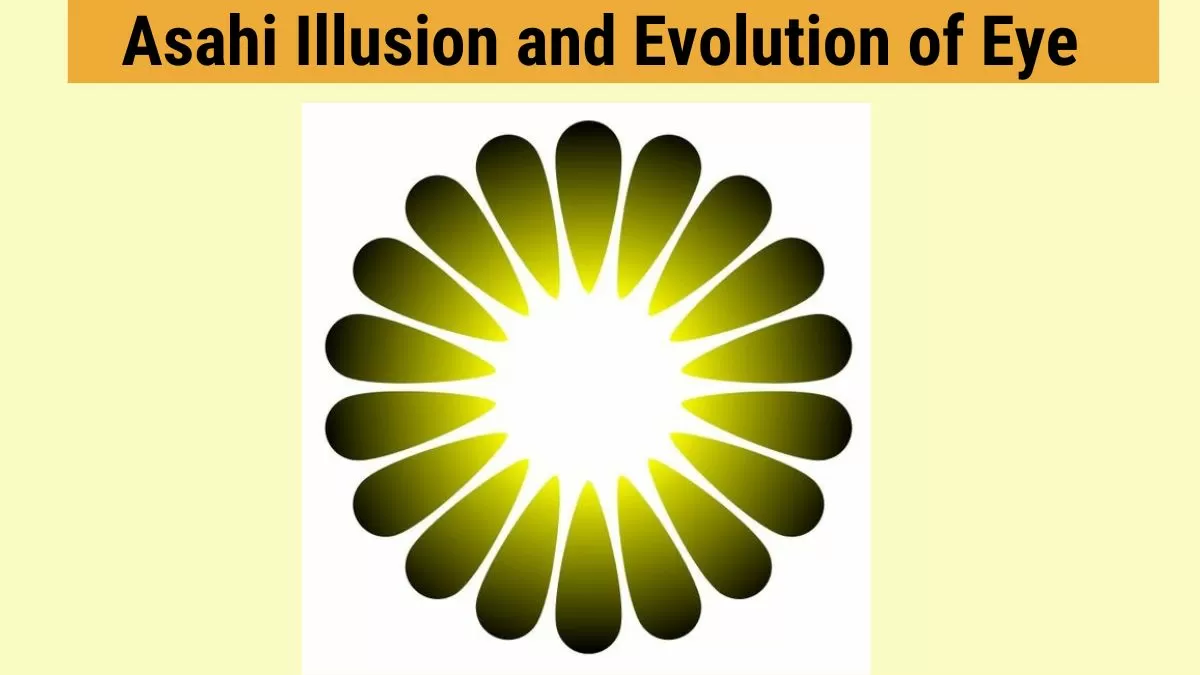
Asahi Illusion: An illusion that has tricked human minds for a long time is now found to be tricking rats also. The illusion is known as Asahi Illusion and it is playing an important role in understanding how our eyes evolved over the course of development.
Let us dive in to read more about the Asahi Illusion.
What is Asahi Illusion?

Source : Akiyoshi Kitaoka
Asahi Illusion is a bright illusion that resembles a glowing sun at first glance. It consists of a series of petal-like shapes surrounding a centre.
The design of this optical illusion is such that centre of the illusion has a yellow colour, while the edges become black.
It resembles a glowing sun covered by dense foliage and it tricks human eyes into believing that the centre is more bright than the surrounding areas
This colour gradient combined with the petal shape provides the impression that the white centre is brighter than it actually is.
Asahi Illusion - Evolution of Eye
This was found in a study conducted in 2012 by Dr. Bruno Laeng and his team, in which it was established that our brains perceive the bright light to be overpowering like that of the sun and in response to this, our pupils constrict.
This constriction of the pupil is known as the pupillary reflex which helps protect the retinas against bright light and damage.
Their study indicated that there exists a connection between perception and pupil size evolved in mammals during the course of development.
According to Nelson Totah, from the University of Finland, these illusions trick the human mind.
He conducted the study to see if higher-level brain regions responded to these kinds of lower-level reflexes.
This study was conducted on rats also and was found that rats also respond to the illusion with constricted pupils.
Asahi Illusion - What Next
Researchers can now study the neurons involved in the illusion and how it brings about a change in bodily processes.
Also Read:
Hermann Grid Illusion: What it Reveals About Your Brain? Find Out Now.

Mriganka Chakraborty is a seasoned digital journalist and communications professional who is currently working as Deputy Manager at Jagran Josh, where he leads the General Knowledge Section. As a subject matter expert with 8+ years of editorial experience, he has created authoritative content that is trusted by millions of readers around the world in Science, History, Geography, Polity, Economy, Sports, and Technology. His extensive expertise in these subjects enables him to present complex topics in an engaging, accurate, and reader-friendly manner to a global audience, making learning addictive and fun.
His background in a wide range of content areas and his ability to move between them make him a trusted voice to readers who want reliable, well-researched content across a variety of disciplines.
In his leisure time, Mriganka enjoys reading fiction novels and watching action and thriller movies, and cricket, which not only hone his storytelling skills but also keep his editorial vision fresh and dynamic.


-1791106861750_t.webp)