Which was the Longest War in History?
Which was the Longest War in History? Let’s know about the longest wars in history, what was the longest war, and also the circumstances, origins, and aftermaths of the longest war in history.
Human history features many dramatic wars—some lasting days, as was the case with the famous Six-Day War; some stretching into years or decades, as was true with the complex period of the Hundred Years' War.
Nonetheless, the most remarkable event of the kind stands out as the one involving the longest battle, the Reconquista.
Incredibly long in its duration, the Reconquista is believed to have lasted for 781 years, between 711 AD and 1492 AD.
Starting out as the struggle in misty northern areas, it developed into a religious struggle aimed not only at taking possession of lands but also at restoring the supremacy of Christians in Spain, Iberian Peninsula.
"The Reconquest" (the Spanish translation of the name), unlike many other military events of the type, had no blood thirst involved in it but a Crusades-inspired urge to restore the glory of Christians on the territory invaded by Muslim Moors.
Which is the Longest War in History?
The Reconquista, the war that continued for 781 years, spanning from 711 AD to 1492 AD, is considered the longest war in history.
Christian dominions were looking to recover the land which had been captured by the Muslim Moors by takeover and set up the Al-Andalus state.
The fighting occurred on the Iberian Peninsula. The literal meaning of "Reconquista" in Spanish and Portuguese is ‘The Reconquest’.
While partly territorial, the campaign was fueled by a desire to restore Christian power to Iberia, leading to strong cultural and religious clashes and aligning with the ideology of the Crusades.
The Reconquista started as small-scale resistance by Christian states in northern Spain and gradually developed into a larger movement to reclaim territory.
Over time, kingdoms such as Castile, Aragon, and Portugal expanded their control southward. Important events like the Battle of Las Navas de Tolosa marked turning points that weakened Muslim power and accelerated Christian advances.
What was the Reconquista war?
The Reconquista was a long series of military campaigns in medieval Spain and Portugal by which Christian kingdoms made an effort to take back the Iberian Peninsula from Muslim rulers (often called Moors), who had controlled much of the Iberian Peninsula since the early 8th century. It continued intermittently for several centuries rather than as a single continuous war.
During this period, Christian states such as Castile, León, Aragon, and Portugal moderately stretched southward.
The Battle of Las Navas de Tolosa was a moment. This is where the Almohads lost to a group of Christians who worked together. The Christians. This made it easier for them to take over more places.
Ferdinand III of Castile took over cities like Córdoba and Seville. This meant that the Muslims had control over these areas.
By the 13th century, the Christians were in charge of most of Iberia. The only place that was still controlled by Muslims was the Kingdom of Granada. The Kingdom of Granada was a Muslim state in this area.
When did the Reconquista Start and End?
Generally considered to have begun around 718 CE, the Reconquista started with the Christian resistance at the Battle of Covadonga.
In this early encounter, Christian forces from the Kingdom of Asturias opposed Muslim rule, marking the first significant effort to reclaim territory in the Iberian Peninsula after the Muslim conquest of the early 8th century.
Reconquista, however, was not a continuous or unified movement in its initial centuries. Progress being slow and irregular, it was influenced by internal conflicts among Christian kingdoms and periods of strong Muslim political unity, such as under the Córdoba Caliphate.
From the 11th century onward, the Reconquista sped up as the Muslim unity weakened, with the growing strength of Christian states like Castile, Aragon, and Portugal.
A major landmark came with the Battle of Las Navas de Tolosa, where Christian forces surely overcame the Almohads. This victory opened the way for rapid territorial expansion into southern Spain. By the mid-13th century, a major part of the peninsula had been reconquered, leaving only the Muslim Kingdom of Granada.
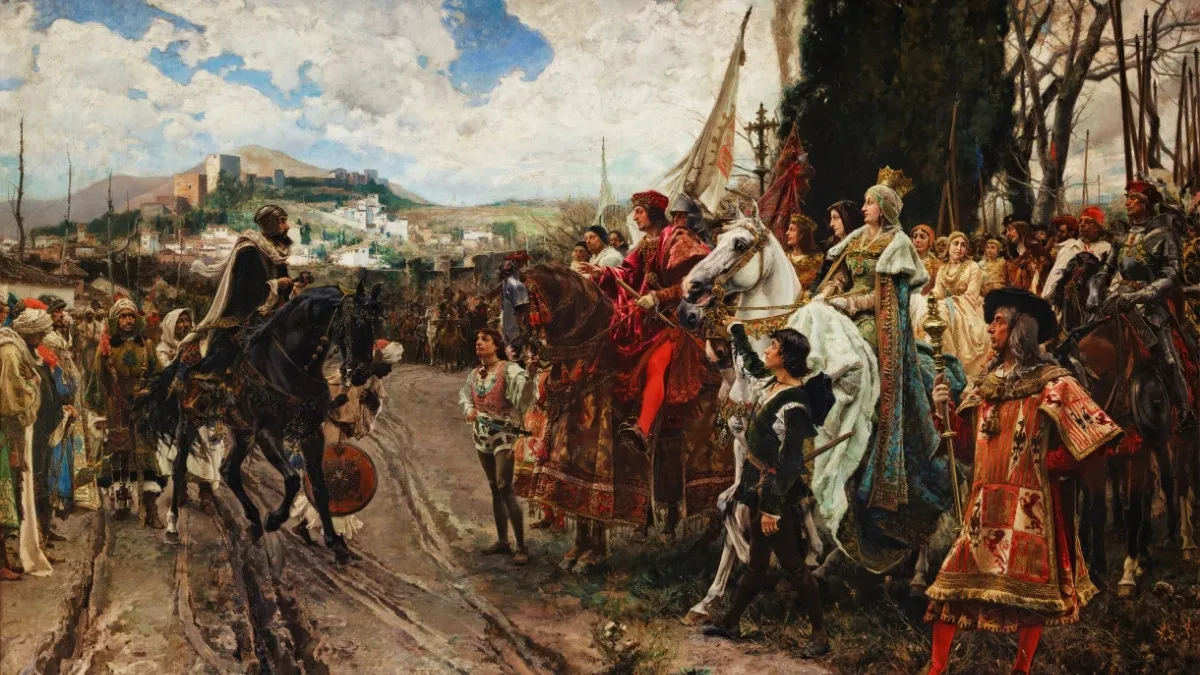
The Reconquista ended in 1492 when Ferdinand II of Aragon and Isabella I of Castile took control of Granada, the Muslim stronghold. This marked the end of an effort by Christians to reclaim their land. It helped Spain become one country under rule.
Conclusion
The Reconquista, which changed Iberia a lot, started with the Battle of Covadonga. It ended in 1492 when Granada fell to Ferdinand II of Aragon and Isabella I of Castile. The Reconquista changed politics, culture, and religion in Iberia. This, in turn, shaped Spain's identity.

Alisha Louis is a US content specialist with over 3 years of experience in journalism and storytelling. A graduate with a Bachelor’s degree in Journalism and Mass Communication (BJMC), Alisha has focused her career on covering trending news and major educational developments across the United States. Her sharp eye for detail, combined with a strong journalistic point of view, helps her break down complex American educational topics into accessible, engaging narratives for a global audience. Dedicated to delivering timely and trustworthy reporting, she brings a fresh and insightful perspective to the evolving US academic landscape.