National Large Solar Telescope: Key Objectives, Features & Latest Updates
The union Budget 2026-2027 proposed the Two mega telescopes National Large Solar Telescope and National Large Optical-Near Infrared Telescope to boost the Astronomical Infrastructure in India. Read the full article to explore the Key Objective and Features of the Telescopes.
Key Points
- Union Budget 2026-27 proposes NLST (solar) in Ladakh for solar magnetic field study.
- NLOT, a 12-13.7m telescope, will explore the early universe and exoplanets.
- NLOT will be installed in Hanle, Ladakh, part of India's first Dark Sky Reserve.
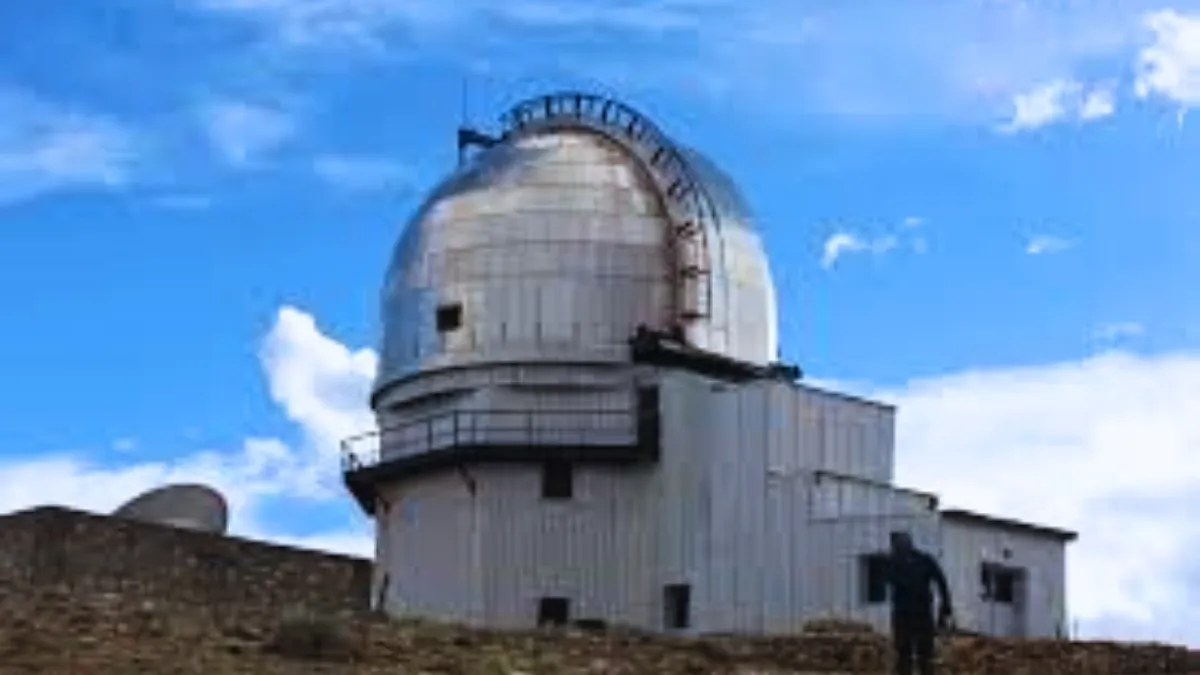
The union Budget 2026-2027 proposed the Two mega telescopes National Large Solar Telescope and National Large Optical-Near Infrared Telescope to boost the Astronomical Infrastructure in India. It will be established in Pongong lake in Merak, Ladakh, at an altitude of around 4200m.
National Large Solar Telescope (NLST):
National Large Solar Telescope (NLST) is a proposed ground based 2-m class optical and near infra-red (IR) observational facility in the Merak region near Pangong Tso Lake, Ladakh. It is designed to address an array of key scientific issues related to origin and dynamics of solar magnetic fields and study of the sun at a spatial resolution of 0.1-0.3 arc-second.
NLST will operate in the visible and near-Infrared wavelengths of the electromagnetic spectrum. It has a broad scope to support and substantiate the multitude of solar atmospheric observations from space-based ADITYA mission and ground based MAST telescope (Udaipur).
The telescope is installed at an altitude of around 4200m of Ladakh, being a high altitude desert, this location is best suited for optical and near IR observations, and provides significant periods of coronagraphic skies (high transparency). The laminar winds with mild gusts throughout the day provide periods of outstanding seeing.
It will fill the Longitudinal Gap, located between the solar observatories in Japan and Europe, the NLST will allow for continuous, 24-hour monitoring of the Sun
National Large Optical–Near Infrared Telescope(NLOT)
The National Large Optical-Near Infrared Telescope also known as NLOT is envisioned as India’s flagship ground-based optical facility, moving beyond the capabilities of current 4-meter class telescopes.
NLOT is a Deep Space Exploration to study the early universe, the birth of stars, and the morphology of distant galaxies. Identifying and characterizing planets orbiting other stars within our galaxy.
It will also study cosmic chemistry to analyze the chemical abundance of stellar atmospheres to understand the evolution of the Milky Way and follow up on transient events like Supernovae and Gamma-Ray Bursts (GRBs).
It is a 12–13.7 meter class telescope, significantly larger than the current 3.6m Devasthal Optical Telescope. NLOT has Segmented Mirror Technology (similar to the James Webb Space Telescope or the Thirty Meter Telescope), with segments polished at the India TMT Optics Fabrication Facility (ITOFF) near Bengaluru. The optimized wavelength range for both optical and near-infrared (0.3 to 5 microns) observations.
It will be installed in Hanle, Ladakh within the Indian Astronomical Observatory (IAO) campus. Hanle is part of India’s first "Dark Sky Reserve," offering some of the clearest skies in the world.

Manisha Waldia is a distinguished content strategist with 5 years of experience crafting premium educational content for UPSC and State PCS, with a focus on deep conceptual analysis across Polity, Geography, History, and Environment. She currently brings this expertise to Jagran Josh, where she covers major national and international events, current affairs, and static general knowledge. Over her career, Manisha's specialized insights have led her to curate high-impact materials and serve as a UPSC Mains answer-evaluator for India’s top institutes—including Drishti IAS, Shubhra Ranjan IAS, Study IQ, GS Score, and PWonlyIAS. She has also worked alongside leading NGOs like Oxfam India and Avani Kumaon.
Contact: manisha.waldia@jagrannewmedia.com