Difference Between Himalayan Rivers and Peninsular Rivers: Origin, Features and Examples
Know the difference between Himalayan and Peninsular rivers, including their origin, nature, valleys, and examples.
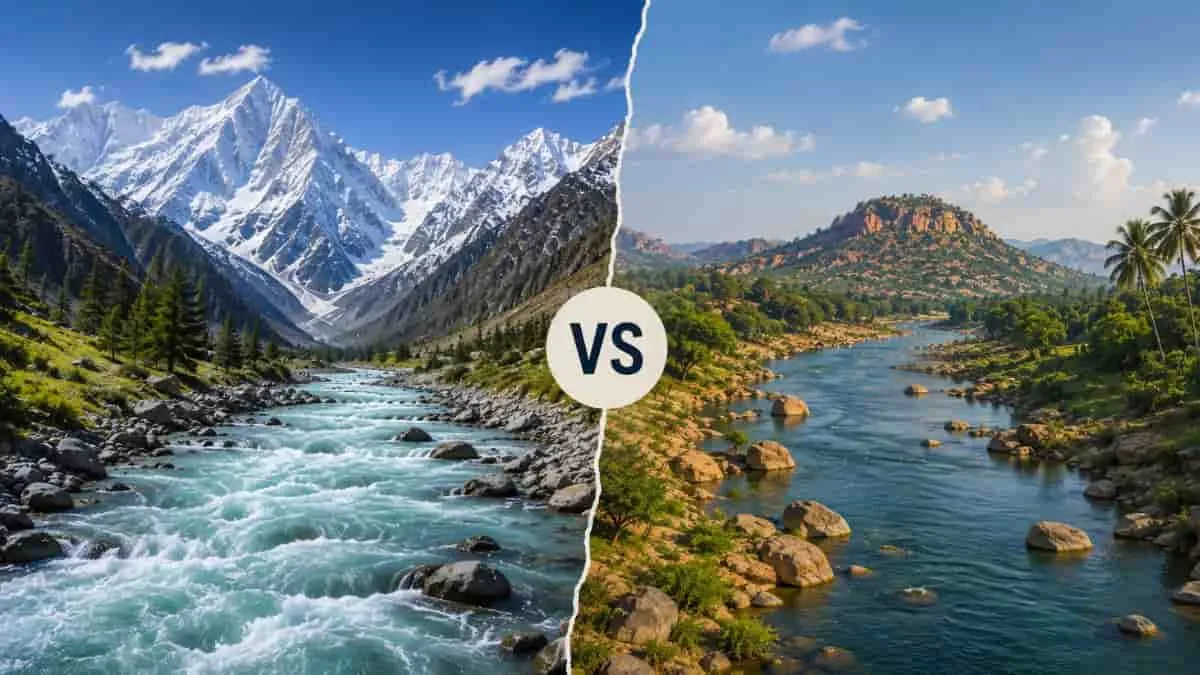
India has a very large river system and it is majorly divided into two groups which are Himalayan Rivers and Peninsular Rivers.
While these groups feature rivers themselves, there are a variety of differences between the two. They differ in origin, water supply, flow pattern, length, drainage pattern and valleys. Here is everything you need to know about differences between the Himalayan and Peninsular rivers.
What are Himalayan Rivers?
Himalayan rivers are already pretty defined by their name. These rivers originate from the Himalayan mountain system and it is still rising.
The water in these rivers come from two sources which are rainfall and melting snow and glaciers. Because of this double water source, many Himalayan rivers are active throughout the year and that is why they are also called perennial rivers.
What Are Peninsular Rivers?
Peninsular rivers originate from the Peninsular Plateau, Central Highlands and Western Ghats. The water source for these rivers is mainly monsoon rainfall and they don’t get any water from melting glaciers.
Peninsular rivers are usually shorter in length in comparison to the Himalayan rivers. Their courses are also more mature because the Peninsular Plateau is much older than the Himalayas.
Himalayan Rivers vs Peninsular Rivers: Main Differences
Here are differences between the two groups of rivers:
| Basis | Himalayan Rivers | Peninsular Rivers |
| Origin | Himalayan mountain system | Peninsular Plateau and Western Ghats |
| Water source | Rainfall and melting of glaciers | Mainly monsoon rainfall |
| Flow pattern | Perennial as they flow all year | Seasonal and depends on monsoon |
| Valleys | Deep gorges and V-shaped valleys | Broad and shallow valleys |
| Length | Longer length | Shorter length |
| Sediment load | Carry more sediment | Carry less sediment |
| Deltas | Form large deltas | Form smaller deltas |
Himalayan Rivers vs Peninsular Rivers: Difference in Origin
Himalayan Rivers rise in or around the Himalayan mountain system and many of them receive water from glaciers and snowfields.
Peninsular Rivers on the other hand rise mainly in the Peninsular Plateau and Western Ghats. Their sources are majorly dependent on rainfall.
Himalayan Rivers vs Peninsular Rivers: Difference in Water Supply
Himalayan rivers are generally perennial which simply means that these rivers flow all around the year. They get water from both rainfall and snow or glacial melt.
Peninsular rivers are majorly seasonal because monsoon rainfall is their main source of water. That is why during the summer their flow reduces.
Himalayan Rivers vs Peninsular Rivers: Difference in Sediment and Flooding
Himalayan rivers carry large amounts of sediment and the major reason is because they flow through young mountains that erode quickly. This sediment is known to provide great help to form fertile alluvial plains in North India.
In contrast, peninsular rivers carry less sediment. This is because they flow over older and harder rock.
Both river systems can cause floods. But the causes and intensity of flooding differ by region and season.
Himalayan Rivers: Major Examples
-
Indus
-
Ganga
-
Yamuna
-
Brahmaputra
-
Ghaghara
-
Gandak
-
Kosi
-
Sutlej
These rivers have many important tributaries. For example, the Yamuna, Ghaghara, Gandak and Kosi are all major tributaries of the Ganga.
Peninsular Rivers: Major Examples
-
Godavari
-
Krishna
-
Mahanadi
-
Kaveri
-
Narmada
-
Tapi
-
Pennar
-
Sabarmati
The Godavari is the longest river of Peninsular India. It is also called the Dakshin Ganga.

Nikhil is a dedicated digital journalist and communications professional with more than five years of experience, currently working within the General Knowledge section at Jagran Josh. He has established himself as a subject matter expert in Finance, Economy, History, Technology, and Trending News, consistently delivering accurate, engaging, and easy-to-read content for a wide global audience.
Over the course of his career, Nikhil has developed deep expertise in crafting informative listicles, viral trending stories. His editorial portfolio also spans finance, historical research, and technology reporting, making him a versatile and well-rounded content professional. Every piece he produces reflects a strong balance between factual accuracy and reader engagement.