Rajasthan Board RBSE Class 12th Political Science Syllabus 2026-27: Download PDF Here for Board Exam
Download RBSE Class 12 Political Science Syllabus 2026-27 PDF. Check chapter-wise topics, part-wise marks distribution, exam pattern and preparation tips for the Rajasthan Board Exam 2027.
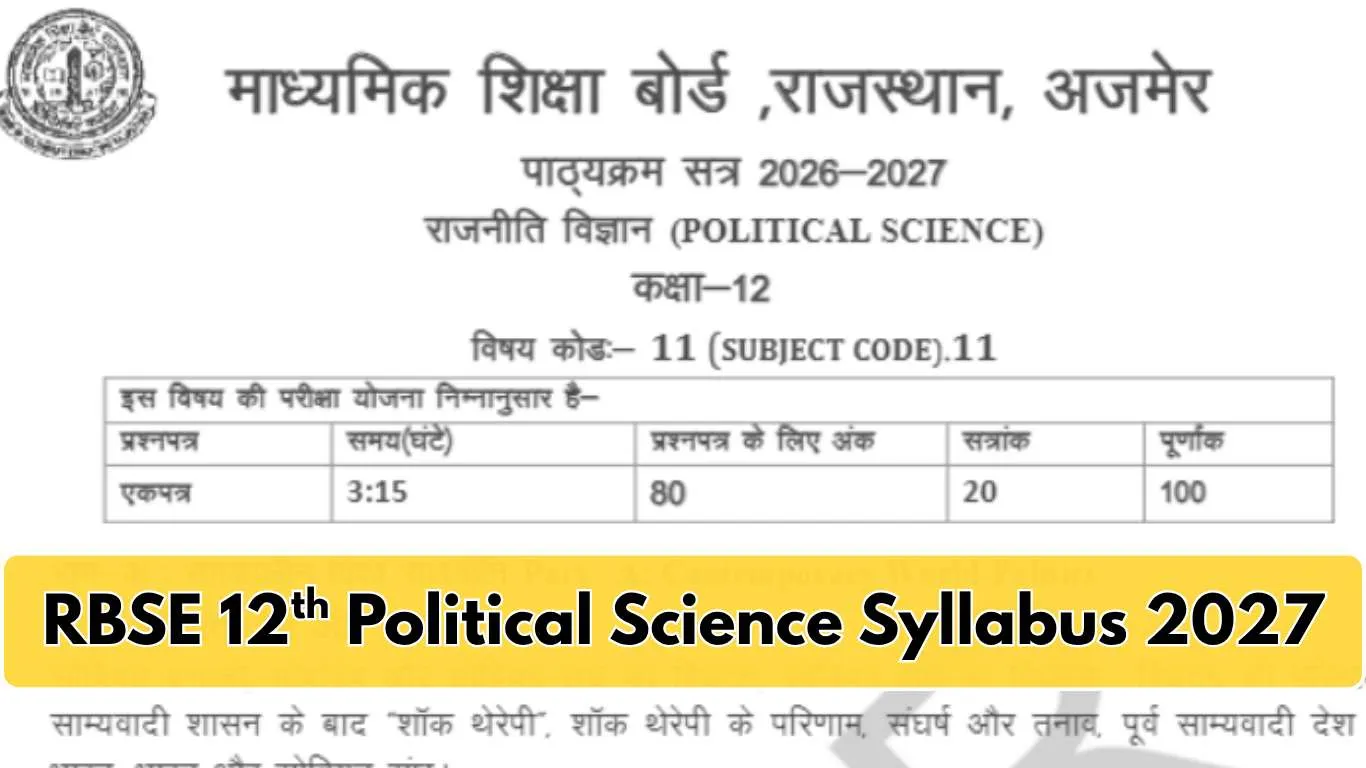
The Board of Secondary Education, Rajasthan (RBSE) has released the Class 12 syllabus for the academic session 2026-27. Students preparing for the Rajasthan Board Class 12 Political Science examination 2027 can check the subject-wise syllabus, chapter names, unit-wise marks distribution and examination details to plan their preparation.
Political Science is an important subject for students pursuing the Arts stream. The RBSE Class 12 Political Science syllabus 2026-27 covers two major sections: Contemporary World Politics and Politics in India Since Independence. Both sections carry equal weightage in the theory examination, with 40 marks allocated to each.
Students should download the latest RBSE Political Science syllabus PDF and review all prescribed chapters before beginning their board exam preparation. The syllabus will help them identify important topics, understand the course structure and avoid studying topics outside the prescribed curriculum.
Also Check: RBSE Class 12 Syllabus 2026-27, All Subjects
RBSE Class 12 Political Science Syllabus 2026-27: Overview
| Particulars | Details |
| Board | Board of Secondary Education, Rajasthan |
| Examination | RBSE Class 12 Board Exam 2027 |
| Academic Session | 2026-27 |
| Class | 12th |
| Subject | Political Science |
| Subject Code | 11 |
| Stream | Arts |
| Theory Marks | 80 |
| Session/Internal Assessment | 20 |
| Total Marks | 100 |
| Exam Duration | 3 Hours 15 Minutes |
| Syllabus Availability | Online PDF |
RBSE Class 12 Political Science Syllabus 2026-27: Part-Wise Marks Distribution
The Rajasthan Board Class 12 Political Science syllabus is divided into two major parts. Each part carries 40 marks in the theory examination, making the total weightage 80 marks.
| Part | Subject | Marks |
| Part A | Contemporary World Politics | 40 |
| Part B | Politics in India Since Independence | 40 |
| Total | 80 |
Students should prepare both parts thoroughly, as they have equal weightage in the final examination.
RBSE Class 12 Political Science Chapter-Wise Syllabus 2026-27
Part - A: Contemporary World-Politics
The End of Bipolarity (06 Marks)
The Soviet System, Gorbachev and the Soviet Union disintegration, Disintegration of the Soviet Union, Consequences of disintegration, Shock Therapy in post-communist regimes, Consequences of shock therapy, Tension and Conflicts, India and post communist countries, India and the USSR.
Contemporary Centers of Power (06 Marks)
European Union, Associations of South East Asian Nations (ASEAN), the Rise of the Chinese Economy, India –China Relations, Japan, South Korea.
Contemporary South Asia (06 Marks)
South Asia, The Military and Democracy in Pakistan, Democracy in Bangladesh, Monarchy and Democracy in Nepal, Ethnic Conflict and Democracy in Sri Lanka, India-Pakistan Conflicts, India and its other neighbours, Peace and Cooperation.
International Organizations (06 Marks)
Importance of International Organizations, Evolution of the UNO, Reform of the UNO after the Cold War, Reform of Structures and Process, Jurisdiction of the UNO, India and the UNO Reforms, The UNO in a Unipolar World, IMF, World Bank, WTO, IAEA, Concerning NGO – Amnesty International, Human Right Watch.
Security in the Contemporary World: (06 Marks)
Security, Traditional Notions: External, Traditional Notions: Internal, Traditional Security and Cooperation, Non Traditional Notions, Cooperative Security New Sources of threats, Human rights, India's Security Strategy.
Environment and Natural Resources (06 Marks)
Environmental Concerns in Global Politics, The protection of Global Commons, Common but Differentiated Responsibilities, Common Property, India`s stand on Environmental Issues, Environmental Movements: One or Many, Resource Geopolitics, The Indigenous Peoples and Their Rights, Sacred Groves in India, Who owns Antarctica, Forests uninhabited.
Globalisation (04 Marks)
The Concept of Globalisation, Causes of Globalisation, Consequences of Globalisation, Political Consequences, Economic Consequences, Cultural Consequences, India and Globalisation, Resistance to Globalisation, India and Resistance to Globalisation.
Part -B: Politics in India Since Independence
Challenges of Nation Building (06 Marks)
Challenges for the New Nation, Three Challenges, Partition: Displacement and Rehabilitation, Process of Partition, Consequences of Partition, Mahatma Gandhi’s Sacrifice, Integration of Princely States Hyderabad Princely State, Manipur Princely State, Government's Approach, Reorganisations of States, Creation of New States.
Era of One-Party Dominance (04 Marks)
Challenge of Building Democracy, Congress Dominance In The First Three General Elections, Nature of Congress Dominance, Emergence of Opposition Parties, Socialist Party, The Communist Party of India, Bhartiya Jana-Sangh Changing voting patterns.
Politics of Planned Development (02 Marks)
Political Contestation, Political conflict Ideas of Development, Planning, The Early Initiatives, The First Five Year Plan, Rapid Industrialisation, Decentralized Planning, Planning Commission NITI Ayog.
India’s External Relations (06 Marks)
International Context, The policy of Non- Alignment, Nehru’s Role, Distance From Two Camps, Afro-Asian Unity, Peace and Conflict With China, The Chinese Invasion-1962, Tibet, Wars And Peace With Pakistan, Bangladesh War-1971, Kargil Confrontation, India's Nuclear Policy, India’s Nuclear Programme Changing equations of world politics.
Challenge to and Restoration of The Congress System (04 Marks)
Challenge of Political Succession, Fourth General Elections-1967, Electoral Verdict, Non-Congressism, Coalitions, Defection, Split in The Congress Indira vs The Syndicate, Presidential Election-1969, , The 1971 Election And Restoration of Congress, Abolition of Privy Purse.
The Crisis of the Democratic Order: (04 Marks)
Background to Emergency, Gujrat and Bihar Movements, Conflict with Judiciary, Declaration of Emergency, Lessons of the Emergency, Politics After Emergency, Lok Sabha Election-1977 Janta Government.
Regional Aspirations (06 Marks)
Region and Nation, Indian Approach, Areas of Tension, Jammu & Kashmir, Roots of The Problem, External and Internal Disputes, Punjab, Political Context, Cycle of Violence, Road to Peace, The North-East Demands for Autonomy, Secessionist Movements, Movements Against Outsiders, Accommodation And National Integration, Sikkim’s Merger, Goa’s Liberation, Dravidian Movement.
Recent Developments in Indian Politics (08 Marks)
Concept of The 1990’s, Era of Coalitions, Decline of Congress, Alliance Politics, Political Rise of other Backward Classes, The Mandal Commission, Political Fallouts, Communalism, Secularism, Democracy, Ayodhya Dispute, Demolition And After, Emergence of a New Consensus.
To download the complete RBSE Class 12th Political Science Syllabus 2026-27, check out the link below:
Download: RBSE Class 12th Political Science Syllabus 2026-27 PDF - Download Here
RBSE Class 12 Political Science Exam Pattern 2026-27
The RBSE Class 12 Political Science examination will carry 100 marks, including the written theory examination and sessional assessment. Students will have to attempt the theory paper for 80 marks.
The previous official RBSE model paper for 2026 provides a useful reference for understanding the examination format. It specifies a duration of 3 hours and 15 minutes and a maximum of 80 marks.
| Examination Component | Marks |
| Theory Examination | 80 |
| Session/Internal Assessment | 20 |
| Total | 100 |
RBSE Class 12 Political Science Question Paper Structure
The previous RBSE Class 12 Political Science model paper includes different types of questions to assess students' understanding of political concepts, historical developments and contemporary international relations.
Students should practise the following question formats:
- Multiple-choice questions
- Very short-answer questions
- Short-answer questions
- Long-answer questions
- Descriptive questions
Internal choices may also be provided in selected questions. Students should refer to the latest model paper for the exact number of questions and marks allotted to each type.
Preparation Tips for RBSE Class 12 Political Science Board Exam 2027
Students preparing for the Rajasthan Board Class 12 Political Science examination should follow a planned revision strategy to complete both parts of the syllabus.
- Understand political concepts: Focus on important political developments, international organisations, India's foreign policy and democratic institutions.
- Prepare chapter-wise notes: Make concise notes covering important events, dates, personalities and political concepts.
- Practice long-answer questions: Write structured answers with suitable examples and explanations.
- Revise important topics: Give special attention to the Cold War, the disintegration of the Soviet Union, India's political developments and regional aspirations.
- Solve previous-year papers: Practise previous RBSE Political Science question papers to understand the examination format.
- Attempt model papers: Solve the latest official sample paper within the prescribed time limit to improve speed and accuracy.
Also Check: CBSE Class 12 Syllabus 2026-27, All Subjects

Apeksha Agarwal is an Education Journalist with over 3.5 years of experience. She covers a wide range of topics, including school board examinations, entrance tests, admissions, results, scholarships, and higher education updates. Over the years, she has closely tracked major examinations such as JEE Main, NEET UG, CUET, and various state-level entrance exams, helping students stay informed throughout their academic journey. Apeksha has a Master's degree in Journalism and Mass Communication and a certificate in Digital Journalism. She is passionate about transforming complex educational developments into clear, accessible, and useful information. Her reporting focuses on providing students, parents, and educators with accurate updates and practical insights on examinations, results, and policy changes. She believes that quality education journalism can make a meaningful difference by helping students make informed decisions about their future.