How did Chandrayaan-2 Radar Achieve a Massive Lunar Ice Discovery?
Data from the active Chandrayaan-2 orbiter has revealed definitive signatures of underground water ice hidden within the Moon's darkest, sub-zero craters. This breakthrough could completely shift the dynamics of the global race toward establishing permanent human habitats on the lunar south pole.

India’s Chandrayaan-2 orbiter has made a groundbreaking discovery of lunar ice near the Moon’s highly contested south pole. This is a historic milestone in deep-space exploration. Scientists at the Physical Research Laboratory (PRL) in Ahmedabad have analyzed fresh data beamed back by the spacecraft and found definitive evidence of subsurface water ice trapped inside ultra-cold, doubly shadowed craters.
These extreme regions are fully insulated from direct sunlight and neighboring thermal radiation, with temperatures plunging to a freezing 25 Kelvin (minus 248 degrees Celsius).
Published in the prestigious Nature portfolio journal npj Space Exploration, these official Indian Space Research Organisation (ISRO) findings provide precise structural roadmaps for future astronaut missions aiming to tap into vital cosmic resources.
How did ISRO’s Chandrayaan 2 See Beneath the Lunar Surface?
While public attention shifted to the subsequent Chandrayaan-3 landing, the Chandrayaan-2 spacecraft has spent nearly seven years quietly mapping the moon from orbit. This discovery is made possible by the advanced ‘Dual Frequency Synthetic Aperture Radar’ (DFSAR), an ultra-sophisticated microwave imaging instrument operating in L-band and S-band frequencies.
Unlike conventional optical cameras that can see only the surface, the DFSAR instrument emits radar signals that can penetrate a few metres into the lunar soil (regolith).
The team developed a better radar-based evaluation matrix to eliminate false signals from rough, rocky terrain:
-
Circular Polarization Ratio (CPR): Scientists searched for CPR values greater than 1, indicating complex volumetric scattering.
-
Degree of Polarization (DOP): The team paired the CPR data with DOP values lower than 0.13, ensuring the radar waves bounced off dense, crystalline ice rather than jagged boulders.
The orbiter investigated the return of these scattered polarimetric microwave signals and produced a high-resolution subsurface map of four major doubly shadowed craters.
What Makes This Specific Lunar Ice Crater Unique?
Among the analyzed formations, an unnamed 1.1-kilometer-wide (0.68 miles) crater nestled inside the larger Faustini basin emerged as the ultimate hotspot for subsurface water ice. This location displays a unique physical footprint known as a lobate-rim morphology.
This unusual flow-like structure of the rim is a strong indication that a meteorite once hit an incredibly ice-rich subsurface layer, says planetary geologists.
The heat created by the impact briefly melted the ice and regolith underground into a slurry of mud, which instantly refroze in place, leaving a permanent geological record of the water that had been hidden beneath the surface.
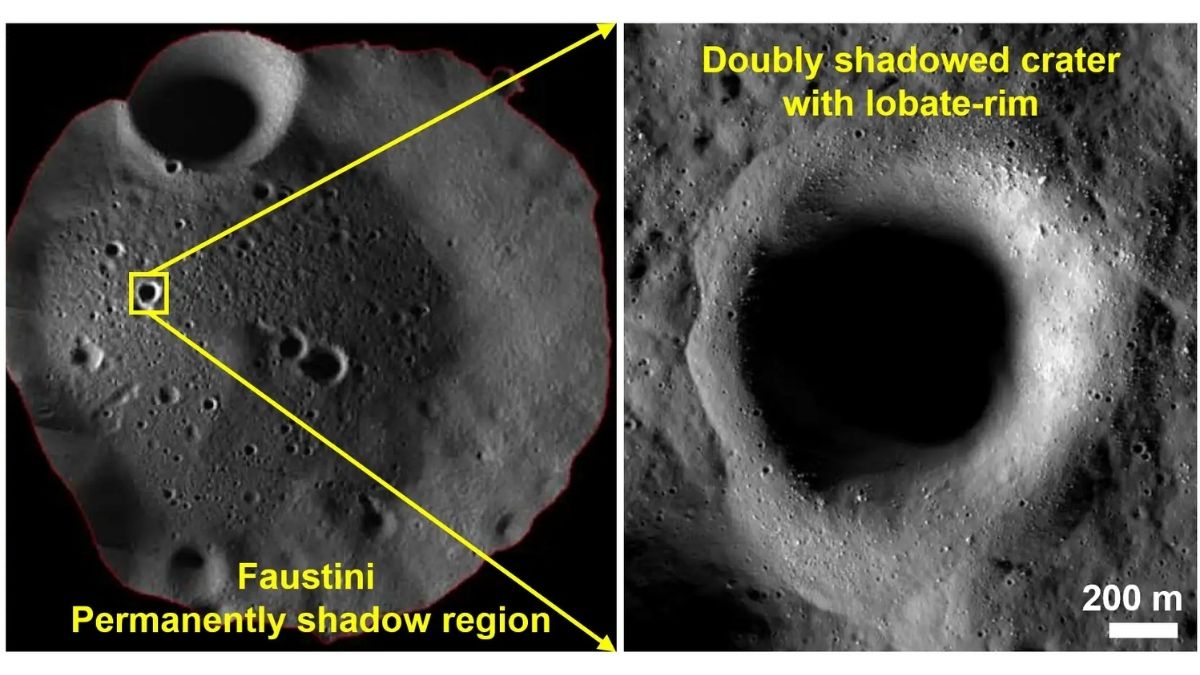
Image of Lunar Ice Crater discovered by ISRO’s Chandrayaan - 2 (Credit: isro.gov.in)
Why is This Water Ice Critical for Future Lunar Missions?
Water is notoriously heavy, expensive, and difficult to transport from Earth. Accessing an abundant local supply of frozen water alters the economic feasibility of deep-space exploration.
| Lunar Resource | Processing Method | Practical Application on the Moon |
| Purified Water-Ice | Excavation and Thermal Melting | Immediate life support, drinking water for astronauts, and agricultural hydration systems. |
| Liquid Oxygen | Electrochemical Water Splitting | Creation of breathable air inside enclosed pressurized lunar base habitats. |
| Liquid Hydrogen | Cryogenic Separation and Storage | Clean, high-energy rocket propellant to refuel spacecraft returning to Earth or traveling to Mars. |
This ISRU process transforms the moon’s south pole from a bleak outpost into a strategic cosmic fueling station. These new coordinates are therefore drawing huge interest from space agencies around the world, including NASA’s Artemis program and China’s International Lunar Research Station.
What Lies Ahead for India’s Space Exploration Plans?
Official statements from ISRO emphasize that these radar maps will directly shape the landing parameters and scientific targets of upcoming space endeavors.
India is already advancing its roadmap with Chandrayaan-4, a complex sample-return mission designed to physicalize these orbital insights by extracting physical soil samples from the polar terrain.
Furthermore, the data establishes crucial foundation work for India's broader target of landing a human astronaut on the lunar surface by 2040.
This landmark Moon’s South pole discovery is a testament to the enduring scientific contribution of the Chandrayaan-2 mission. India has given space agencies across the world the coordinates to fuel the next generation of interplanetary human exploration by providing incontrovertible proof of accessible water reserves hidden within the moon’s deepest deep-freezes.

Harshita Singh is an education and general knowledge journalist with over 5 years of experience in educational writing. Specializing in US affairs and GK, Harshita has a track record of breaking down intricate geopolitical and historical subjects into clear, digestible insights for learners. Her strong background in text analysis, coupled with a Bachelor of Arts (Hons) in English from the University of Delhi, helps her produce authoritative, thoroughly researched content that empowers readers to engage confidently with global current affairs. For inquiries or academic insights, you can reach out to her directly at harshita.singh@jagrannewmedia.com.