How Far Can the Human Eye See?
The human eye is a biological marvel, balancing physics and anatomy to define our visual range. While the Earth's curvature limits our horizon to 3 miles at ground level, we can detect a candle's glow 2.8 km away and witness galaxies millions of light-years distant.
Key Points
- Horizon visible at 3 miles (4.8 km) for 5ft tall person with 20/20 vision.
- Eye detects candle flame at 1.6-2.8 km, surpassing smartphone camera ability.
- Eye can detect 5-9 photons in 100ms, calibrated by Vega star trials.
On a clear day, the horizon can be viewed by an average human being with 20/20 vision and a height of 5 feet (1.5 meters) above the ground about 3 miles (4.8 kilometers) away, because of the curvature of the Earth.
In perfect dark conditions the naked eye can see a flickering candle flame at the distance of at least 1.6-2.8 kilometers, and it demonstrates the wonder of the eye at 12 times the ability of a smartphone camera to capture images.
The integration of biology, physics and the environment is what determines the limits of sight i.e. the retinal cells to outer space panoramas.
What is the Anatomy of a Human Eye?
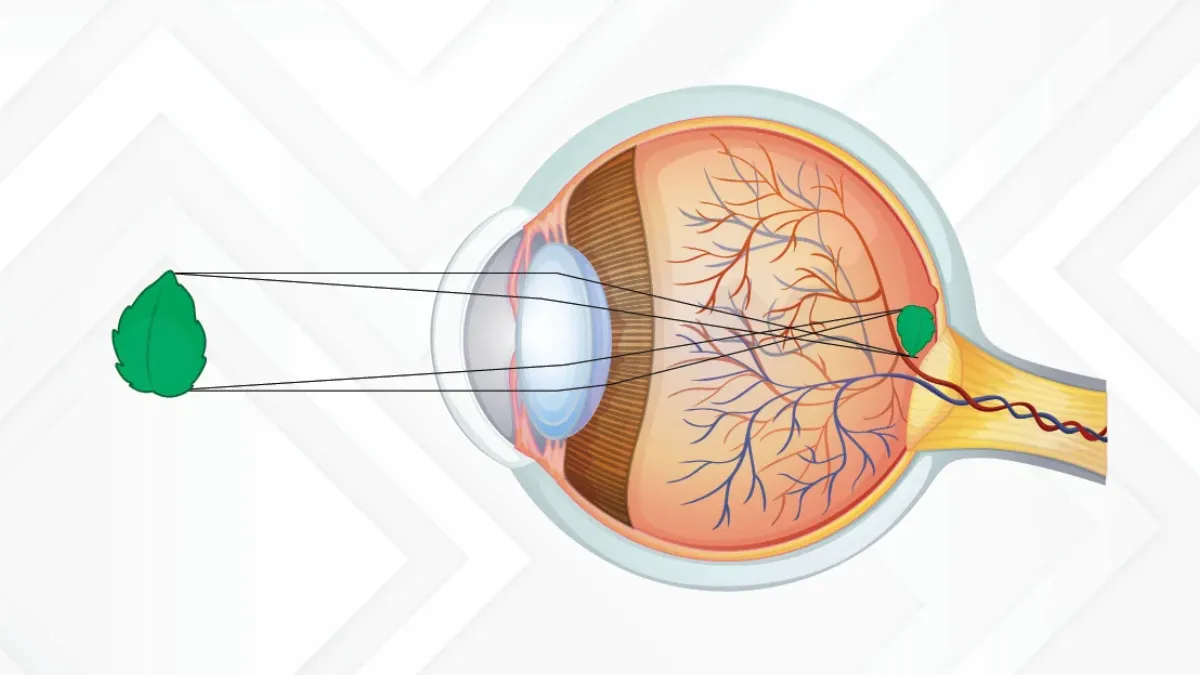
The light takes the cornea and adjustable lens and falls onto the retina, a neural tissue, with 120 million rods to detect low-light motion, as well as 6 million cones to detect color and detail in the fovea.
The fovea provides optimum sharpness of 1 arcminute (1/60 degree) that is able to distinguish two distinct points.
Photons are converted into electrical impulses by the rod and cones, through the optic nerve; color, motion, shape and ambient light channels are processed in the brain.
The peck of cone density is 180,000/mm2 in the fovea, which allows one to see the changes in the spherical lens up to 0.05D (theoretical limit).
Horizon Distance and Earth's Curvature
Earth's radius (6371 km) creates a geometric horizon via
D≈3.57h km, where h is eye height in meters. A 1.7m (5'7") observer sees 4.8 km; taller vantage points extend this exponentially
| Height (m/ft) | Horizon (km/mi) |
| 1.7 / 5.7 | 4.8 / 3.0 |
| 10 / 33 | 11.3 / 7.0 |
| 100 / 328 | 35.7 / 22.2 |
| 828 / 2717 (Burj Khalifa) | 96 / 60 |
Calculated by: LumenCalculator
Atmospheric refraction adds ~10%, but haze, pollution, or fog scatters light (Rayleigh/Mie), slashing range to 20 km max in vacuum-like clarity.
How to Detect a Candle Flame?
The brightness of a candle (1-10 lumens) resembles that of a 6th-magnitude star, which can be seen at a distance of approximately 2.6 km in the dark sky (21.5 mag/arcsec2 background).
Limits are based on photon flux: the eye can detect 5-9 photons in 100ms that are calibrated by the Vega star trials according to Michael Landy, professor of psychology and neural science at New York University.
Key constraints:
-
Contrast against sky glow.
-
Fixation; periphery requires higher sources.
-
On hazy nights atmospheric extinction is half.
Disproved myths include 48 km; the most realistic is 1.6-2.8 km according to astronomical models.
Influencing Factors
Longer wavelengths are scattered by atmospheric particles, obscuring objects that are far on foggy days.
Height is a multiplier of range - In theory, Everest summit is around 336km. Perceptual acuity is devastating beyond the fovea: with 15-20deg eccentricity, even big letters become blurred.
The brain compensates and cataracts are filtered or blind spots filled without conscious thought. Cone spacing (0.5-4 mm) and pupil size (2-8 mm) defined the resolution as ~0.05D. Limits In vacuum, infinite, but ground observation on air caps of Earth is practical up to 3 miles.
Beyond the Horizon: Galaxies and Stars
Clearly, seeing through the curve, eyes jet the Andromeda Galaxy 2.5 million light-years away, where infinite travel of light is not subject to distance. No minimal/distant internal barrier; single photons produce detection.
Human eyes are 3-mile horizons, 2.8-km fires, and intergalactic lights, penetrated by biology and planets.
Knowledge increases aviation security, NDT inspection, and the appreciation of retinal wonders in the wake of LASIK improvements.

Kirti Sharma is a journalist in the education domain with three and a half years of experience creating high-quality content for the education technology (EdTech) and digital media industries. She has an expertise in covering education news. Kirti has experience in writing data backed informational pieces on General knowledge.
Kirti holds a Bachelor of Arts degree, which helped build her strong foundation in writing and research. Over the course of her career, she has brought her skills to a variety of well-known companies, including ThoughtPartners Global, Infinite Group, and MIM-Essay. Through these roles, she has learned how to take complex information and turn it into engaging, easy-to-understand content for readers online.

-1789481527292_t.webp)