This Day in History: What Happened Today in History – 24 February
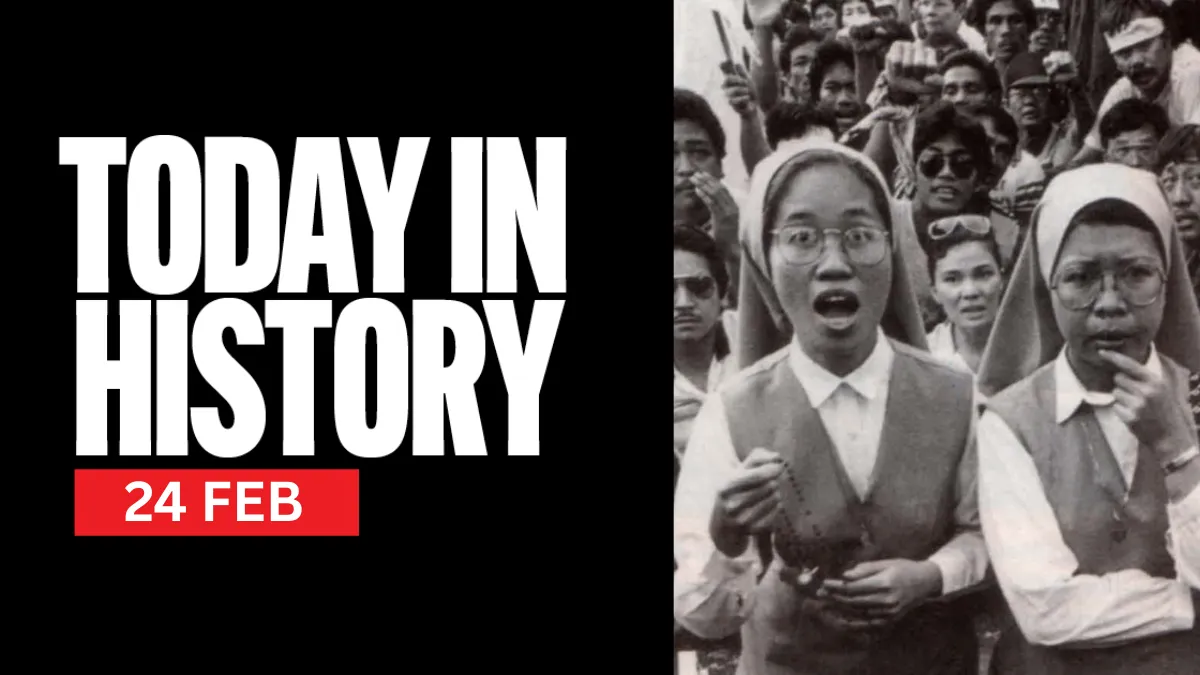
The February 1986 uprising in the Philippines showed the power of peaceful protest. Military defections, mass civilian support, and political pressure rapidly weakened Ferdinand Marcos’s rule. The dramatic events of February 24 became a turning point, paving the way for Corazon Aquino’s presidency and the restoration of democratic governance.
Key Points
- On Feb 24, 1986, rebels seized media outlets and military bases.
- Massive protests and military defections forced Marcos's collapse by Feb 25.
- Cardinal Sin mobilized millions, protecting rebels from loyalist forces.
The People Power Revolution of 1986, peaking on February 24, marked a historic non-violent uprising in the Philippines that ended Ferdinand Marcos's dictatorship.
On February 24, 1986, the third day of the People Power Revolution - reformist rebels seized key government offices, radio and TV stations like Channel 4, Camp Aguinaldo, Villamor Airbase, and advanced toward Malacañang Palace, bolstered by the Air Force defection under Col. Antonio Sotelo.
Massive civilian protests, sparked by Marcos's fraudulent snap election victory over Corazon Aquino, forced his regime's collapse by February 25.
What Happened on February 24?
Decades of Marcos's martial law since 1972 fueled unrest, exacerbated by corruption, abuses, and the 1983 assassination of opposition leader Benigno "Ninoy" Aquino Jr.
The disputed February 1986 election prompted Defense Secretary Juan Ponce Enrile and Lt. Gen. Fidel Ramos to defect on February 22, barricading Camp Aguinaldo. Cardinal Jaime Sin mobilized millions via Radio Veritas, forming human barricades to protect rebels from loyalist forces.
| Date/Time | Event Details |
| Feb 22, 1986 (evening) | Enrile and Ramos rebel; Sin rallies public support via radio. |
| Feb 24, 1986 | Rebels capture media and bases; Air Force defects; crowds shield troops. |
| Feb 25, 1986 (morning) | Aquino sworn in at Club Filipino; Marcos flees to Clark Air Base, then Hawaii. |
Who were the Major Figures?
-
Ferdinand Marcos: Dictator ousted after U.S. pressure from President Reagan; fled amid the revolt.
-
Corazon "Cory" Aquino: Opposition widow who became the first female president post-uprising.
-
Fidel Ramos and Juan Ponce Enrile: Defectors igniting the military break; Ramos later president.
-
Jaime Cardinal Sin: Archbishop whose calls mobilized the masses for non-violence.
Other February 24 Events
Notable milestones include Pope Gregory XIII's 1582 papal bull Inter gravissimas, skipping 10 days for the Gregorian calendar. The 1991 Gulf War ground offensive began with U.S.-led advances on Iraq. Russia's 2022 invasion of Ukraine launched after recognizing Donetsk and Luhansk.
The revolution inspired global non-violent movements, like Nepal's 2006 protests, and restored Philippine democracy under Aquino's Fifth Republic. Despite post-revolution coups, it symbolizes civilian triumph, commemorated annually at EDSA shrines.
Related | Today in History (23 February)
Related | Today in History (22 February)

Kirti Sharma is a journalist in the education domain with three and a half years of experience creating high-quality content for the education technology (EdTech) and digital media industries. She has an expertise in covering education news. Kirti has experience in writing data backed informational pieces on General knowledge.
Kirti holds a Bachelor of Arts degree, which helped build her strong foundation in writing and research. Over the course of her career, she has brought her skills to a variety of well-known companies, including ThoughtPartners Global, Infinite Group, and MIM-Essay. Through these roles, she has learned how to take complex information and turn it into engaging, easy-to-understand content for readers online.