What is River Sand Mining? What Has the Supreme Court Recommended to Stop It?
What is river sand mining? Know its environmental impacts, Supreme Court judgements, CEC recommendations, sand replenishment studies and government guidelines.
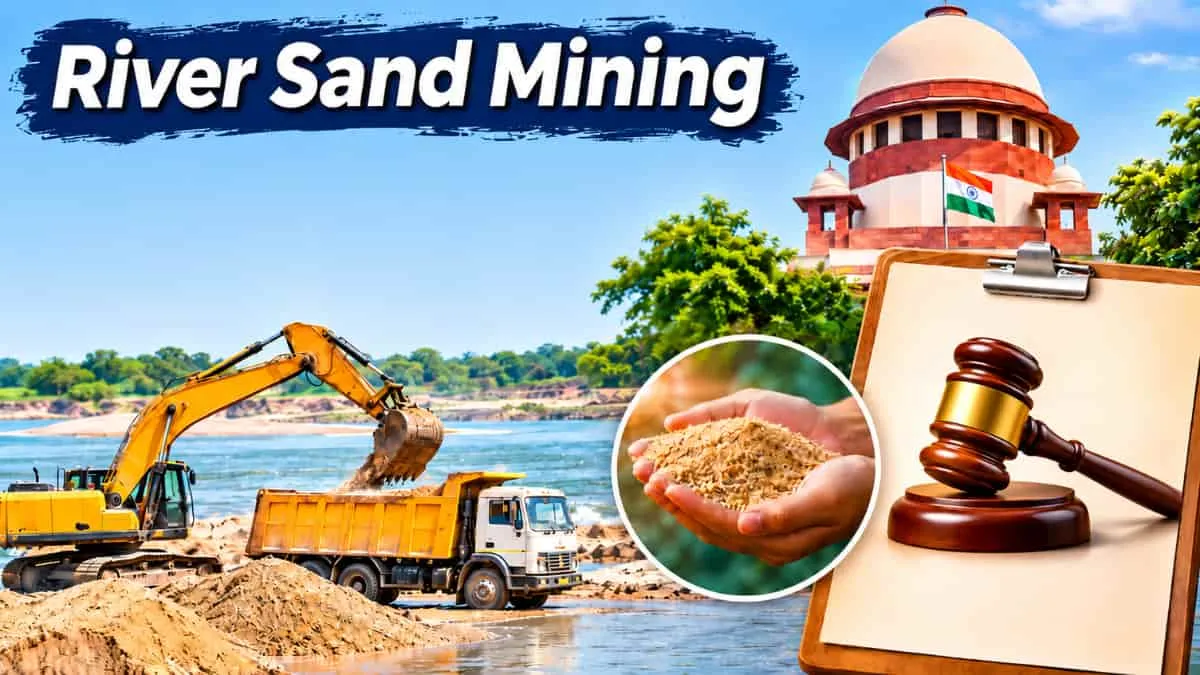
Sand is one of the most essential material used in the construction industry. It is essential for the construction of houses, roads, bridges and infrastructure. A large amount of this sand is collected from riverbeds.
However, what would happen if too much sand is taken out of a river?
Over-exploitation of sand can lead to degradation of riverbeds, soil erosion and loss of habitat for riverine life. It may also impact on the flow of river water and groundwater levels.
A committee set up by the Supreme Court recently proposed to gradually phase out river sand mining from active river channels over the next three years, which is considered unsustainable. It also suggested using other sources of sand to meet the needs of the construction industry.
Let's understand what river sand mining is, why it is harmful and what the committee has recommended.
What is River Sand Mining?
River sand mining means the process of extracting sand from the bed and banks of a river to use in construction or other projects.
The primary use of sand is for the production of concrete, building houses, roads and bridges.
The higher the demand for buildings and infrastructure, the higher the demand for sand. This compacts the river as a lot of sand is taken away from the river.
The natural accumulation of sand in rivers occurs as a result of the flow of water and soil. But, if people take away more sand than a river can replace, it becomes an environmental issue.
The need for proper rules and monitoring is why sand mining ought to be properly regulated.
Why is River Sand Mining Harmful?
Excessive sand removal can cause imbalance in the river. Can cause issues for both the environment and residents of riverside communities.
Some of the large problem areas associated with over-exploitation of the sand from rivers include:
-
Riverbed Damage: Removing too much sand changes the natural shape and depth of the riverbed.
-
Soil erosion: Inappropriate mining can cause river banks to become more fragile and lead to soil erosion.
-
Aquatic Animal Damage: Sand mining can lead to destruction of natural habitat for fish, turtle, gharials and other aquatic animals.
-
Groundwater Problems: Rivers and Groundwater are interconnected. Excessive extraction of sand can influence the water level in neighbouring communities.
-
Water Pollution: Mined water may be polluted and become dirty.
-
Damage to Bridges: If too much sand is removed near bridges, their foundation may be weakened.
Therefore, sand mining must be carried out carefully and only in permitted areas.
What Has the Supreme Court Recommended on River Sand Mining?
The Supreme Court appointed Central Empowered Committee (CEC) has recommended a three-year plan to gradually stop the unsustainable extraction of sand from active riverbeds.
The CEC Report No. 36 of 2026, presented to the Supreme Court on 2nd November 2026, contained the recommendation.
The committee has called for a phased shift away from river sand use and to consider alternative sources to cater to the demand of construction activities in India.
Here are the major recommendations:
1. Phase Out Unsustainable Sand Mining in Three Years
The committee has suggested that a strategy to phase out unsustainable sand mining from active river channels be developed in the coming 3 years.
The main aim is to protect rivers from excessive sand removal.
But the committee has also stated that other sources of sand should be found to prevent the delays in construction activities.
Important: This is a recommendation by the committee. It should not be interpreted to be a blanket ban on river sand mining in India by the Supreme Court.
2. Use Manufactured Sand (M-Sand)
The committee has recommended the production and utilization of Manufactured Sand or M-Sand.
M-Sand is produced by crushing the appropriate type of rocks into small pieces. If it has the quality required, it can be used as a natural river sand in construction.
Its use can serve to decrease demands for sand that is taken from rivers.
3. Use Sand from Dams and Reservoirs
The committee has also recommended the use of proper sands and sediments from the dams and reservoirs.
With time, sediment, sand and other materials accumulate at the bottom of reservoirs. This is known as sedimentation.
This extra material is removed by a process called desilting.
The committee thinks that desilted materials when used properly, after testing and processing, should be available for construction purposes.
This also can help to maximize the storage capacity of reservoirs.
But this material, which is collected from dams, is not all suitable material for use as construction sand. It first needs to be evaluated for quality and suitability.
4. Reuse Construction and Demolition Waste
This committee has also suggested the use of recycled construction and demolition waste.
A vast quantity of waste is produced when old buildings, roads and other structures are destroyed.
Some of this can be recycled for use in building rather than disposed of.
This can help to decrease the need for new natural sand and control construction waste.
5. Introduce Digital Monitoring of Sand Mining
The committee proposed to have monitoring of sand mining activities through digital technology.
The State mining departments need to maintain records of the amount of sand allowed to be mined and the amount of sand actually removed.
It has also made a recommendation to implement QR codes, barcodes and RFID technology in electronic transport permits.
This will enable the authorities to follow the flow of sand and to detect unauthorized sand transport.
What is the Supreme Court's Stand on Illegal Sand Mining?
The Supreme Court has also taken action against illegal sand mining, particularly in the National Chambal Sanctuary.
The National Chambal Sanctuary is an important wildlife area. It is home to the endangered gharial, along with several other aquatic animals.
Illegal sand mining in this region has damaged river habitats and created serious concerns for wildlife.
On March 13, 2026, the Supreme Court took suo motu cognisance of the issue.
Suo motu means that a court takes action on its own after noticing an important issue, without waiting for someone to file a formal petition.
The case is related to illegal sand mining in the National Chambal Sanctuary and the threat it poses to endangered aquatic wildlife.
The sanctuary is spread across parts of Madhya Pradesh, Rajasthan and Uttar Pradesh.
The court has sought action from the concerned state governments and authorities to control illegal mining and protect wildlife.
What Are the Government Guidelines for Sand Mining in India?
The Ministry of Environment, Forest and Climate Change (MoEFCC) has issued guidelines to make sand mining more organised and environmentally safe.
Two important guidelines are:
| Guidelines | Year | Purpose |
| Sustainable Sand Mining Management Guidelines | 2016 | To promote scientific and environmentally safe sand mining |
| Enforcement and Monitoring Guidelines for Sand Mining | 2020 | To improve monitoring and control illegal sand mining |
These guidelines focus on identifying suitable mining areas, checking the amount of available sand and monitoring mining activities.
The government also requires proper environmental clearances before mining activities can begin, as applicable under environmental rules.
Key Facts About River Sand Mining
| Aspects | Details |
| River sand mining | Removing sand from riverbeds and banks |
| Main use | Construction of houses, roads and bridges |
| Major environmental concern | Riverbed damage and loss of aquatic habitats |
| Sand classification in India | Minor Mineral |
| Important law | Mines and Minerals (Development and Regulation) Act, 1957 |
| First important guidelines | Sustainable Sand Mining Management Guidelines, 2016 |
| Monitoring guidelines | Enforcement and Monitoring Guidelines, 2020 |
| Recent recommendation | Three-year phase-out of unsustainable river sand mining |
| Committee | Central Empowered Committee (CEC) |
Conclusion
River sand is an important natural resource, but removing too much of it can damage rivers and harm aquatic animals.
The recent recommendations of the Supreme Court-appointed committee aim to reduce unsustainable sand mining and encourage the use of alternative materials such as M-Sand, reservoir sediment and recycled construction waste.
The main objective is to meet India's growing construction needs without causing further damage to rivers and the environment.
In simple words, the idea is to use sand wisely, protect rivers and find better alternatives for the future.

Prabhat Mishra is a Subject Matter Expert and digital journalist with an extensive background in the competitive exam landscape and over 4 years of experience in education, national and international news, and current affairs. Over his tenure with top knowledge platforms like Mentorship India, IAS BABA, IAS SARTHI, and now Jagran Josh, he has a deep understanding of government exams like UPSC and State PCS, including UP and Bihar, as he has already qualified for the UPPCS 2022 Mains and Bihar 68th Mains. With his core expertise in history, polity, geography & current affairs, he specialises in creating well-researched, aspirant-centric content and simplifying complex topics for competitive examinations.