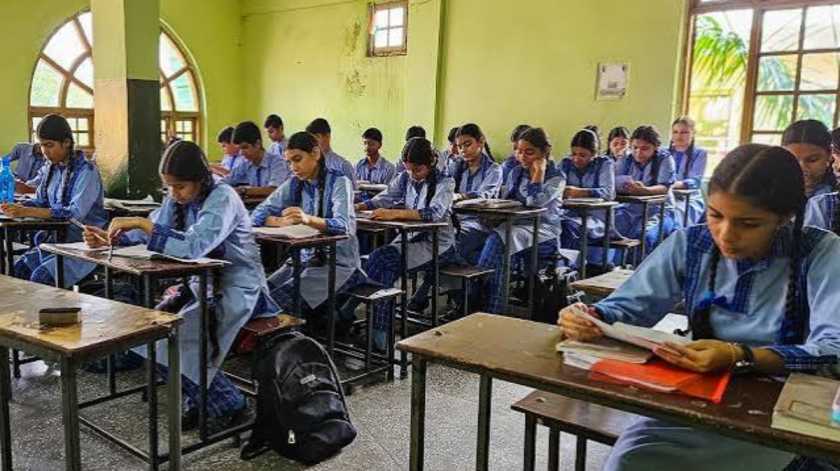
CBSE Class 10 Social Science Pre-Board Sample Paper 2025-26 with Solutions - Download Free PDF
CBSE Class 10 Social Science Sample Paper 2025 - 26 - The CBSE Class 10 Social Science Pre-Board Sample Paper 2025-26 with Solutions is a vital resource for high scores. Designed per the latest CBSE guidelines, these papers clarify the updated exam pattern, question distribution, and chapter weightage. The solved answers aid students in checking their responses and improving skills. Downloading the FREE PDF enables anytime practice, helping students identify strengths and weaknesses. Regular practice boosts time management, conceptual clarity, and exam confidence, making it essential for effective preparation.

CBSE Class 10 Social Science Sample Paper 2025 - 26 - The CBSE Class 10 Social Science Pre-Board Sample Paper 2025-26 with Solutions is an essential resource for students aiming to score high in their board exams. Designed as per the latest CBSE guidelines, these sample papers help students understand the updated exam pattern, question distribution, and chapter-wise weightage. With solved answers included, students can compare their responses and improve their accuracy and writing skills. Downloading the FREE PDF of the CBSE Class 10 Social Science pre-board sample paper allows students to practice anytime and identify their strong and weak areas. Regular practie with these papers boosts time management, conceptual clarity, and exam confidence, making them a must-have tool for effective preparation.
CBSE Class 10th Social Science Marking Scheme 2025-26
| Section | Type of Questions | No. of Questions | Marks per Question | Total Marks |
| Section A | MCQs (Objective) | 20 | 1 | 20 |
| Section B | Very Short Answer (VSA) | 4 | 2 | 8 |
| Section C | Short Answer (SA) | 5 | 3 | 15 |
| Section D | Long Answer (LA) | 4 | 5 | 20 |
| Section E | Case-Based/Source-Based Questions | 3 | 4 | 12 |
| Section F | Map Work (History + Geography) | 2 | 1 + 3 | 4 |
| — | Total | — | — | 80 Marks |
Internal Assessment (20 Marks)
| Component | Marks |
| Periodic Tests | 5 |
| Multiple Assessments | 5 |
| Portfolio | 5 |
| Subject Enrichment Activity | 5 |
| Total Internal Assessment | 20 Marks |
CBSE Class 10 Social Science Pre-Board Sample Paper 2025
The CBSE Class 10 Social Science Pre-Board Sample Paper 2025 helps students practice the latest exam pattern and understand important question formats before the board exam. Solving these papers boosts confidence, improves writing skills, and ensures thorough revision of all SST chapters.
General Instructions:
i. Question paper comprises Six Sections – A, B, C, D, E and F. There are 37 questions in the question paper. All questions are compulsory.
ii. Section A – From question 1 to 20 are MCQs of 1 mark.
iii. Section B – Question no. 21 to 24 are Very Short Answer Type Questions, carrying 2 marks each. Answer to each question should not exceed 40 words.
iv. Section C contains Q.25to Q.29 are Short Answer Type Questions, carrying 3 marks each. Answer to each question should not exceed 60 words
v. Section D – Question no. 30 to 33 are long answer type questions, carrying 5 marks each. Answer to each question should not exceed 120 words.
vi. Section-E - Questions no from 34 to 36 are case based questions with three sub questions and are of 4 marks each
vii. Section F – Question no. 37 is map based, carrying 5 marks with two parts, 37a from History (2 marks) and 37b from Geography (3 marks).
viii. There is no overall choice in the question paper. However, an internal choice has been provided in few questions. Only one of the choices in such questions have to be attempted.
ix. In addition to this, separate instructions are given with each section and question, wherever necessary.
SECTION A – MCQ (1 x 20 = 20 marks)
1.Which one of the following is an example of ‘Coming together federation’?
|
|
|
|
2.Which one of the statements is incorrect as regards to commercial farming?
(a) crops are grown for sale
(b) Family involved in growing crops
(c) Practiced in large land holdings
(d) Use of higher doses of modern inputs
3.Who can make laws relating to the subjects given in the Concurrent list
(a) State Government (b) Union Government
(c) Both (d) None of the above
4.Which one of the following countries adopted majoritarianism in their Constitution?
|
|
|
|
5.Who among the following proclaimed dams as ‘the temple of modern India’?
(a) Rajendra Prasad
(b) Mahatma Gandhi
(c) Sardar Patel
(d) Jawaharlal Nehru
6.Choose the correct option from the following:
List I (Example) List II (Sector)
A. Courier Tertiary Sector
B. Fisherman Secondary Sector
C. Carpenter Primary Sector
D. Transporter Secondary Sector
7.Arrange the following in chronological order:1
-
Print culture created the conditions for the French Revolution
-
Martin Luther’s writings led to beginning of the Protestant Reformation
-
Menocchio reinterpreted the message of the Bible
-
Johann Gutenberg invented Printing press
OPTIONS:
|
|
|
|
8.The Book Gulamgiri deal with—
(a) Restriction on vernacular press (b) Treatment of widows
(c) Injustices of caste system (d) None of these
9.Which one of the statements is incorrect as regards to commercial farming?
(a) crops are grown for sale
(b) Family involved in growing crops
(c) Practiced in large land holdings
(d) Use of higher doses of modern inputs
10.A woman works at a sweet shop in her village on a contract basis and gets meagre salary after working the entire day. She doesn’t get any holidays or paid leave, rather her employer deducts her salary whenever she is absent from work. Find out in which of the following sectors she is working?
|
|
|
|
11.The process of integration between different countries is called as ______.
|
|
|
|
12.Assertion (A): When power is taken away from central and state governments and given to local governments it is called decentralisation.
Reason (R): At least one third of all positions are reserved for women in local government bodies.
(a) Both assertion (A) and reason (R) are true and reason (R) is the correct explanation of assertion (A).
(b) Both assertion (A) and reason (R) are true but reason (R) is not the correct explanation of assertion (A).
(c) Assertion (A) is true but reason (R) is false.
(d) Both assertion (A) and reason (R) are false.
13.What is an 'alliance'?
(a) Two parties contest elections
(b) Several parties join hands for contesting elections
(c) One party contests elections
(d) None of these
14.Apart from the Central and the State Government, Belgium has a third kind of government as well. Identify this third kind of government from the following options:
|
|
|
|
15.Choose the incorrect option from the following
(a) Courier – Tertiary sector
(b) Fisherman – Primary sector
(c) Carpenter – Primary sector
(d) Banker – Tertiary sector
16.There are two statements marked as Assertion (A) and Reason (R). Mark your answer as per the codes provided below:
Assertion (A): Sustainable development is essential for economic growth of the countries.
Reason (R): Sustainable development ensures that environment friendly measures are adopted for carrying out production processes.
-
Both (A) and (R) are true and (R) is the correct explanation of (A)
-
Both (A) and (R) are true and (R) is not the correct explanation of (A)
-
(A) is correct but (R) is wrong
-
(A) is wrong but (R) is correct
17.Development of a country can generally be determined by
(a) its per capita income (b) its average literacy level
(c) health status of its people (d) all the above
18.Which one of the following Project was launched in 1973?
|
|
|
|
19.Name the writer of the novel ‘Anandmath’?
|
|
|
|
20.Based on the conflicting developmental goals, which of the following pairs are not correctly matched?
(A) More wages to workers - against the interests of the entrepreneur.
(B) Rich farmers want to sell food grains at high prices - poor workers want to purchase it at low prices.
(C) Construction of a dam means more and cheaper power for people - The tribal do not want to leave the place.
(D) Expansion of roads in the city - good for reducing traffic congestion.
SECTION- B
VERY SHORT ANSWER QUESTIONS (2X4=8)
21.Highlight any two measures to conserve minerals
OR
Highlight the importance of petroleum.
22.In what ways Government can increase employment in the rural sector?
23.Explain any two provisions that make India a secular state.
24.What are the modern forms of money?
SECTION-C
SHORT ANSWER BASED QUESTIONS (3X5=15)
25.Describe the provisions of “National Rural Employment Guarantee Act 2005.”
26.“There is overwhelming support for the idea of democracy all over the world." Support the statement.
27.How had Non-Cooperation Movement spread to the countryside? Explain.
OR
Why did the Non-Cooperation Movement gradually slowdown in the cities? Explain.
28.Define plantation agriculture. Explain any two characteristics of plantation agriculture.
29.‘Advancement of international trade of a country is an index to its prosperity.’
Support the statement with suitable examples.
SECTION D
LONG ANSWER BASED QUESTIONS (5X4=20)
30.Describe any five major functions of political parties.
OR
Suggest and explain any five measures to reform political parties.
31.“Cheap and affordable credit is crucial for the country’s development.” Assess the statement.
OR
Why is it necessary for the banks and cooperative societies to increase their lending facilities in rural areas? Explain.
32.How would you evaluate Napoleon as an administrator who created a more rational and efficient system? Elucidate with suitable examples.
OR
Analyse the role of folklore and symbols in the revival of nationalism in India during late 19th century.
33.“Cheap and affordable credit is crucial for the country’s development.’’ Explain the statement with five points.
OR
Define the merits and demerits of “Formal Sector of Credit” in India.
SECTION-E
CASE BASED QUESTIONS (4x3=12)
34.Read the given extract and answer following questions:
Do you know that in India about 60 percent of the population belongs to the age group 5-29 years? Out of this, only about 51 per cent are attending educational institutions. The rest and particularly those aged less than 18 years may be at home or many of them may be working as child labourers. If these children are to attend schools, we will require more buildings, more teachers and other staff. A study conducted by the erstwhile Planning Commission estimates that nearly 20 lakh jobs can be created in the education sector alone. Similarly, if we are to improve the health situation, we need many more doctors, nurses, health workers etc. to work in rural areas. These are some ways by which jobs would be created and we would also be able to address the important aspects of development. Every state or region has potential for increasing the income and employment for people in that area. It could be tourism, or regional craft industry, or new services like IT. Some of these would require proper planning and support from the government. For example, the same study by the Planning Commission says that if tourism as a sector is improved, every year we can give additional employment to more than 35 lakh people
i) How many jobs can be created in the education sector alone? (1)
ii) What are the different areas where people can be employed? (1)
iii) What is the study of Planning commission about tourism sector? (2)
35.Read the given extract and answer following questions:
The 1830s were years of great economic hardship in Europe. The first half of the nineteenth century saw an enormous increase in population all over Europe. In most countries there were more seekers of jobs than employment. Population from rural areas migrated to the cities to live in overcrowded slums. Small producers in towns were often faced with stiff competition from imports of cheap machine made goods from England, where industrialization was more advanced than on the continent. This was especially so in textile production, which was carried out mainly in homes or small workshops and was only partly mechanized. In those regions of Europe where the aristocracy still enjoyed power, peasants struggled under the burden of feudal dues and obligations. The rise of food prices or a year of bad harvest led to widespread pauperism in town and country.
i)What kind of economic hardship did Europe face during the first half of the nineteenth century (2)
ii) Which country was producing cheap machine made goods? (1)
iii) How were peasants struggled in the region? (1)
36. In Rio de Janeiro Earth Summit, In June 1992, more than 100 heads of states met in Rio de Janeiro in Brazil, for the first International Earth Summit. The Summit was convened for addressing urgent problems of environmental protection and socio economic development at the global level. The assembled leaders signed the Declaration on Global Climatic Change and Biological Diversity. The Rio Convention endorsed the global Forest Principles and adopted Agenda 21 for achieving Sustainable Development in the 21st century.
Agenda 21- It is the declaration signed by world leaders in 1992 at the United Nations Conference on Environment and Development (UNCED), which took place at Rio de Janeiro, Brazil. It aims at achieving global sustainable development. It is an agenda to combat environmental damage, poverty, disease through global co-operation on common interests, mutual needs and shared responsibilities. One major objective of the Agenda 21 is that every local government should draw its own local Agenda 21.
i) When and where was the first International Earth Summit held? (1)
ii) What did the Rio Convention endorse? (1)
iii) What are the main features of Agenda-21? (2)
SECTION-E
MAP SKILL BASED QUESTION (2+3=5)
37a. Two places A and B have been marked on the given outline map of India. (2)
Identify them and write their correct names on the lines drawn near them
A. Place where congress session held in December 1920.
B. Place associated with the cotton mill workers movement
37b. On the same outline map of India locate and label any THREE of the following with suitable Symbols. (3)
CBSE Class 10 Social Science Pre-Board Sample Paper 2025 Solutions
| 1. |
|
| 2. | B) Family involved in growing crops |
| 3. | c) Both |
| 4. | (C) Sri Lanka |
| 5. | (d) Jawaharlal Nehru |
| 6. | (a) Courier Tertiary Sector |
| 7. |
|
| 8. | (c) Injustices of caste system |
| 9. | B) Family involved in growing crops |
| 10. | (d) Unorganised Sector |
| 11. |
|
| 12. | B) both assertion (A) and reason (R) are true but reason (R) is not the correct explanation of assertion (A). |
| 13. | B. Several parties join hands for contesting elections |
| 14. | (C) Community Government |
| 15. | C. Carpenter – Primary sector |
| 16. | (a) Both (A) and (R) are true and (R) is the correct explanation of (A) |
| 17. | (d) All of the above |
| 18. |
|
| 19. | (d) Bankim Chandra Chatterjee |
| 20. | D. Expansion of roads in the city - good for reducing traffic congestion. |
Section B | |
|---|---|
| 21. | •Minerals have to be used in a planned and sustainable manner. •Improved technologies should be evolved to make use of low grade ores at low costs. • Recycling of metals, using scrap metals and other substitutes would help in the conservation of minerals OR Importance of petroleum •It provides fuel for heating and lighting. • It provides lubricants for machinery and raw materials for many manufacturing industries. • Petroleum refineries act as a ‘nodal industry’ for synthetic textiles, fertiliser and chemical industries. (any two) |
| 22. | i)By introducing tertiary facilities in an area ii. To identify, promote and locate industries and services in semi-rural areas iii. It is also possible to set up industries that process vegetables and agricultural produce like potato, sweet potato, iv. By promoting tourism, or regional craft industry, or new services like IT. v. Any other relevant point. |
| 23. | (i)There is no official religion for the any state. (ii)Our constitution does not give a special status to any religion. (iii)The constitution provides to all individuals and communities freedom to profess, practice and propagate any religion. (iv)The constitution prohibits discrimination on grounds of religion. Any other relevant point. |
| 24. | Modern forms of money include paper notes and coins. |
Section C | |
|---|---|
| 25. | Provisions of NREGA 2005 are : (i)It provides 100 days assured employment every year to each rural household. (ii) One-third of the proposed jobs are reserved for women. (iii) If an applicant is not employed within 15 days he/she is entitled to a daily unemployment allowance. (iv) The governments have to establish Central Employment Guarantee Funds and State Employment Guarantee Funds for the implementation of the scheme. Any other relevant point. |
| 26. | (i)Democracy gives freedom to people to select their government without any domination or pressure unlike other form of govt. (ii) Democratic government develops mechanism for citizens to hold government Accountable and mechanism for citizens to take part in decision-making. Promotes equality among citizens. (iii) Democratic government enhances the dignity of the individual. (iv) Democratic government provides a method to resolve conflicts. |
| 27. | •In Awadh, peasants were led by Baba Ramchandra. Here, the movement was against talukdars, who charged high rents and peasants had to do begar. •The peasant movement demanded reduction of revenue and abolition of begar. By the end of 1920, Jawaharlal Nehru, Baba Ramchandra and others had formed Oudh Kisan Sabha. •Tribal peasants interpreted the message of Gandhiji and idea of swaraj in their own way. In Gudem Hills in Andhra Pradesh, a militant guerrilla movement was organised against colonial oppression under the leadership of Alluri Sitaram Raju. He was inspired by the Non-Cooperation Movement. •The movement also spread among the plantation workers in Assam. They were not permitted to leave the tea gardens without permission. OR The Non-Cooperation Movement slowed down in the cities for various reasons. •Khadi cloth was often more expensive than mass-produced mill cloth and poor people could not afford to buy it. So people could not boycott mill cloth for very long. •Similarly boycotting British institutions also posed a problem as there were no alternative national institutions to fulfil the educational needs. •The students and teachers trickled to government schools. The lawyers joined government courts. With all these, the enthusiasm of people in the cities lost its force. |
| 28. | Plantation Agriculture : Plantation agriculture is a form of commercial farming where crops are grown for profit. Large land areas are needed for this type of agriculture. It is a type of commercial farming practised in tropical and sub-tropical regions. It was introduced by the British in India. Characteristics : (i) A single crop is grown over large area. (ii) It is capital intensive and done with migrant labour. (iii) All produce is used as raw material in industries such as tea, coffee, rubber, sugarcane, banana, etc. (iv) Plantation has interface of agriculture and industry both. Any other relevant point. |
| 29. | • No country can survive without international trade because resources are space bound. • Advancement of international trade of a country leads to its economic prosperity because such a trade provides so many jobs to workers as well as business to traders. • It is through international trade that we earn much of our foreign exchange which is required for importing many essential goods. Foreign trade helps in transfer of technology. • International trade gives rise to competition. Domestic producers make their production process efficient to meet the international standards and thus, are able to compete. |
Section C | |
|---|---|
| 30. | The following are the various functions political parties perform in a democracy. •Contest elections: Parties contest elections. In countries like India, top party leaders choose candidates for contesting elections. •Put forward policies and programmes: Parties put forward different policies and programmes and voters choose from them. Political parties accommodate different views and opinions. •Play an important role in making laws: Political parties play a decisive role in making laws for a country. Formally, laws are debated and passed in the legislature, but since most of the members belong to a party, they go by the direction of the party leadership, irrespective of their personal opinions. •Form and run government: To run the government, political parties prepare a council of ministers by recruiting and training the leaders. •Provide access to government machinery and welfare schemes: Political parties provide people access to government machinery and welfare schemes implemented by governments. For an ordinary citizen, it is easy to approach a local party leader than a government officer. •Play the role of position: The party which loses election plays the role of opposition. Opposition party tries to put checks on the ruling party by constantly criticizing its policies. •Shape public opinion: One of the most important functions of political parties is that they shape public opinion on relevant issues for the proper functioning of the government and to deepen the concept of democracy OR •Regulation of party’s internal affairs: A law should be made to regulate the internal affairs of political parties. It should be made compulsory for political parties to maintain a register of their members, to follow their own constitution, to have an independent authority, etc. •State funding: There should be state funding of elections. The government should give money to parties to support their election expenses to avoid corruption. •Pressure of public opinion: Political parties can be reformed if people put pressure on them. This can be done through petitions, propaganda and agitations. Pressure groups and media play an important role in this. •Ban on political parties based on religion and caste: The Election Commission should ban the political parties which are formed on the basis of religion and caste. •Ensure women participation: It should be made mandatory for all political parties to allot one-third of the tickets to women to ensure their decisive voice in decision making. If the above-mentioned suggestions are taken into consideration, it can be ensured that these could lead to some improvement in the working of the political parties |
| 31. | Cheap and affordable credit is crucial for a country’s development because: • More lending would lead to higher incomes and encourage people to invest in agriculture, engage in business and set up small industries. •Cheap credit will enable more investment. This leads to acceleration of economic activity. •Cheap credit would also allow weaker sections of society to access formal sector of lending and get rid of from informal moneylenders. • Affordable credit would also end the cycle of debt trap. • Cheap and easy terms of credit would inspire better investment in technology and thus increase competition. OR Banks and cooperatives should extend their lending activities in rural areas because: •Rural poor and farmers have to borrow money from moneylenders at a very high rate of interest. Therefore, the cost to the borrowing is very high. •A large part of the earnings of borrower is used to repay the loans. Hence, they have less income. • Sometimes, a higher rate of lending means that the amount to be repaid is more than the earnings of the borrower. •To save the people from the clutches and exploitation by the moneylenders, it is necessary for the banks and co-operatives to extend their lending activies. • It would lead to higher incomes and improve the condition of the rural poor. •People can also start a business or set up a small scale industry |
| 32. | The Civil Code of 1804 – usually known as the Napoleonic Code, secured the right to property, established equality before the law, and removed all privileges based on birth. ∙ The Napoleonic Code was followed by the regions under the French control. ∙ New businessmen, artisans, peasants, and workers enjoyed a new-found freedom. ∙ In territories under French control such as Italy, Germany, Switzerland, and Dutch Republic, peasants were freed from manorial dues, peasants were freed from serfdom, feudal system was abolished, administrative divisions were simplified. ∙ Guild restrictions were removed in towns. ∙ There were improvements in communication and transport systems. ∙ To facilitate the movement and exchange of goods and capital from one region to another, small-scale producers of goods and businessmen began to realise that common national currency, standardised measures and weights, and uniform laws were of great help. (Any other relevant points) OR
|
| 33. | Credit for the development of country: (i) Higher cost of borrowing means a larger part of the earnings of the borrowers is used to repay the loan. Hence, borrowers have less income left for themselves. (ii) In certain cases, the high interest rate of borrowing can mean that the amount to be repaid is greater than the income of the borrower. This could lead to increasing debt and debt trap. For these reasons, banks and co-operative societies need to lend more. (iii) This would lead to higher incomes and many people could then borrow cheaply for a variety of needs. (iv) They could grow crops, do business, Set-up small-scale industries, etc. (v) They could Set-up new industries or trade goods. Any other relevant point. OR Ans. Merits:
Demerits:
|
Section D | |
|---|---|
| 34. | i) 20 lakh jobs ii) Education sector, IT sector, tourism sector iii) Planning Commission says that if tourism as a sector is improved, every year we can give additional employment to more than 35 lakh people |
| 35. | i) an enormous increase in population all over Europe. In most countries there were more seekers of jobs than employment. Population from rural areas migrated to the cities to live in overcrowded slums. ii) England iii) peasants struggled under the burden of feudal dues and obligations. The rise of food prices or a year of bad harvest led to widespread pauperism in town and country |
| 36. | i) Rio de Janeiro, In June 1992 ii) The Rio Convention endorsed the global Forest Principles and adopted Agenda 21 for achieving Sustainable Development in the 21st century. iii) achieving global sustainable development. It is an agenda to combat environmental damage, poverty, disease through global co-operation on common interests, mutual needs and shared responsibilities. |
Section E |
|---|
| Use Map |
For more CBSE Class 10 Social Science Sample Paper with Solutions download the given pdf below.
| CBSE Class 10 Social Science Pre Board Sample Paper with Solutions PDF |
Also Check -
CBSE Class 10 Syllabus 2025-2026: Download Subject-wise Curriculum PDFs

Simran is currently working as an education content writer at Jagran Josh, has completed her master's degree in journalism from the University of Delhi. She was previously associated with The Indian Express.