What were the Top 5 Longest Lasting Empires in History?
From the Mediterranean to the Indian subcontinent, some civilizations survived for over 1,500 years. We dive into the official records to reveal the longest-lasting empire in history, uncovering how these legendary dynasties maintained power across centuries of global upheaval.
Recent archaeological findings and digital mapping of ancient territories have reignited the debate: what truly was the longest-lasting empire in history? While many Americans grew up learning about the British or Mongol expansions, neither comes close to the sheer endurance of the world’s most persistent dynasties.
According to Guinness World Records, the Roman Empire remains the primary titleholder for endurance, stretching nearly 1,500 years when accounting for its eastern continuation. However, new historical data from the Indian subcontinent suggests the Pandyan Empire may have governed in various forms for over 1,800 years.
Understanding these longest-lasting empires requires a look at how they balanced military might with cultural adaptability to survive the ages.
The Top 5 Longest Lasting Empires in History
Historical longevity is often measured by continuous political structure and territorial control. Below are the civilizations that stood the test of time:
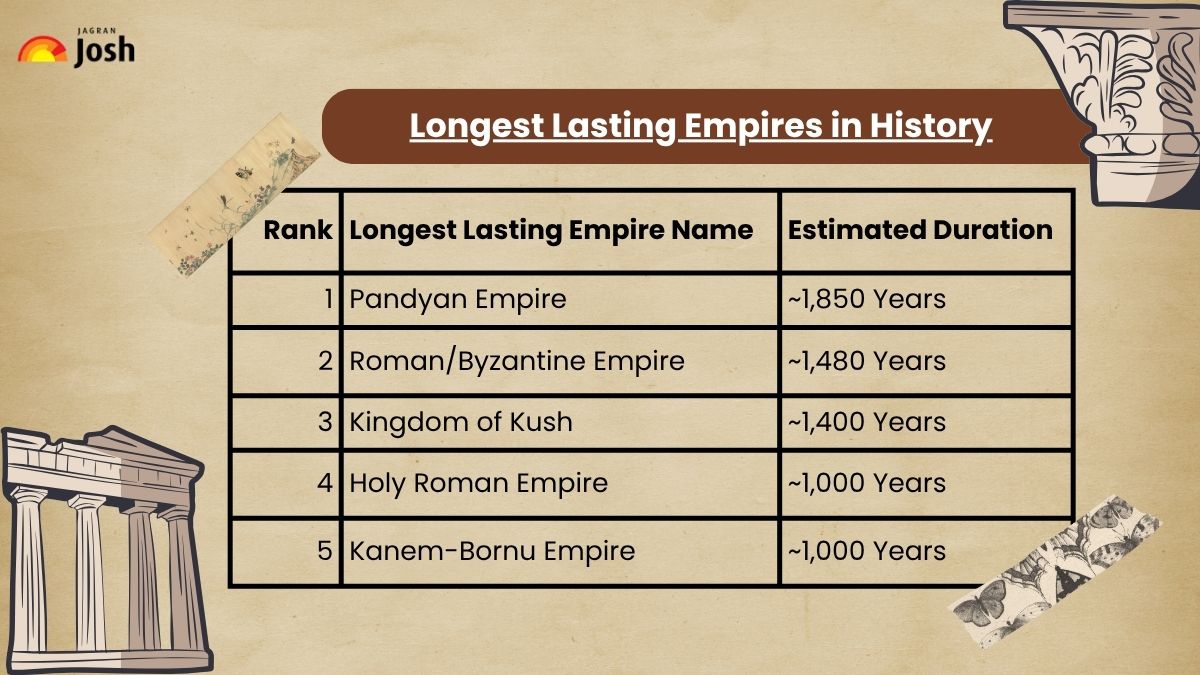
| Rank | Longest Lasting Empire Name | Estimated Duration | Era of Dominance |
| 1 | Pandyan Empire | ~1,850 Years | 500 BC – 1350 AD |
| 2 | Roman/Byzantine Empire | ~1,480 Years | 27 BC – 1453 AD |
| 3 | Kingdom of Kush | ~1,400 Years | 1070 BC – 350 AD |
| 4 | Holy Roman Empire | ~1,000 Years | 800 AD – 1806 AD |
| 5 | Kanem-Bornu Empire | ~1,000 Years | 8th Century – 1808 AD |
What was the Longest lasting Empire in History?
While the Roman Empire is the most culturally present in history books, the Pandyan Empire of Southern India is frequently cited by historians as the longest ruling empire. According to official records and Tamil inscriptions, the Pandyas were mentioned as early as the 6th century BC and maintained a presence until the 14th century AD.
Their secret to becoming the longest-lasting empire lay in their control over the lucrative pearl trade and a resilient agricultural economy that survived even when their political borders shifted.
How did the Roman Empire last 1,500 years?
The longest lasting empire in the Western tradition is undoubtedly Rome. Although the Fall of Rome is commonly dated to 476 AD, this only applied to the Western half. The Eastern Roman Empire, or the Byzantine Empire, flourished from its capital in Constantinople (modern-day Istanbul).
-
Official Source: Guinness World Records notes that the clock began ticking in 27 BC with Augustus and didn't stop until 1453 AD.
-
Key Factor: Their survival was driven by a sophisticated legal system and a "buffer zone" geography that protected the heart of the empire from early medieval invasions.
Also Read - Who is Known as the 'Great King' of the World? Top 7 Revealed
If you value stable institutions over long-lasting bloodlines, then the longest-lasting empire in history is up for debate. These civilizations show that real power comes from being strong. For example, the Pandyas were the most powerful traders in ancient times, and the Roman-Byzantine legacy shaped modern law. These great historical figures teach us how to survive even when things are tough in modern countries.

Harshita Singh is an education and general knowledge journalist with over 5 years of experience in educational writing. Specializing in US affairs and GK, Harshita has a track record of breaking down intricate geopolitical and historical subjects into clear, digestible insights for learners. Her strong background in text analysis, coupled with a Bachelor of Arts (Hons) in English from the University of Delhi, helps her produce authoritative, thoroughly researched content that empowers readers to engage confidently with global current affairs. For inquiries or academic insights, you can reach out to her directly at harshita.singh@jagrannewmedia.com.